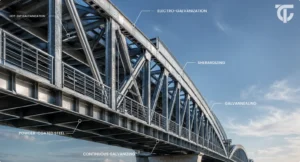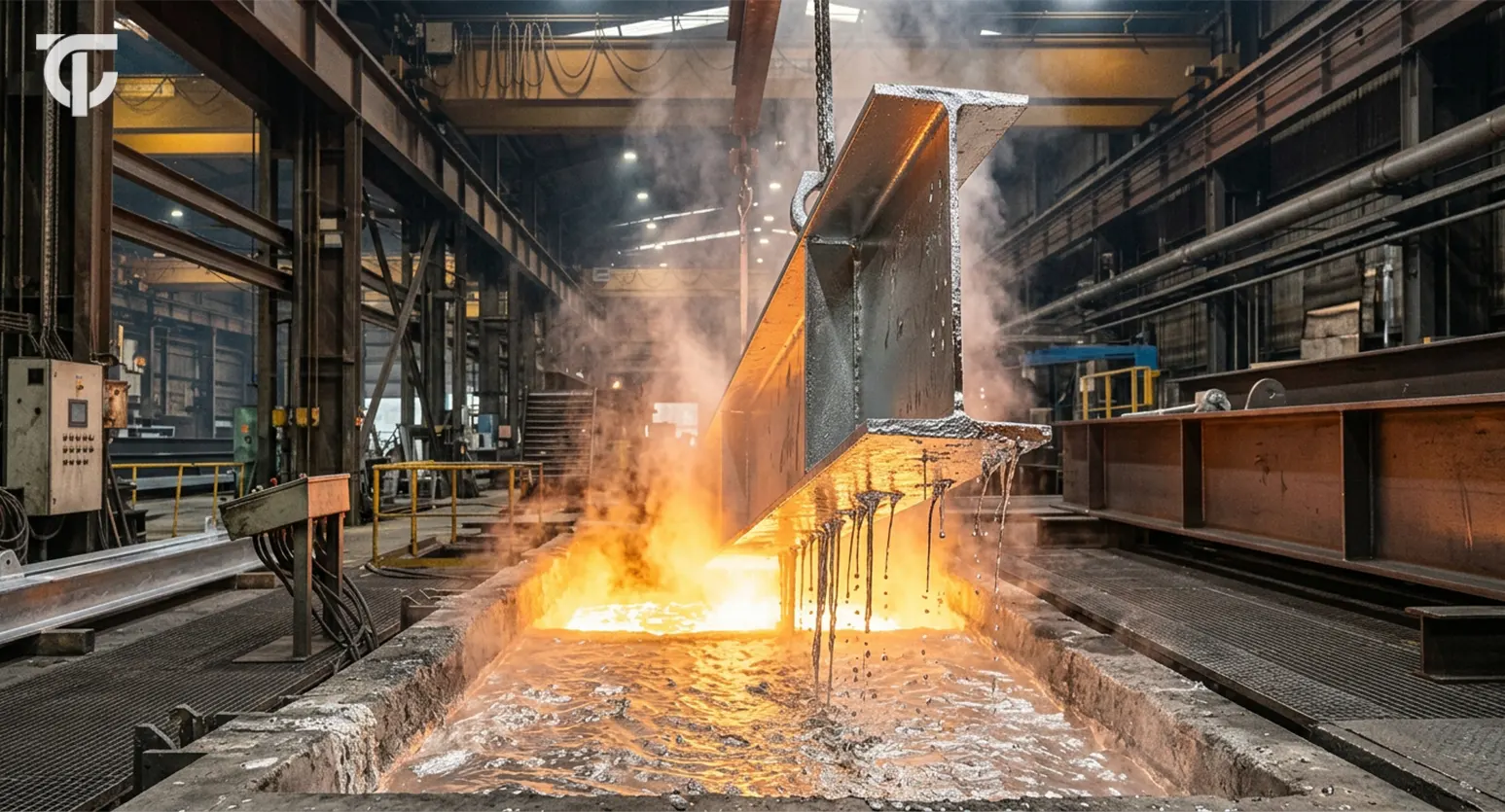

Picture a steel handrail, fence, or bridge beam that’s held up against rain, humidity, and years of outdoor exposure without visible rust. It likely went through hot-dip galvanization. This process protects iron and steel from corrosion by giving it a metallurgically bonded zinc coating.
During hot-dip galvanizing, properly prepared steel is fully immersed in a bath of molten zinc. The zinc reacts with the iron in the steel, forming zinc-iron alloy layers beneath an outer layer of free zinc. Together, these layers create a coating that isolates the steel from moisture and air, while the zinc provides sacrificial protection if the surface is scratched or damaged.
This guide walks through how the process works, how the coating actually forms, its benefits and limitations, where it’s used, and the design and inspection details that matter most.
What Is Hot-Dip Galvanizing?
Hot-dip galvanizing is a corrosion-protection process used on iron, steel, and fabricated steel articles, everything from structural beams to small brackets.
The basic idea is straightforward: Cleaned and prepared steel is dipped into a bath of molten zinc, where the zinc reacts with the iron at the surface.
It helps to be precise about what’s actually happening here. Zinc doesn’t just sit on top of the steel the way paint does. Instead, molten zinc reacts metallurgically with the iron in the steel, forming zinc-iron alloy layers with an outer layer of zinc on top. That reaction makes the coating durable; it bonds to the steel’s surface, not just stuck onto it.
This bond is also why hot-dip galvanizing steel provides more than one type of protection at once. The coating acts as a barrier between the steel and the environment; the zinc itself can offer cathodic protection if the surface gets damaged; and, over time, a zinc patina develops on the surface that adds another layer of defense. Each of these is explained in more detail later in the benefits section. For now, it’s enough to know that the protection comes from a real chemical bond, not a surface film.
How Does Hot-Dip Galvanizing Work?
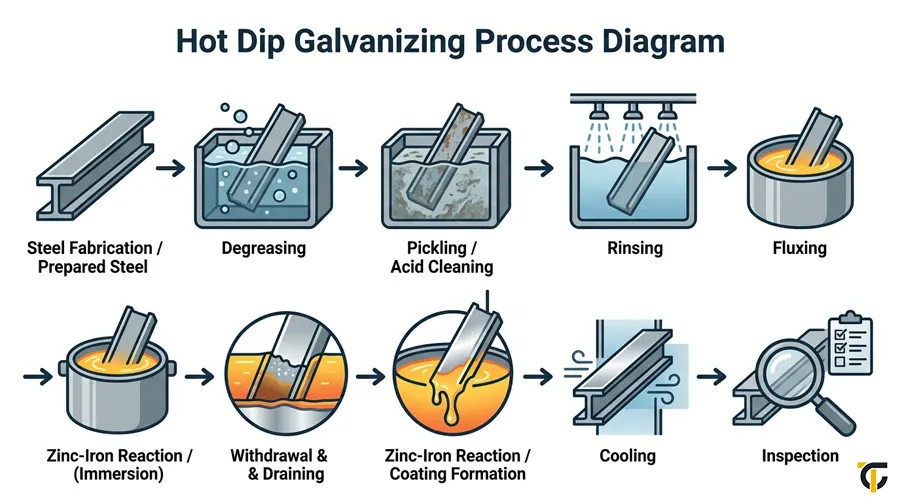
At a high level, the process follows a simple sequence: The steel is prepared, immersed in molten zinc, allowed to react and form a coating, then withdrawn, cooled, and inspected.
Surface preparation comes first because it has to. The American Galvanizers Association points out that zinc won’t react properly with steel that isn’t clean; oil, rust, or mill scale left on the surface gets in the way of the reaction. That’s why galvanizers spend real time cleaning steel before it ever touches the zinc bath.
Once the steel is properly prepared, it goes into the molten zinc bath, where the reaction between the zinc and the iron begins right away. This step builds the coating: Alloy layers form while the steel sits in the bath. After the reaction runs its course, the article is withdrawn, excess zinc drains off, and the piece cools.
The last step is inspection, where the coating gets checked for appearance, thickness, and anything that might need addressing. We’ll go through each of these stages degreasing, pickling, rinsing, fluxing, immersion, the zinc-iron reaction, withdrawal, and inspection in more detail in the next section, since each one plays a specific role in how hot-dip galvanizing steel gets its final finish.
Hot Dip Galvanizing Process Steps
Each stage in the hot-dip galvanizing process serves a specific purpose, and skipping or rushing one of them affects everything that follows. Here’s what actually happens, step by step.
1. Steel Preparation and Fabrication
Before galvanizing even starts, the steel article needs to be properly fabricated with the process in mind. Welds, joints, hollow sections, and overall geometry affect how well the piece cleans, drains, and coats once it reaches the zinc bath.
It’s also worth planning for what happens after galvanizing. Cutting or drilling into a galvanized piece damages the coating in that spot, so it’s better to finish these details before the article goes through the process rather than after.
That said, not every piece needs the same preparation route. How much surface prep a piece needs and whether something like blasting comes into play depends on the steel’s condition and the specification it needs to meet, not a fixed rule that applies to every job.
2. Degreasing / Cleaning
The first cleaning stage removes oils, grease, dirt, and other organic contaminants from the steel surface. This is usually done through alkaline or caustic cleaning solutions.
The point is simple: The surface needs to be free of anything that could interfere with the chemical cleaning and zinc reaction steps that come next.
3. Pickling / Acid Cleaning
Once the surface is degreased, it goes through pickling, an acid cleaning step that removes rust, mill scale, and other oxide buildup. This step doesn’t coat the steel with anything; it strips away what shouldn’t be there.
The goal is a clean, chemically active steel surface where the iron is exposed and ready to react with zinc later in the process.
4. Rinsing
After pickling, the steel gets rinsed to remove leftover cleaning and acid residues. It’s a quick but important step; carrying chemical residue into the next stage can interfere with how well the flux and zinc perform.
5. Fluxing
Fluxing protects the cleaned steel surface from oxidizing again before it goes into the molten zinc. This is typically done with a flux solution such as zinc ammonium chloride, which activates the surface and keeps it in a suitable condition for coating.
It’s worth being clear about what flux actually does: It’s not a coating, and it’s not a protective layer that stays on the finished piece. Its job is purely to prepare the surface right before immersion.
6. Immersion in the Molten Zinc Bath
This is where the steel meets the zinc. The prepared article is fully immersed in a bath of molten zinc, typically held at approximately 830°F (443°C), with the bath itself made up of at least 98% zinc for the standard batch process.
The steel goes in at an angle and orientation chosen to help air escape and zinc flow properly, which matters a lot for hollow or tubular pieces. Without the right venting and drainage, trapped air or liquid can cause problems during immersion.
One thing to keep in mind: there’s no single fixed dip time that applies to every piece. How long an article stays in the bath depends on its geometry, thickness, and the specific process requirements for that job.
7. Zinc-Iron Reaction and Coating Formation
While the steel sits in the bath, the molten zinc reacts with the iron at the surface. This reaction forms zinc-iron alloy layers, with a layer of free zinc developing on top. Together, these layers make up the finished galvanized coating. This structure transitions gradually from the steel substrate through the alloy layers to the outer zinc layer, rather than a single uniform layer of pure zinc.
The key point is that this coating is metallurgically bonded to the steel itself, which is very different from a coating applied on top of a surface.
8. Withdrawal, Draining and Cooling
Once the reaction has run its course, the article is withdrawn from the bath. Excess molten zinc drains off, and the piece cools down to reveal its final galvanized surface.
It’s worth noting that this cooling step isn’t the same as the curing or drying process associated with paint coatings. The zinc coating has already formed through the reaction; cooling lets the finished surface settle.
9. Inspection and Quality Checking
The last step is inspection. This typically includes a visual check of the coating’s appearance, along with thickness measurement using tools like a magnetic thickness gauge. Inspectors also look for bare spots or other defects and confirm the coating meets the relevant specification.
Together, these nine steps make up the full hot-dip galvanizing process from a bare, fabricated steel piece to a finished, corrosion-resistant surface ready for use.
Hot Dip Galvanizing Process Diagram
Want to explore other types of galvanized steel?
Read our guide to the Different Types of Galvanized Steel to understand how they differ and where each type is used.
What Is a Hot Dip Galvanized Coating?
The process explains how the steel gets coated, but it’s worth stepping back and looking at what the finished hot-dip galvanized coating actually consists of.
How the Coating Forms
The coating starts with the steel or iron substrate, which reacts with molten zinc during immersion. That reaction produces alloy and intermetallic layers between the steel and the outer surface, topped by a layer of free zinc. The result is a coating that’s metallurgically bonded to the steel rather than sitting on top of it as a separate film.
Think of it less like paint drying on a wall and more like the zinc and steel meeting halfway, reacting together to form something new at the surface.
Zinc-Iron Alloy Layers and Outer Zinc Layer
It helps to be clear about the coating’s structure. A galvanized coating isn’t a uniform layer of pure zinc sitting on bare steel. Between the steel substrate and the outer zinc-rich layer, zinc-iron alloy layers form during the reaction. This layered structure gives the coating its strong bond to the steel underneath.
Coating Thickness
Coating thickness isn’t a single fixed number that applies to every galvanized piece. It depends on the steel’s characteristics and the specification the job needs to meet.
For EN ISO 1461, which covers fabricated iron and steel articles, the minimum coating requirements change based on steel thickness. For non-centrifuged articles, the standard sets these minimum mean coating requirements:
- Steel over 6 mm: 85 µm
- 3 mm to ≤6 mm: 70 µm
- ≥1.5 mm to ≤3 mm: 55 µm
- Under 1.5 mm: 45 µm
These figures are specific to EN ISO 1461 and shouldn’t be read as a universal “hot-dip galvanizing is always this thick” rule; they only apply when that particular standard is the relevant one for the article in question.
What Affects Galvanized Coating Thickness?
A handful of factors influence how thick the final coating turns out to be:
- Steel thickness
- Steel chemistry
- Surface condition
- Surface profile
- The applicable galvanizing specification
- Whether the steel is considered reactive
- Fabrication and product characteristics
Actual coating thickness varies with section size, surface profile, and surface composition, which is part of why two different galvanized pieces can end up with noticeably different coatings even when they go through the same bath.
Hot Dip Galvanizing Benefits
Hot-dip galvanizing offers several distinct forms of protection, and understanding each one helps explain why the process holds up as well as it does in real-world conditions.
Corrosion Protection
At its core, the zinc coating works as a barrier. It separates the steel from moisture, oxygen, and other corrosive elements in the environment. As long as that barrier stays intact, the steel underneath is shielded from direct exposure.
Cathodic / Sacrificial Protection
Barrier protection isn’t the only mechanism at work. Zinc is more anodic than steel, meaning that if the coating gets damaged and a small area of steel becomes exposed, the surrounding zinc will preferentially corrode instead of the steel. This gives the exposed area a degree of cathodic protection.
That said, this isn’t a claim that the coating is indestructible. The coating can still be damaged, and galvanized steel isn’t immune to rust under every possible circumstance; the sacrificial protection is a real mechanism, not a guarantee against all damage.
Zinc Patina
Over time, zinc naturally weathers when exposed to the atmosphere. This weathering produces zinc corrosion products that form a patina on the surface. That patina isn’t a sign of failure; it’s a passive protective layer that develops through ordinary environmental exposure and adds another level of protection on top of the barrier and cathodic mechanisms already in place.
Strong Metallurgical Bond
Because the coating forms through a reaction with the steel rather than sitting on top of it, it bonds metallurgically to the surface. The zinc-iron alloy layers formed during the process are what give the coating this adhesion, which is conceptually different from a film that’s mechanically applied afterward.
Abrasion and Impact Resistance
That metallurgically bonded structure also gives the coating useful mechanical durability. In many applications, it holds up to handling and abrasion better than some conventional coating systems. That doesn’t mean the coating is damage-proof or scratch-proof; it simply tends to resist wear reasonably well because of how it’s bonded to the steel.
Coverage of Complex / Hollow Sections
When hollow or tubular sections are properly designed for galvanizing, hot-dip galvanizing can coat both their external and internal surfaces. This depends on suitable venting, drainage, and immersion design; it isn’t automatic for every hollow shape that goes through the process, which we’ll cover in the design section later.
Long Service Life and Lower Maintenance
Hot-dip galvanizing can provide long-term corrosion protection, though how long depends on coating thickness and the environment the steel is exposed to. There isn’t one universal lifespan that applies across every application.
To illustrate what “long service life” can look like under specific conditions, a European sector Environmental Product Declaration (EPD) models a 1 m × 1 m × 8 mm steel plate with an 85 µm galvanized coating in a C3 exposure category. Under an average zinc corrosion rate of 1.35 µm per year, it predicts a minimum maintenance-free coating life of 63 years under those stated assumptions.
That figure is a representative example tied to a specific plate size, coating thickness, and exposure category, not a claim that hot-dip galvanized steel lasts 63 years across the board. Actual service life will vary depending on the specific coating and environment involved.
Hot Dip Galvanizing Disadvantages
No process is without trade-offs, and hot-dip galvanizing is no exception. Understanding these limitations helps in planning a project properly rather than running into surprises partway through.
High-Temperature Processing
During galvanizing, steel is exposed to molten zinc at approximately 443°C (830°F). That heat drives the reaction, but it also means fabrication and design must account for the heating and cooling involved.
This doesn’t mean every steel component is automatically damaged or weakened by the process; it simply means heat exposure is a real factor to consider during design.
Distortion / Warping Risk in Certain Fabrications
The heating and cooling cycle can introduce thermal stresses into a piece. Fabrications that are large, thin, asymmetrical, or made up of varying thicknesses can be more susceptible to distortion or warping as a result.
It would be inaccurate to say hot-dip galvanizing causes steel to warp as a rule. The more accurate way to put it: certain fabrications can be susceptible to distortion because of the heating and cooling involved and their specific geometry. Good design and fabrication practices go a long way toward minimizing that risk.
Design Requirements for Hollow or Enclosed Sections
Hollow and enclosed sections need to be designed with venting, drainage, and access in mind for cleaning solutions, for molten zinc, and for escaping air. Without that, trapped air or trapped liquids can become a problem during processing.
This isn’t just a cosmetic consideration. Improperly designed enclosed sections can create real processing and safety issues during the galvanizing process itself, which is why this gets its own dedicated section later in the article.
Appearance Can Vary
Galvanized surfaces aren’t always a uniform, bright silver. Batch-galvanized steel can come out with a range of appearances, including matte, spangled, mottled, or mixed finishes.
This variation shouldn’t automatically be read as a defect. Differences in finish are a normal part of how the batch process works and don’t necessarily indicate a problem with the coating itself.
Repair May Be Needed After Mechanical Damage
While the coating is durable, it can still be mechanically damaged during handling, transport, or erection. When that happens, the damaged area may need repair using appropriate zinc-rich repair materials, following the requirements set out in the applicable standard, such as EN ISO 1461.
Factors That Affect Hot-Dip Galvanizing Quality
A few underlying variables shape how well the galvanizing process turns out. Understanding them is useful for anyone specifying or fabricating steel for galvanizing.
Steel Chemistry
The steel’s chemical composition, including elements like silicon and phosphorus, can influence how the iron-zinc reaction unfolds and what the resulting coating looks like. Steel that reacts differently than expected during galvanizing is sometimes referred to as reactive steel.
Specific threshold numbers for silicon or phosphorus content aren’t included here, since getting those figures right requires referencing the applicable standard or specification directly, not a general approximation.
Surface Condition
Rust, mill scale, oils, grease, and other surface contamination all affect how well the steel cleans and reacts during the process. This is exactly why the preparation stages degreasing, pickling, and rinsing matter as much as they do earlier in the process.
Steel Geometry and Thickness
The shape and thickness of a steel article influence how it behaves during immersion, drainage, and cooling. Pieces with varying thicknesses within a single assembly, hollow sections, or complex geometries each introduce considerations for how the coating forms and how evenly it develops across the piece.
Designing Steel for Hot-Dip Galvanizing
Getting good results from galvanizing often comes down to decisions made before the steel ever reaches the plant. Here are the core principles worth understanding not a full engineering design manual, but the fundamentals that matter most.
Vent Holes and Drainage Holes
Hollow and enclosed sections need appropriately placed vent and drainage holes. Air needs a way to escape during immersion, and cleaning solutions and molten zinc need to flow freely through the piece. Where these holes go depends on the piece’s specific geometry and the orientation it will be immersed in.
Getting this wrong isn’t just a minor issue; improper venting or drainage can cause poor appearance, bare spots, or excessive zinc buildup, and can create safety and processing problems during galvanizing.
Hollow Sections
Tubular sections, pipes, handrails, poles, and other hollow structural members are common candidates for galvanizing. When these components are properly designed for cleaning, venting, zinc flow, and drainage, both their internal and external surfaces can be protected; it isn’t limited to just the outside.
Welding and Fabrication
Ideally, galvanizing is considered before fabrication is finalized rather than as an afterthought. Welded assemblies need suitable venting and drainage, and overall design should take into account how the galvanizer will handle and immerse the piece.
Detailed welding parameters aren’t necessary here, since those depend on the specific project and specification involved.
Communicating With the Galvanizer
For anything beyond straightforward pieces, it’s worth talking to the galvanizer before finalizing fabrication. This is especially important for large components, hollow structures, unusual geometries, assemblies with different steel thicknesses, specific coating thickness requirements, or particular appearance expectations. A quick conversation early on can prevent costly rework later.
Hot Dip Galvanized Coating Standards and Inspection
Standards exist to make sure a galvanized coating actually meets the requirements it’s supposed to meet. Here’s an overview without turning this into a standards-heavy deep dive.
EN ISO 1461
EN ISO 1461:2022 is the standard covering hot-dip galvanized coatings on fabricated iron and steel articles. It specifies both the coating requirements and the test methods used to verify them, with requirements varying by article and product characteristics, as covered earlier in the coating thickness section.
It’s worth being clear about scope here: EN ISO 1461 doesn’t apply identically to every galvanized product out there. It specifically excludes products processed through automated methods, such as continuously galvanized sheet, wire, and tube, which fall under different standards entirely.
ASTM Standards
Alongside EN ISO 1461, ASTM specifications are widely used for hot-dip galvanized products, particularly in North American practice. Depending on the type of article involved, relevant standards can include:
- ASTM A123 — for galvanized coatings on fabricated iron and steel products
- ASTM A153 — for galvanized coatings on iron and steel hardware
- ASTM A385 — covering practices for providing high-quality zinc coatings
Which of these applies depends entirely on the specific type of article being galvanized; there’s no need to reference every standard for every project.
Coating Inspection
Once a piece comes out of the bath and cools, it goes through inspection to confirm it meets the required specifications. This typically covers:
- Visual inspection of the surface
- Coating thickness measurement
- Checking adherence and overall finish
- Comparing results against acceptance criteria
- Identifying whether any repairs are needed
Hot Dip Galvanized Steel Uses
Hot-dip galvanizing shows up across a wide range of industries, largely because so many applications involve steel that has to survive outdoor exposure over long periods. Here’s where and why it gets used.
Construction and Structural Steel
Structural steel, building components, stairs, railings, handrails, and other fabricated steel pieces are common candidates for galvanizing, especially when they’ll be exposed to the elements as part of a building’s exterior structure.
Bridges and Transport Infrastructure
Bridges, walkways, barriers, and other infrastructure components are often galvanized because of the weather exposure they face over their service life.
One example worth mentioning is the Connel Bridge Walkway in Scotland, where more than 1,000 galvanized components were used with a specified 85 µm coating. Based on an anticipated zinc corrosion rate of 1.5 µm per year, the project source estimates a coating life of 57 years for that application.
As with the EPD example mentioned earlier, this figure is a project-specific estimate tied to Connel Bridge’s particular coating thickness and environmental conditions, not a universal lifespan that applies to hot-dip galvanized steel generally.
Utilities and Power Infrastructure
Utility structures and transmission or power infrastructure often rely on galvanized steel, since these components are typically external and exposed to weather over long service periods.
Agriculture and Horticulture
Agricultural equipment and structures, livestock-related steel, fencing, and other outdoor fabricated steel used in farming settings often need the corrosion protection galvanizing provides.
Pipes, Tubular Structures and Hollow Steel
Handrails, poles, tubular structures, and pipe columns are commonly galvanized fabrications. As mentioned earlier, tubular pieces are commonly galvanized for both interior and exterior corrosion protection, provided they’re appropriately designed for cleaning, venting, and drainage.
Street Furniture and Outdoor Equipment
Outdoor furniture, lighting-related structures, street infrastructure, and other exposed steel equipment round out the list of common applications, given how much of this equipment sits outside year-round.
To put these applications in perspective, the Galvanizers Association UK has published an end-use distribution for hot-dip galvanizing in the UK:
- Construction — 41%
- Street and outdoor furniture — 22%
- Agriculture and horticulture — 12%
- Transport infrastructure — 9%
- Utilities — 8%
- Industrial plant and equipment — 3%
- Storage and handling — 2%
- Fastenings — 2%
- Miscellaneous — 1%
It’s worth being precise about what this data represents. These figures come from the Galvanizers Association UK and reflect UK end-use data; specifically, they shouldn’t be read as global statistics, and since the underlying survey date isn’t confirmed here, they aren’t being presented as current-year figures either.
How Long Does Hot-Dip Galvanizing Last?
Durability is one of the main reasons people consider hot-dip galvanizing, so it’s worth addressing directly, while being honest that no single number applies to every situation.
Coating life depends on several variables working together:
- Coating thickness
- The environment the steel is exposed to
- The zinc corrosion rate in that environment
- Overall exposure conditions
- Steel and product characteristics
Because of these variables, there isn’t one universal lifespan that applies across the board.
To give a sense of what “long service life” can look like under specific, stated conditions, a European sector EPD models a 1 m × 1 m × 8 mm steel plate with an 85 µm galvanized coating in a C3 exposure category. Under an average zinc corrosion rate of 1.35 µm per year, it predicts a minimum maintenance-free coating life of 63 years under those particular assumptions.
That number reflects a specific plate size, coating thickness, and exposure category; it isn’t a blanket claim that hot-dip galvanized steel lasts 63 years everywhere it’s used. A thinner coating, a harsher environment, or different steel characteristics will all shift that number.
Appearance of Hot-Dip Galvanized Steel
Galvanized steel doesn’t always look the same. Depending on the batch and the specific steel, the surface can look bright, matte, spangled, mottled, or a mix of these finishes.
This variation is a normal part of the batch galvanizing process, not a sign that something went wrong. A duller or mottled finish doesn’t mean the coating has failed; it simply reflects natural differences in how the zinc reacted with that particular piece of steel.
Can Hot-Dip Galvanized Steel Be Welded?
Yes, you can weld galvanized steel. That said, welding affects the zinc coating immediately around the weld, since the heat removes or damages the zinc locally.
Because of this, welding galvanized steel requires appropriate procedures, along with attention to ventilation and fume control due to the zinc involved. Depending on the application and specification, the affected area may also need appropriate coating repair afterward.
It wouldn’t be accurate to describe welding galvanized steel as completely safe without any qualification, and it’s equally inaccurate to say that welding leaves the entire article unprotected.
The reality falls somewhere in between: Welding affects the coating locally, and that area may need treatment or repair depending on the applicable requirements.
Hot-Dip Galvanizing Timing and Turnaround
It’s worth separating a few ideas that often get blurred together: How long the actual dipping takes, how long the full process takes, and how long the overall project turnaround takes.
The dipping itself, the immersion step, typically takes only minutes. Preparation, handling, cooling, and other processing steps add time on top of that. Beyond the process itself, overall turnaround also depends on the galvanizing plant’s workload and the project’s specific requirements.
In some circumstances, a 24-hour turnaround can be arranged. In other cases, a more typical turnaround might be around three days, depending on the circumstances. It wouldn’t be accurate to say hot-dip galvanizing always takes 24 hours, or that the process always takes three days; both numbers depend heavily on the specific job and plant conditions at the time.
Final Thoughts
Hot-dip galvanization protects iron and steel by immersing prepared articles in molten zinc, where a metallurgical reaction forms zinc-iron alloy layers beneath an outer zinc layer. Getting to that finished coating depends on proper surface preparation, degreasing, pickling, rinsing, and fluxing along with thoughtful design for hollow or complex sections.
The resulting coating protects steel in multiple ways: As a physical barrier, through sacrificial cathodic protection, and eventually through a weathered zinc patina. How long that protection lasts depends on coating thickness and the environment the steel faces, which is why service life figures are always tied to specific conditions rather than treated as universal numbers.
Hot-dip galvanizing shows up across construction, infrastructure, utilities, agriculture, and countless other applications where steel needs to hold up outdoors over time. Getting good results ultimately comes down to proper design, adherence to the relevant standard, whether EN ISO 1461 or an applicable ASTM specification, and careful inspection once the process is complete.
Frequently Asked Questions
How Long Does Hot Dip Galvanizing Last?
There’s no single universal lifespan for hot-dip galvanized steel; it depends on coating thickness and the environment the steel is exposed to. For example, a European sector EPD models an 85 µm coating in a C3 exposure category with a predicted minimum maintenance-free life of 63 years, but that figure applies to those specific assumptions rather than galvanized steel in general.
What Temperature Is Used for Hot Dip Galvanizing?
The molten zinc bath is commonly cited at approximately 830°F (443°C). Actual process conditions vary by plant and specification, so don’t treat this figure as the exact temperature used everywhere.
Does Hot Dip Galvanizing Protect the Inside of Hollow Steel Sections?
Yes, when the hollow section is properly designed for galvanizing. This includes suitable venting, drainage, and access for cleaning solutions and zinc flow. Without that design consideration, internal protection isn’t guaranteed.
Can Hot-Dip Galvanized Steel Be Welded?
Yes, but welding affects the zinc coating in the area around the weld. Depending on the application, it requires appropriate welding procedures, ventilation and fume control, and consideration of post-weld coating repair.
Does Hot Dip Galvanizing Prevent Steel From Rusting Completely?
It provides strong corrosion protection through barrier, cathodic, and patina mechanisms, but that doesn’t mean the steel can never corrode under any condition. Coating life and performance depend on exposure conditions and the specific coating characteristics involved, so it’s more accurate to think of galvanizing as strong, long-term protection rather than a permanent guarantee against rust.