
Before a single foundation is dug, a client must decide how the project will be procured. That choice affects who handles the design, when a contractor joins, and how that contractor is selected. Traditional procurement is one route a client can take. Under it, the client’s appointed design team develops the design first. Contractors are then invited to price the work from the completed tender information.
In traditional construction procurement, design and construction responsibilities are generally kept separate, although the exact split depends on the contract.
This guide covers the process step by step, the parties involved, tendering and contracts, the benefits and drawbacks, and the kinds of projects where the route may fit. First, let’s look at what the traditional procurement method actually is.
What Is Traditional Procurement?
Definition and Basic Concept
The traditional procurement method delivers a construction project in a fixed order. The client first appoints an architect, engineers, and other consultants. That design team develops the design up to the tender stage. Contractors then submit prices based on the tender documents, and the contractor the client selects builds the project.
Two sets of agreements sit behind this sequence. The client signs a construction contract with the contractor. The consultants work under their own appointments, which define their duties separately.
Keep one point in mind: Traditional procurement is a procurement route, not a specific contract form or pricing method. The contract and the pricing arrangement can differ from one project to the next.
Traditional procurement is also one of several approaches used to deliver construction projects. Our guide to Construction Procurement Routes explains how the main methods compare and what distinguishes each one.
Is Traditional Procurement the Same as Design-Bid-Build?
In sequence, largely yes. US construction terminology commonly calls this approach Design-Bid-Build (DBB). Design-Bid-Build procurement follows the same broad order as the traditional route: Design first, then bid or tender, then build.
The details, however, change from country to country. Contract forms, tender rules, consultant roles, and legal requirements aren’t the same everywhere. UK projects may use contract families such as JCT or NEC. In contrast, US public-sector projects may use Design-Bid-Build as their procurement or delivery route under applicable contract documents and procurement rules. These terms describe different aspects of project delivery: JCT and NEC refer to contract families, whereas Design-Bid-Build describes the sequence of design, tendering, and construction.
For UK market context, Rider Levett Bucknall’s (RLB) Procurement Trends Report 2026 offers a snapshot of procurement practice. The survey was conducted in April 2026 and included more than 100 UK main contractors. Among them, 8% reported traditional contracts with quantities and 19% reported traditional contracts without quantities. Combined, these two categories made up 27% of the contract types shown in the survey, compared with 66% for Design and Build.
These figures reflect what the survey respondents reported, not every UK construction project.
How Does the Traditional Procurement Method Work?
The traditional procurement method in construction industry follows a clear sequence.
Each step produces something the next one depends on: A brief leads to a design, the design leads to tender documents, and the tender documents lead to prices.
Here is the full sequence in one view:
- Client Brief
- Consultant Appointment
- Design Development
- Tender Documentation
- Tender Invitation
- Tender Evaluation
- Contract Award
- Construction
- Handover and Final Account
1. Establishing the Client’s Requirements
Every project starts with the client deciding what it needs. The client defines the project’s purpose and identifies its intended use, capacity, quality level, functional requirements, and budget expectations. It also gathers site information, constraints, and planning considerations.
From this, the client prepares an initial brief or scope-of-work document, then decides whether to appoint a project team or a lead consultant. No final construction design or contractor price exists yet. This stage sets the requirements and starts the planning.
2. Appointing the Design Team and Consultants
Next, the client appoints an architect and the other consultants the project needs. Depending on the project, that can include a structural engineer, a civil engineer, MEP (Mechanical, Electrical, and Plumbing) consultants, a quantity surveyor, and other specialists. Team structures aren’t the same on every project.
Each consultant’s responsibilities, including design responsibility, are defined in an appointment agreement. The architect may lead design coordination and development, though the exact role depends on the appointment. The quantity surveyor can support cost planning, estimates, the Bill of Quantities (BOQ), and tender pricing documentation.
3. Developing the Design and Preparing Tender Documents
With the team in place, the design moves from concept to developed and technical design. The team produces architectural, structural, and building-services drawings, along with construction specifications and workmanship requirements. It also prepares the scope of work, relevant schedules, preliminary information, site details, and contract conditions. Where the pricing arrangement calls for one, the team adds a BOQ.
Together, these form the construction tender documentation. They tell contractors what work to price, to what quality, and to which technical requirements. Catching design discrepancies before tender is an important part of design coordination.
Not every project uses a BOQ. Tender documentation and pricing formats change with the project and the contract.
4. Inviting Contractors to Tender
Once the documents are ready, the client or its procurement team issues the tender invitation and provides the documents to contractors. Tendering can be open or selective. Open tendering invites bids widely, while selective tendering limits bids to chosen contractors. Which route applies depends on the client and the procurement rules in force, so traditional procurement doesn’t always mean open tendering.
Contractors then review the drawings, specifications, quantities, and contract requirements. They may visit the site, send clarification questions, and respond to tender addenda, which update or clarify the tender documents during the tender period.
One common form is single-stage competitive tendering, where contractors submit bids in one stage, based on detailed tender information.
Public figures show what bidding can look like in practice.
The Colorado Department of Transportation’s 2025 Construction Cost Index Report for April to June (Q2 2025), published November 13, 2025, recorded 17 Design-Bid-Build projects with 47 bids, an average of 2.76 bidders per project. The previous quarter’s average was 3.88 bidders per project. The report counts total bids, not necessarily 47 different contractors.
This is one state agency’s data, so treat it as an example of competitive bidding in a US public-sector program, not a national average.
5. Tender Evaluation and Contractor Selection
When the tender deadline passes, the client’s team reviews every submission. Price comparison is part of that review, but it isn’t the whole job. The team also checks whether each tender complies with the tender documents, and looks for qualifications, exclusions, and assumptions a contractor may have added. A bid that leaves out part of the scope can look cheaper than it really is.
Evaluation usually looks beyond the number on the front page. Depending on the project’s tender evaluation criteria, the team may consider relevant experience, resources, the proposed construction program, quality, and risk. Where applicable, it also runs clarifications and arithmetic checks on the submissions.
The lowest tender isn’t automatically the best one. Contractor selection follows the applicable rules and the evaluation criteria set for the project. Once the client settles on a preferred contractor, it completes the award process.
6. Contract Award and Construction Start
Next, the client finalizes the contract with its preferred contractor. Both sides confirm the scope, drawings, specifications, price basis, program, and other relevant terms. These documents set out the contractual obligations the contractor will follow.
Work doesn’t necessarily begin the moment the contract is signed. Site possession or access, mobilization, and approvals may need to come first, depending on the project. After that, the contractor plans the construction work, sets up the site, and organizes labor and materials. It also arranges its subcontractors, so subcontractor coordination starts here. From then on, the work follows the approved contract documents and the applicable requirements.
7. Construction, Contract Administration and Quality Control
During construction, the contractor manages the day-to-day work on site. Meanwhile, the architect, engineer, contract administrator, or other appointed professionals carry out their own contractual responsibilities. They may handle inspections, answer design clarifications, hold progress reviews, and carry out quality checks.
Construction contract administration also covers the money and the changes. Where the contract requires them, the contractor submits payment applications and the administrator issues interim payment certificates. Variations, meaning changes to the work, go through the contract’s change management process. If the program slips, the team monitors it, and extension-of-time matters may arise where the contract allows. Defects and non-compliant work also get addressed during this stage.
Don’t assume the architect always acts as contract administrator. The contract documents and the appointments specify who is responsible for each duty.
8. Practical Completion, Handover and Final Account
As the work finishes, the team inspects it and lists any outstanding defects, often called snags. The contractor then rectifies them as required by the contract.
Handover brings the paperwork. Typically that means operation and maintenance manuals, warranties, and relevant certificates. Final account settlement and the final payment procedures follow, as the contract provides.
Terminology matters here. Practical completion (or acceptance, depending on the contract and jurisdiction), completion, and the final account aren’t one event. Each contract defines its own stages and what they mean.
Key Parties Involved in Traditional Procurement and Their Responsibilities
Traditional procurement brings together a client, a design team, a main contractor, and the contractor’s own supply chain. The roles below describe the usual arrangement. The contract and each appointment set the actual duties on a given project.
👨🏻💼 Client / Employer
The client sets the project brief and objectives, then appoints the consultants. It approves the budget and key decisions, selects the contractor, and enters the construction contract. After that, it meets its own obligations under the contract, including payments.
👷🏻♂️ Architect / Lead Designer
The architect develops the architectural design and turns the client’s requirements into it. This role also coordinates with the other consultants and helps prepare design information and specifications. Depending on the appointment, the contract may add further duties.
👷🏻♂️ Engineers and Specialist Consultants
Structural, civil, MEP, and other specialists develop the technical designs. They provide calculations, drawings, and specifications for their part of the project. Within their appointment and scope, they also support design coordination and answer technical questions.
👷🏻♂️ Quantity Surveyor (QS)
The quantity surveyor supports cost estimates and cost planning. Where the project uses one, the QS prepares the BOQ. The QS also analyzes and compares tender prices. Interim valuations and final account matters may also fall to the QS, subject to the appointment and the contract.
👷🏻♂️ Main Contractor
The main contractor carries out the construction work. It coordinates labor, materials, plant, site management, and subcontractors, and manages the contract program and quality requirements. Safety, workmanship, and delivery obligations also sit with the contractor, as the contract provides.
👷🏻♂️ Subcontractors and Suppliers
Specialist trades and material suppliers work under their own subcontracts or purchase arrangements with the main contractor. They deliver within the main contractor’s overall coordination framework.
The diagram below shows how these parties connect. The client’s consultant appointments sit on one side, and the main contractor’s subcontractor and supplier relationships sit on the other.
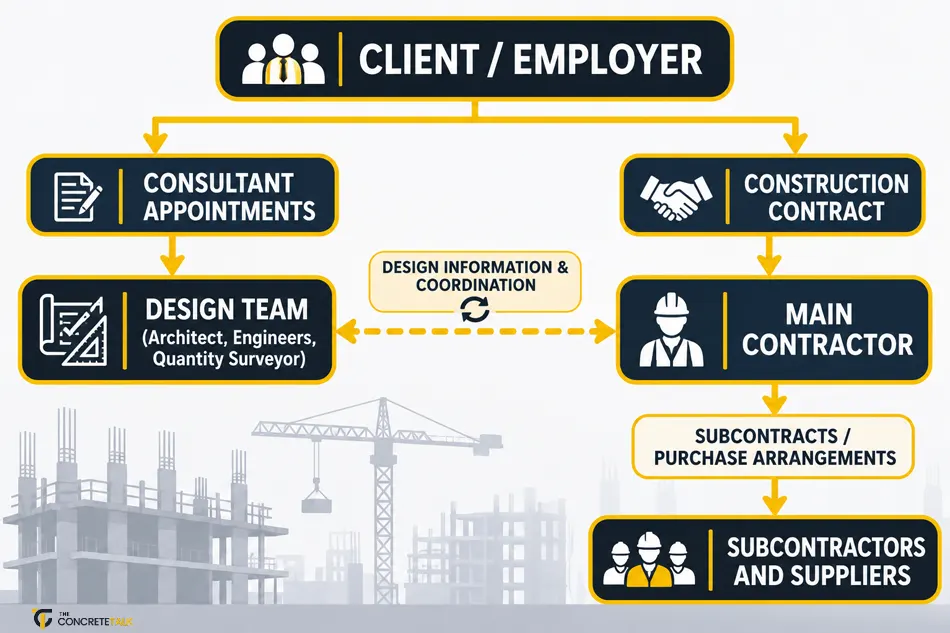
position may vary depending on the project and contractual arrangements.
Contractual Relationships in Traditional Procurement
The previous section covered who does what. This one covers who has a contract with whom.
The client appoints the architect and consultants under separate appointments. Those appointments define each consultant’s duties and professional responsibilities. The client then enters a construction contract with the main contractor. The main contractor, in turn, makes its own arrangements with subcontractors and suppliers.
During the project, design information, coordination, and contract administration communication pass between the consultants and the contractor. The contractor is responsible for its contracted scope of work. A consultant’s design responsibility follows its appointment and professional duties.
One nuance matters here. In a traditional route, the client generally appoints the design consultants directly. However, the contractor can still hold design responsibility for specific parts of the work.
The Hobbs View housing project in Winchester, UK, shows this. It used traditional procurement with the JCT Intermediate Building Contract with Contractor’s Design 2016. So it would be wrong to say that the contractor never takes on design responsibility in traditional procurement. We look at that project in more detail later in this guide.
Avoid shortcuts such as “the architect is the contractor’s boss”. Who answers to whom, and for what, depends on the contract documents and the appointments.
Contract and Pricing Arrangements Used in Traditional Procurement
Traditional procurement describes the route a project takes. The contract and pricing arrangement are separate choices, and they can differ from one project to the next. The following sections explain common pricing arrangements and related contract administration mechanisms used in traditional procurement.
1. Lump Sum Contracts
Under a lump sum contract, the contractor submits one total price based on the tender documents and a defined scope. The contract sum is fixed at award, subject to adjustments the contract allows.
How much price certainty that gives depends on how complete the design is, how clear the scope is, how risk is allocated, and what the contract provisions say. Lump sum is a common arrangement in traditional procurement, but it isn’t a universal rule.
👉🏻 Read our detailed guide on Lump Sum Contracts in Construction to understand how fixed-price agreements work, including their benefits and limitations.
2. Bills of Quantities and Remeasurement
A Bill of Quantities (BOQ) lists the measured work items and their quantities. Each tenderer then enters its rates or prices against those items.
Some contracts are remeasurement contracts. In those, payment can adjust to the actual measured quantities, as the contract provides. A BOQ is a pricing basis, so don’t confuse it with a lump sum arrangement.
3. Provisional Sums and Approximate Quantities
Sometimes the scope or cost of a work item isn’t fully defined at the tender stage. A provisional sum in construction covers that kind of item, and approximate quantities apply when the quantities aren’t final and the contract allows measurement adjustments. In both cases, the effect on the final price depends on the contract terms and the valuation mechanism.
4. Variations, Interim Payments and Final Account
Approved changes can affect construction cost. Interim payments follow the completed work or whatever valuation basis the contract sets. The final account then reconciles the contract sum with the applicable adjustments. Each contract defines its own payment rules, so this guide doesn’t give a standard interval or formula.
Don’t read “traditional procurement” as “lump sum,” and don’t read “lump sum” as “no cost changes”. Variations, provisional sums, remeasurement, and payment rules all work according to the contract in use.
Wider market conditions can also affect cost planning.
The BCIS Tender Price Index for the third quarter of 2026, published September 23, 2026, estimated that tender prices rose 0.7% between Q2 and Q3 2026. It put annual growth in its All-in Tender Price Index at 3.2%.
BCIS presents these as estimates. They describe the UK market overall, not cost changes under traditional procurement specifically.
✅ Advantages of Traditional Procurement
Each benefit below comes with a condition. None of them applies automatically to every project.
Greater Client Control Over Design
The client’s appointed design team develops the design, so the client generally has more influence over appearance, layout, materials, specifications, and functional requirements. Much of the design can also be settled before a contractor is appointed.
Control over design doesn’t make changes impossible, and it doesn’t rule out contractor design input.
Competitive Tendering and Price Comparison
Detailed tender documents let a client invite bids from several contractors and compare the prices and submissions side by side. That competition can help with value and price comparison.
How much competition a project actually gets depends on how many bidders are available, how attractive the project is, the tender rules, and market conditions. In the Colorado data above, the average number of bidders per project differed between two quarters.
Clearly Defined Design Before Construction
The route gives the team time to develop drawings, specifications, and scope before building starts. Contractors then receive relatively detailed information at the tender stage, which can support their pricing and construction planning.
An incomplete or poorly coordinated design weakens this advantage.
Independent Professional Advice
The client can get specialist advice from an architect, engineers, and a quantity surveyor. That means professional input on design, cost, and technical questions. Each consultant’s independence and duties follow its own appointment.
Established and Familiar Procurement Structure
The traditional route is an established process in the industry. Parties’ roles and tender stages can be defined clearly. How familiar the route feels varies by country, sector, client, and the project team’s experience.
🛑 Disadvantages of Traditional Procurement
The traditional route has real drawbacks. Each one below affects the project in a specific way, and how much it matters depends on the project and the contract.
Longer Overall Project Duration
Design development and tendering generally happen before construction starts. Once the design is complete, tendering and contractor appointment take further time. This sequential process can lengthen the overall pre-construction period.
For that reason, fast-track projects may find the sequence less suitable. However, phasing and overlap arrangements can sometimes be made.
Limited Contractor Input During Early Design
The contractor is often appointed after the detailed design is developed. That limits early input on buildability, construction sequencing, and the supply chain. Practical coordination issues or design changes can then surface later.
Two-stage procurement with early contractor involvement can partly address this limitation. The Manchester Street Viaduct example later in this guide shows one such arrangement.
Risk of Design Changes and Variations
Client requirements or design details can change during construction. Design discrepancies and incomplete information can also trigger variations. Depending on the contract and the circumstances, those changes may affect both cost and program.
Client-Side Coordination and Management Demands
The client has to manage consultant appointments and design coordination. Delays in design decisions or approvals can hold up the project. A clear communication and decision-making structure helps, and the client needs to build one.
Cost and Time Uncertainty Despite Tendering
Receiving a price at the tender stage doesn’t guarantee the final project cost. Changes, provisional sums, quantity adjustments, unforeseen conditions, and contractual claims can all move the number. As a result, the tender price and the final outturn cost can differ. The program can shift too, because of changes, approvals, supply availability, and site conditions.
None of this makes traditional procurement slower or more expensive in every case. Its sequential design and tendering stages can extend the pre-construction period. At the same time, changes and incomplete information may affect cost and program.
🚧 Risk Allocation in Traditional Procurement
Risk is easy to oversimplify here. Traditional procurement doesn’t automatically place all design risk on the client and all construction risk on the contractor. The actual allocation depends on the contract wording, the consultant appointments, the applicable law, and the project’s own arrangements.
Client and Design-Related Risks
The client carries responsibility for defining the brief and requirements. The client-appointed consultants have design obligations under their appointments. Design coordination problems, errors or omissions, and late design changes can affect the project. Delays in client decisions and approvals can too.
Contractor and Construction Risks
The contractor takes on the work it is contracted to execute. That covers labor, materials, site management, and subcontractor coordination, along with workmanship and the quality obligations the contract defines. Construction program and site execution responsibilities also sit here, subject to the contract.
Shared or Contract-Specific Risks
Several risks have no single default owner. Examples include:
- Unforeseen site conditions
- Changes in scope
- Delays and extensions of time
- Price fluctuations and supply-chain disruption
- Insurance, indemnities, and contractual claims
The contract determines who bears each one and how it is handled. Always check the contract documents rather than assuming.
When Is Traditional Procurement Suitable for a Construction Project?
In the construction industry, traditional procurement is one option among several. Whether it fits depends on the project.
Projects Where It May Be a Suitable Choice
The route may suit projects where:
- The client wants close control over design and specifications.
- The design can be sufficiently developed before tender.
- Competitive tendering matters for contractor selection.
- The client can manage consultants and design coordination.
- It’s practical to prepare detailed design information before construction starts.
Situations Where Another Route May Be Worth Considering
Another route may deserve a look when a project has:
- Very tight delivery deadlines.
- A need for significant early contractor or specialist input.
- Complex construction sequencing, or substantial design and construction integration.
- A client who wants one main contracting organization to take broader design-and-build responsibility.
No route is suitable or unsuitable for every project. The decision depends on project complexity, client priorities, design maturity, time, cost, risk appetite, and available expertise.
Traditional Procurement vs Design and Build
Design and Build is the route most often compared with traditional procurement. The table below shows how the two differ on the points that matter most to a client.
| Comparison Factor | Traditional Procurement | Design and Build |
| Design Development | Generally, the client-appointed design team develops the design before the main construction tender. | The contractor takes responsibility for design and construction, subject to the contract. |
| Contractor Appointment | Usually after the design has been developed to a tender stage. | Often appointed earlier in the design development process. |
| Design Responsibility | Generally remains with the client-appointed design team for its scope; contractor design portions may exist. | The contractor generally has broader responsibility for design under the contract. |
| Client Design Control | The client generally keeps closer direct influence through its design team. | The client sets requirements, but the contractor has greater responsibility for delivering the design solution. |
| Tender Basis | Often based on developed drawings, specifications, and pricing documents. | Often based on the employer’s requirements and the contractor’s proposals. |
| Early Contractor Input | May be more limited in a conventional single-stage sequence. | The contractor can contribute earlier. |
| Project Duration | Sequential design and tendering may lengthen pre-construction. | Design and construction activities may overlap, subject to project arrangements. |
| Contractual Structure | Separate consultant appointments and a construction contract are common. | A single main design-and-build contract commonly covers design and construction. |
Traditional procurement may suit a client who wants more direct involvement in design development. Design and Build may suit a client who wants one main contractor to take broader design and construction responsibility.
Neither route automatically guarantees lower cost, a shorter schedule, or better quality. The outcome depends on the project brief, the contract, the quality of the design, the contractor’s capability, and how the project is managed. Risk allocation also stays contract-specific under both routes.
Real Construction Project Examples of Traditional Procurement
Three public projects show the route at work. Each one illustrates a different point, and none of them proves how traditional procurement performs in general.
Hobbs View Affordable Housing, Winchester, UK
Hobbs View is the most fully documented of the three. It’s a project of six affordable flats in Micheldever, Winchester. The flats were completed in October 2024, and the project received Passivhaus Plus certification in May 2025.
Winchester City Council used traditional procurement with the JCT Intermediate Building Contract with Contractor’s Design 2016. That route gave the council and its design team close control over the design. The council’s “Hobbs View, Southbrook Cottages, Micheldever – Lessons Learned” report, included in its November 13, 2025 scrutiny committee papers, also reports cost and time challenges.
The figures need careful reading, because they measure different things:
- Original build contract sum: £1,730,881
- Final account for the construction works: £2,155,000, an increase of £424,119 on the contract sum
- Total project cost: £2,526,004, which is £535,491, or 27%, above the approved project budget
The £424,119 compares the construction contract sum with the final construction account. The £535,491 and the 27% compare total project cost with the approved budget. The two aren’t interchangeable, and £535,491 isn’t a construction contract overspend.
The report discusses several contributing factors. They include limited availability of specialist Passivhaus suppliers, product substitutions, certification requirements, and approval delays. It doesn’t attribute the overall increase to the procurement route.
The report also lists lessons for future projects. These include identifying supplier availability earlier, reviewing contingency and professional fees, and considering Design and Build for price certainty. So the project shows both sides: Design control was a reason to choose the route, and cost and time challenges were reported alongside it.
Manchester Street Viaduct, Oldham, UK
This project shows that traditional procurement can use two stages. Oldham Council’s contract register covers the refurbishment of the 1970s Manchester Street Viaduct. It records the appointment of Eric Wright Civil Engineering Ltd. The procurement description refers to two-stage traditional procurement. In Stage 1, the contractor was engaged alongside the design team for Early Contractor Involvement (ECI).
That arrangement differs from the conventional single-stage sequence. ECI can bring design and construction considerations into the discussion earlier.
The register gives an estimated total value of £3,941,861.86. That’s an estimate, not a confirmed final cost or awarded payment, and the register doesn’t set an awarded value. It lists a start date of November 18, 2024, and an end date of November 27, 2026. The register doesn’t confirm whether the work is finished.
Ellsworth Air Force Base Environmental Protection Shelters, USA
The third example comes from US public-sector work. In a contract announcement dated September 19, 2025, the US Department of War said the US Army Corps of Engineers, Omaha District, awarded a contract to Federal Contracting Inc. The work is construction of environmental protection shelters at Ellsworth Air Force Base, South Dakota. The announcement identifies the project as design-bid-build construction.
The contract action amount is $59,713,973, and the total cumulative face value is $60,222,924. Bids were solicited online, and four were received. That’s a fact about this one project, not an industry average. The estimated completion date is December 17, 2027, so the project isn’t complete.
Together, the Ellsworth example shows that the Design-Bid-Build sequence appears in real public construction contracts, with competitive bidding and contract award.
Common Mistakes and Challenges in Traditional Procurement
Most problems in this route start before the first contractor sees a drawing. The five below are general project-management pitfalls, not findings tied to any statistic or specific project in this guide.
1. Incomplete or Poorly Coordinated Tender Documents
Missing drawings, specifications, or scope details leave contractors guessing. Design discrepancies between drawings make it worse. When each bidder fills the gaps with its own assumptions, comparing the bids becomes difficult.
2. Unrealistic Budget and Program Assumptions
Thin cost planning leads to a budget that doesn’t match the design. Short tender periods or construction timelines cause similar trouble. So does ignoring supply-chain lead times, which can push the program out once work starts.
3. Late Client Decisions and Design Changes
Slow approvals and late specification changes ripple through the project. Variations follow, and each one can affect the program.
4. Weak Tender Evaluation
Judging bids on price alone is a common trap. It overlooks the contractor’s capability, exclusions, qualifications, and proposed program. Incomplete tender comparisons have the same effect, because the bids weren’t measured on equal terms.
5. Poor Contract Administration and Communication
Unclear roles and approval authority slow decisions down. So do slow replies to requests for information. Variations and payments also cause disputes when nobody documents them properly.
Final Thoughts
Traditional procurement follows a clear sequence: The client sets requirements, the design team develops the design, contractors tender on that information, and the selected contractor builds the project. Its main strengths are design control, detailed tender information, and competitive contractor selection. Its limitations are the sequential process, the possible shortage of early contractor input, and the challenges of design changes and coordination. The right route depends on the project’s objectives, design maturity, budget, program, and the client’s own capability.
Frequently Asked Questions
Is Traditional Procurement the Same as Design-Bid-Build?
Broadly, yes. Both generally follow the same order: design first, then contractor tendering and selection, then construction. However, contract forms and legal arrangements can differ by jurisdiction.
Who Is Responsible for Design in Traditional Procurement?
Generally, the client-appointed design team is responsible for its design scope. The contractor may also have specific design responsibilities under the construction contract, so check the contract documents for the actual allocation.
Is Traditional Procurement Always a Lump Sum Contract?
No. Lump sum arrangements are common, but the route can also involve remeasurement, approximate quantities, provisional sums, and other contract-specific pricing arrangements.
When Should Traditional Procurement Be Used?
It may suit a client who wants closer control over design, can develop the design before tendering, and has the resources to manage consultants and design decisions. The final choice depends on the project’s requirements.
What Are the Main Risks of Traditional Procurement?
Potential risks include longer pre-construction periods, limited early contractor input in a conventional single-stage approach, design coordination issues, variations, and cost or program changes. Actual risks depend on the project and the contract arrangements.