Grade 304 stainless steel is an austenitic chromium-nickel steel that combines corrosion resistance, formability, and weldability. Those qualities make it useful in building and architectural work, including cladding, handrails, window frames, and other building components.
It isn’t a one-size-fits-all material, though. How a 304 component performs depends on its environment, surface finish, fabrication, and maintenance. An indoor handrail and an exterior facade panel face very different conditions, even when both are made from the same grade.
This article explains what Grade 304 is, what it contains, and how its properties behave. It then looks at where the grade fits in construction and where its limits begin. You’ll also see the designations and composition limits that appear on material specifications. Treat it as a technical reference, not a substitute for project-specific engineering advice.
What Is Grade 304 Stainless Steel?
Understanding Grade 304 Stainless Steel
Grade 304 is an austenitic chromium-nickel stainless steel. “Austenitic” describes the steel’s internal crystal structure, which nickel helps stabilize. You may also see the material written as 304 grade stainless steel.
Two designations identify it in specifications.
- UNS S30400 is the designation commonly used for Grade 304.
- EN 1.4301 is its European designation.
It is also commonly described as 18/8 stainless steel. The name comes from its nominal composition, which is associated with approximately 18% chromium and 8% nickel.
Treat 18/8 as shorthand, though. It isn’t a complete chemical specification, and a product sold as 18/8 doesn’t automatically meet every Grade 304 requirement. Compliance comes from the applicable material standard and the product’s certification.
So what makes stainless steel “stainless”?
Chromium. In suitable conditions, the chromium in the alloy allows a thin, protective passive film to form on the surface. That film is the source of stainless steel’s corrosion resistance. It isn’t a separate coating applied to the metal.
Why Is Grade 304 Used in Different Industries?
Grade 304 combines corrosion resistance, formability, weldability, and a clean appearance. That balance explains why its use isn’t limited to buildings. It is used in:
- Building and architectural components
- Food-processing equipment
- Kitchen equipment
- Storage tanks
- General fabrication
This article focuses on construction. The list above simply shows that the grade has a wider industrial footprint.
Chemical Composition of Grade 304 Stainless Steel
Composition explains much of how Grade 304 behaves. This section first gives the specified limits, then explains what the main elements do.
Grade 304 Chemical Composition
The limits below are the ASTM A240 requirements for plate, sheet and strip, as published by the Australian Stainless Steel Development Association (ASSDA). They apply to that specification context only. Other product forms, such as tube, bar, or fasteners, may fall under different specifications.
| Element | Composition |
| Carbon (C) | 0.08% maximum |
| Chromium (Cr) | 18.0–20.0% |
| Nickel (Ni) | 8.0–10.5% |
| Manganese (Mn) | 2.00% maximum |
| Silicon (Si) | 1.00% maximum |
| Phosphorus (P) | 0.045% maximum |
| Sulfur (S) | 0.030% maximum |
Read the table as permitted limits, not as the exact analysis of one product. The 18/8 label gives two rounded numbers, while the specification gives ranges. For a supplied product, the standard and its certificate establish compliance.
What Each Main Element Does
- Chromium. Chromium supports the formation of the chromium-rich passive surface film. That film helps stainless steel resist corrosion. Chromium is an alloying element that supports the film. It isn’t a permanent coating.
- Nickel. Nickel helps stabilize the austenitic structure. It also contributes to the material’s formability and toughness.
- Carbon. Carbon affects strength and carbide precipitation behaviour. Its permitted amount matters when you consider welding and sensitisation. Later sections explain both terms.
- Manganese and silicon. Both are part of the steelmaking and alloy composition, and the specification sets an upper limit for each. Their individual effect on corrosion resistance shouldn’t be overstated. Chromium is the element tied to the passive film.
- Phosphorus and sulfur. These are controlled residual elements in the specification. Each has a stated maximum, and neither needs extended discussion here.
How Chromium Helps Protect Grade 304
The protection works through a thin chromium oxide layer. Here is how it develops and where it can fail:
- Chromium in the alloy supports the formation of a thin, chromium-rich oxide film. This process is called passive layer formation.
- The film separates the underlying metal from the surrounding environment.
- In suitable oxygen-containing conditions, the film can reform after minor surface damage.
- Deposits, contamination, and aggressive chloride exposure can undermine the protection.
The passive layer is why Grade 304 resists corrosion in suitable conditions. It also explains why the environment and the surface condition matter so much. The corrosion section covers both in detail.
Grade 304, 304L and 304H – Understanding the Related Variants
Stainless steel grades 304, 304L, and 304H are closely related, and the suffix letters indicate differences in carbon content. The carbon figures come from the ASTM A240 composition reference published by ASSDA.
What Is Grade 304L?
304L is the low-carbon variant of Grade 304. The “L” stands for low carbon. In the cited ASTM A240 composition reference, its carbon limit is 0.03% maximum.
Why does that matter? It comes down to welding. Heat from welding and other thermal exposure can cause chromium-carbide precipitation. This means chromium combines with carbon and forms carbides at the grain boundaries, the borders between the metal’s crystals. That can leave chromium-depleted areas near those boundaries. This condition is called sensitisation (or sensitization in stainless steel). Chromium supports the passive film, so chromium-depleted areas are a concern.
Lower carbon content reduces the risk of this precipitation under certain welding and thermal exposure conditions. That is why 304L comes up when welded components are being specified.
That statement is limited, though. A lower carbon limit reduces the risk. It doesn’t remove it for every thermal exposure and service condition. Whether sensitisation actually happens depends on composition, thermal cycle, section thickness, fabrication and service conditions.
What Is Grade 304H?
304H is the higher-carbon variant. The “H” stands for higher carbon. Its cited carbon range is 0.04–0.10%.
That carbon range matters for elevated-temperature strength requirements. It would still be a mistake to treat 304H as the automatic choice for every high-temperature application. The right material depends on the operating temperature, the fabrication method, and the applicable design code. Nor does the higher carbon make 304H stronger in every condition.
How Are These Variants Specified?
The suffix matters. A single letter changes the carbon limit, so “304”, “304L” and “304H” aren’t interchangeable labels.
A few points are worth checking when you specify one of them:
- The certificate. The product certificate should confirm the actual grade and the specification it meets.
- The wording on the order. A product sold under a general “304” description shouldn’t automatically be treated as certified 304L or 304H.
- The product form. Availability and applicable requirements depend on the product form and the specification.
The table below summarizes the carbon difference. It also shows why 304L and 304H aren’t identical to standard 304.
| Variant | Carbon limit/range in Cited ASTM A240 Reference | Main point |
| 304 | 0.08% Maximum | Standard Composition |
| 304L | 0.03% Maximum | Lower Carbon for Welded Applications |
| 304H | 0.04–0.10% | Higher Carbon for Relevant Elevated-temperature Requirements |
The right variant for a real project depends on temperature, fabrication, and the applicable design code. A general article can’t settle that choice.
Mechanical Properties of Grade 304 Stainless Steel
Mechanical properties describe how the material responds to force. They’re the numbers engineers and fabricators look at first, but they need careful reading.
Tensile Strength and Yield Strength
The table gives the reference values for Grade 304 in the annealed condition, taken from the ASTM A240M reference published by ASSDA.
| Property | Reference Value |
| Minimum Tensile Strength | 515 MPa |
| Minimum 0.2% Proof Stress | 205 MPa |
| Minimum Elongation | 40% |
| Maximum Brinell Hardness | 201 HB |
| Maximum Rockwell Hardness | 92 HRB |
| Maximum Vickers Hardness | 210 HV |
Here is what each term means:
- Tensile Strength: The maximum tensile stress the material reaches in a tensile test.
- 0.2% Proof Stress: The stress associated with a specified permanent strain of 0.2%. It is used when a clear yield point isn’t defined.
- Elongation: A measure of how much the test specimen stretches before it fractures.
- Hardness: Resistance to indentation under a defined test. Brinell (HB), Rockwell (HRB), and Vickers (HV) are different test methods.
These are specification values. The strength and elongation figures are minimums, and the hardness figures are maximums. They aren’t guaranteed results for every product supplied. Always read them with the stated ASTM A240M context in mind.
What Do These Properties Mean for Construction?
Tensile strength and proof stress matter when you design fabricated components. They are test properties of the material, though, and they aren’t the same as design values.
The tensile strength isn’t the allowable design stress. Structural design needs the applicable design standards, safety factors, load conditions and engineering calculations. A property table alone can’t tell you the safe load of a handrail, a support or a connection.
Elongation indicates ductility. A ductile material stretches and deforms before it fractures, and that helps during forming.
Hardness often gets misread. It relates to indentation resistance, not to overall structural strength. A harder surface doesn’t mean a stronger component.
So, is Grade 304 suitable for a load-bearing application? A general property table can’t answer that. The responsible engineer has to establish suitability through engineering design.
Work Hardening
Austenitic Grade 304 can get stronger when it is plastically deformed through cold working. This is called work hardening. Forming and drawing operations can increase both strength and hardness.
How much the material changes depends on the amount of deformation, the material condition and the product form. Cold working may also change the material’s magnetic response. The FAQ section returns to that point.
For fabricators, work hardening has practical consequences, such as tool selection and forming force. The fabrication section covers those.
Physical Properties of Grade 304 Stainless Steel
Physical properties don’t describe strength. They describe how the material behaves in terms of weight, stiffness, heat, and movement. For construction work, thermal expansion deserves the most attention.
Density and Modulus of Elasticity
| Property | Reference Value |
| Density | 8,000 kg/m³ |
| Elastic Modulus | 193 GPa |
Density supports material weight calculations. As a simple illustration, a sheet measuring 1 m × 1 m and 1 mm thick has a volume of 0.001 m³. At 8,000 kg/m³, its mass is about 8 kg.
The elastic modulus describes stiffness in the elastic range. It tells you how much the material deforms under load before any permanent change begins.
Neither value alone determines the strength or design capacity of a finished component. Section shape, thickness, connections and loading all play a part.
Thermal Expansion
Stainless steel expands as its temperature increases. The coefficient of thermal expansion measures that change: How much a length grows per degree of temperature rise. The table gives the mean coefficient for Grade 304 over three temperature ranges.
| Temperature Range | Mean Coefficient of Thermal Expansion |
| 0–100°C | 17.2 × 10⁻⁶ /°C |
| 0–315°C | 17.8 × 10⁻⁶ /°C |
| 0–538°C | 18.4 × 10⁻⁶ /°C |
This movement matters in several building applications:
- Long Cladding Panels
- Exterior Architectural Metalwork
- Handrail Systems
- Long Fabricated Assemblies
- Connections and Expansion Joints
Designers need to account for movement in the complete assembly, not just in the stainless steel part. Fixings, joints, and neighbouring materials all affect how the movement plays out on site.
Thermal Conductivity
Thermal conductivity describes how readily heat passes through a material. ASSDA gives two reference values for Grade 304:
- 16.2 W/m·K at 100°C
- 21.5 W/m·K at 500°C
The two figures show that conductivity rises with temperature. It is a useful property when you assess heat transfer through a component. Don’t use it as a shortcut for other ratings, though. Thermal conductivity isn’t a fire-resistance rating, and it isn’t a building insulation value.
Other Physical Characteristics
Grade 304 also has other physical properties: Electrical resistivity (how strongly the material resists the flow of electric current), specific heat capacity (the energy needed to raise the temperature of a given mass), and a melting range (the temperature range over which it melts).
Corrosion Resistance of Grade 304 Stainless Steel
Corrosion resistance is one of the qualities that make Grade 304 useful in buildings. It is also where many misunderstandings begin. This section explains why the material resists corrosion and where that resistance begins to fail.
How Grade 304 Resists Corrosion
The protection starts with the passive film introduced earlier. Chromium in the alloy supports a thin, chromium-rich oxide layer on the surface. Under suitable conditions, Grade 304 forms this film on its own, a process known as self-passivation.
Oxygen plays a part. In suitable oxygen-containing conditions, the film can reform after minor surface damage.
A clean surface matters just as much. Dirt, deposits, and contamination can undermine the film.
So a grade name doesn’t guarantee corrosion resistance. It depends on the actual environment and on the condition of the surface.
Pitting Corrosion
Pitting corrosion is a localised form of corrosion. It doesn’t attack the surface evenly. Small pits form in particular spots, and most of the surface can still appear unaffected.
Chloride ions are an important risk factor. Salt contains chloride ions, which is why this form of attack is often described as chloride-induced corrosion. Salt deposits and moisture sitting on the surface can increase the risk.
Crevice Corrosion
Think about where two parts meet. Crevice corrosion occurs in narrow gaps, and those gaps can form in several places:
- Around overlapping components
- Around fasteners
- At joints
- Under trapped deposits
Oxygen helps the passive film reform, as covered above. Inside a crevice, access to oxygen is restricted. That can undermine the passive condition in the gap, even when the surrounding surface is in good shape.
Good design should avoid moisture traps and inaccessible gaps where possible.
Intergranular Corrosion and Sensitisation
This part of the topic comes with its own vocabulary. Here are the four terms in plain language:
- Intergranular corrosion: Corrosion that attacks the grain boundaries, the borders between the metal’s crystals.
- Carbide precipitation: Chromium combining with carbon to form chromium carbides at the grain boundaries.
- Sensitisation (sensitization in stainless steel): The condition associated with chromium-carbide precipitation at grain boundaries under certain thermal conditions.
- Heat-affected zone (HAZ): The area of base metal next to a weld whose structure has been changed by the heat of welding.
Here is how they connect. Sensitisation creates chromium-depleted areas near the grain boundaries. Chromium supports the passive film so that these areas can be open to intergranular corrosion.
Weld heat-affected zones may be relevant here. This is also why lower-carbon 304L is sometimes selected to reduce the risk in welded components, as the variants section explained.
None of this means every Grade 304 weld will suffer sensitisation. The actual risk depends on composition, thermal cycle, section thickness, fabrication and service conditions.
Is Grade 304 Suitable for Outdoor Use?
The honest answer is that it depends on the site. Suitability for outdoor use depends on several factors:
- Atmospheric Pollution
- Humidity
- Chloride Exposure
- Surface Finish
- Drainage and Design
- Maintenance Access
- Local Microclimates
BSSA’s building guidance classifies atmospheric exposure into four environment types: Rural, Urban, Industrial, and Marine.
Its guidance indicates that Grade 304 can be considered for many building sites. Heavily polluted industrial environments and most marine environments create significant concerns. Coastal atmospheric conditions bring sea salt into the picture, and salt is a source of chloride-induced corrosion.
Treat this as guidance, not a guarantee. It doesn’t apply universally, and it doesn’t replace a project-specific corrosion assessment.
Tea Staining on Stainless Steel
Tea staining is a brown discolouration on the surface of stainless steel. It is often associated with atmospheric deposits and local environmental conditions. Several factors can influence it:
- Grade selection
- Fabrication
- Jointing
- Surface finish
- Cleaning
Brown staining on a facade or handrail can look alarming. Tea staining doesn’t automatically mean the component has suffered deep structural corrosion. The maintenance section later explains how cleaning and design affect the risk.
For recent technical guidance, see worldstainless’s Understanding Corrosion, Chapter 4: Tea Staining, published on 17 February 2026. It is a technical resource on causes and prevention. It isn’t a statistical study of how many Grade 304 installations are affected.
Common Applications of Grade 304 Stainless Steel in Construction
The wider topic of stainless steel in building construction covers architectural finishes, building components, and other applications where the material’s properties suit the exposure conditions. Grade 304 is one of the stainless steel materials used in selected applications.
It can be used in architectural and building components where its corrosion resistance, appearance, formability, and fabrication characteristics meet the project’s requirements. The key phrase is “meet the project’s requirements”. Each application below depends on its exposure, design, and specification.
Three real projects from France, the USA, and the UK show how the grade has been used.
Stainless Steel Cladding and Building Facades
Facades are one of the most visible uses of Grade 304 in architectural metalwork. The material appears as stainless steel cladding panels and architectural sheet cladding on building exteriors. Several points decide how well a stainless steel facade works in practice:
- Surface finish and appearance. The finish determines how the facade looks and affects cleanability and corrosion performance, as the finishes section below explains.
- Panel joints and fixing arrangements. Joints and fixings are part of the facade design, not an afterthought.
- Thermal movement. Grade 304 expands as temperature rises, so long panels need movement accounted for across the whole assembly.
- Exposure and maintenance. The environment around the building and the cleaning plan influence how the facade ages. Stainless steel building facades also need access for cleaning.
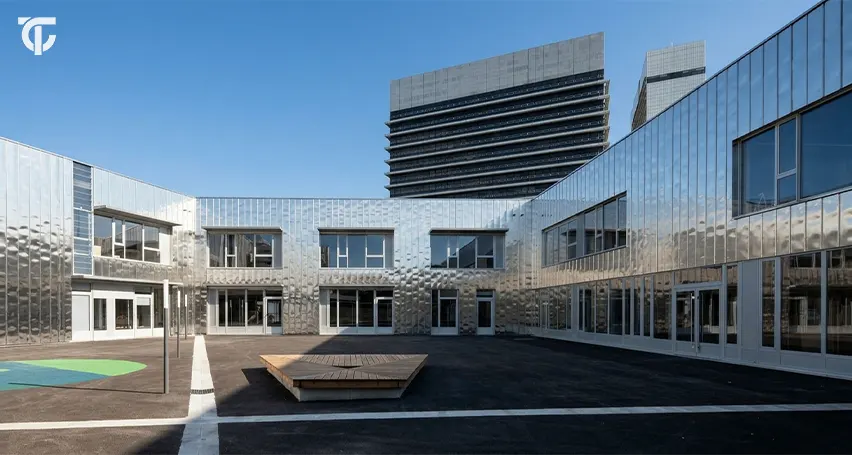
Real project example: Miriam Makeba School, Nanterre, France
The Miriam Makeba School was inaugurated in 2019. Its building area is 4,050 m², and its facade is clad in Aperam’s Uginox 304 stainless steel. Cabinet Toa architectes associés designed the project.
This project shows Grade 304 used as an architectural facade cladding on a school building. The source documents only the facade, so the example doesn’t say the entire building is made from Grade 304.
Handrails, Balustrades and Glass Guardrails
Handrails and stainless steel balustrades are another everyday use. Grade 304 can be used for handrails, balustrade components, glass guardrail caps, and supporting or finishing components.
Long continuous runs raise two practical questions.
Will the surface finish look consistent from piece to piece? And do the fabrication tolerances let the parts fit properly during installation?
Both questions belong in the planning stage, before fabrication starts.
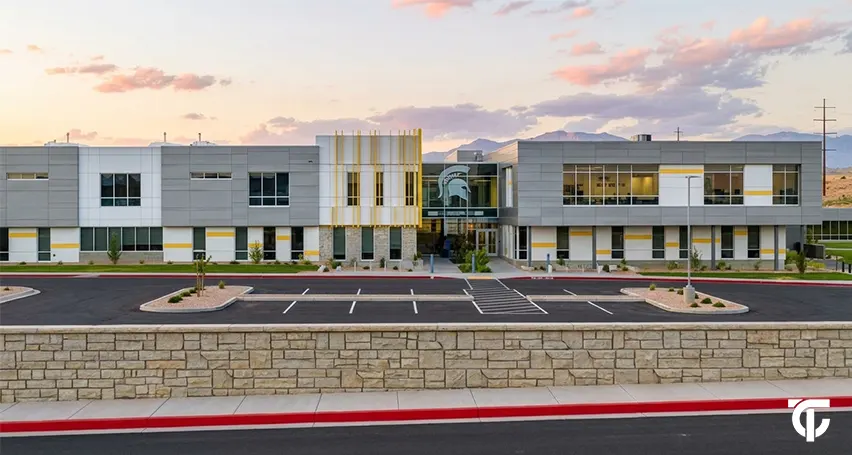
Real project example: Career Tech High School, St. George, Utah, USA
This project ran from 2022 to 2023. It included approximately 450 linear feet of glass guardrail. The guardrail used 304 stainless steel caps and handrails with a #4 brushed satin finish.
The project shows Grade 304 used for the cap and handrail components of a glass guardrail system. The source doesn’t describe the whole system as Grade 304. It identifies an aluminium base shoe clad in stainless steel, and it names 304 stainless steel for the cap and handrail.
Structural Supports and Fabricated Building Components
Grade 304 is also fabricated into support assemblies and connection components. Typical examples include lattice structures, brackets and connection components, and formed plates and angles. These parts are joined by welding, mechanical fixing, or a combination of both.
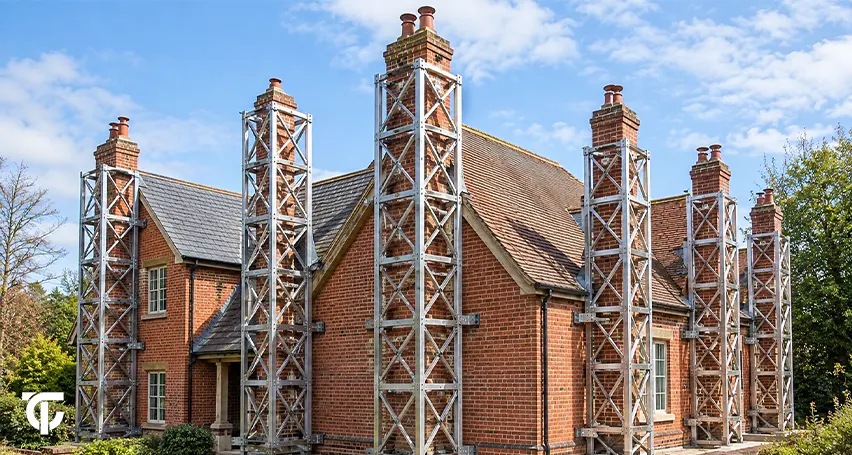
Real project example: Hampshire Chimney Supports, United Kingdom
Ancon fabricated six stainless steel lattice towers to support the brick chimneys of a large new residential property in Hampshire. Two towers are 7 meters high, and four are 5.5 meters high. All six are made from austenitic stainless steel, grade 1.4301 (304).
Each tower has four corner angles, braced at regular intervals by horizontal and diagonal plates. Three sides of each tower are fully welded. The braces on the fourth side are bolted, allowing some on-site fixing tolerance. The towers were mechanically fixed to the building’s structural frame, and the brickwork was tied back to them as construction progressed.
Treat this as one documented, engineered project. It isn’t evidence that Grade 304 suits every structural steel application. Any structural use needs engineering design for its own loads and conditions.
Window Frames, Fixings and Other Architectural Details
Smaller components make up a long tail of Grade 304 uses in buildings:
- Window-frame components
- Stainless steel fixings and fasteners, and other fittings
- Architectural metalwork
- Interior components
- Building hardware
Small parts still need the same checks as large ones. For each use, confirm the product form, specification, connection detail, and exposure environment. A fastener sold under a general 304 description isn’t automatically covered by the plate, sheet and strip limits shown earlier.
Available Forms and Surface Finishes of Grade 304 Stainless Steel
The same grade can reach a project in several shapes and surface conditions. Choosing the form and finish is part of specifying the material.
Common Product Forms
Construction-related forms fall into three groups:
- Flat Products: Sheet, plate, coil and strip
- Bars: Bar, including round bar and flat bar
- Hollow Products: Tube and pipe
You may wonder where sheet ends and plate begins. The boundary comes from the applicable product standard and its thickness range, so there is no universal figure to quote here.
Availability depends on the producer and the product form. Specifications also differ by form. The composition table earlier in this article applies to plate, sheet and strip under ASTM A240, not to every form in the list above.
Common Surface Finishes
A finish is a manufacturing or surface-treatment condition. It isn’t a separate grade. The same Grade 304 can be supplied with different finishes. Relevant examples include:
- 2B
- BA
- No. 1
- No. 4 (Brushed Satin)
- 2D
- Polished Finishes
Not every finish is available in every product form. Availability depends on the producer and the product form, and definitions come from the applicable product standard. The stainless steel surface finish affects more than looks:
- It changes the appearance of the finished component.
- Surface roughness and finish can influence cleanability and corrosion performance.
- The right finish depends on the application and the environment.
A visually attractive finish isn’t automatically the most suitable one for every outdoor exposure. For example, the Career Tech guardrail above used a #4 brushed satin finish on its caps and handrails. That is one project’s choice, not a rule for all handrails.
Fabrication and Welding of Grade 304 Stainless Steel
Sheet, plate and tube become building components through cutting, forming and joining. How those steps are carried out also affects the finished surface and its corrosion behaviour.
Forming and Machining
Fabricators cut, bend, form, drill and machine Grade 304 to make building components. The material is formable, which helps when a part has to be shaped. The ductility discussed earlier, shown by its minimum elongation, is part of the reason.
There is a catch. Grade 304 work hardens as it is deformed, and cold working raises its strength and hardness. In practice, that influences:
- Tool selection
- Forming force
- Machining conditions
This article doesn’t give cutting speeds, feed rates, or tool-life figures. Those depend on the fabricator’s procedures and tooling.
Welding Grade 304 Stainless Steel
Yes, Grade 304 can be welded. It needs suitable processes and procedures, though. TIG (GTAW) and MIG (GMAW) welding are common examples. GTAW stands for GasTungsten Arc Welding and GMAW for Gas Metal Arc Welding.
A few points need attention during and after welding:
- Filler selection. The filler must suit the base material, the joint design, and the service conditions. There’s no single filler choice for every job.
- Heat effects. Weld heat can produce heat tint, a discoloration, and other surface changes. The Heat-affected Zone (HAZ) around the weld also sees a thermal cycle. That ties back to the sensitization discussion earlier.
- Cleaning. Weld areas may need cleaning and appropriate post-weld treatment.
- Contamination. Stainless steel weld contamination should be avoided from the start. The next section covers how.
Preventing Contamination During Fabrication
Contamination is easier to prevent than to fix. Iron contamination means foreign iron on the stainless steel surface, and it can show up later as rust staining. The following habits help:
- Use clean tools and suitable handling practices.
- Keep the stainless steel away from carbon-steel grinding debris.
- Avoid embedding iron particles in the surface.
- Protect the material during storage and transport.
- Clean welds and heat-tinted surfaces using appropriate procedures.
Don’t assume a quick wipe or a passivation treatment will fix every type of surface damage or contamination. Some problems need a different treatment, which the next section explains.
Pickling and Passivation
People often use these two terms as if they meant the same thing. They don’t.
| Treatment | What It Does |
| Pickling | Removes oxide scale and affected surface layers using a suitable chemical process. |
| Passivation | Helps establish or restore a clean passive surface condition by removing free iron and facilitating passive-film formation. |
The difference matters on site. Stainless steel passivation doesn’t remove all weld scales. It also doesn’t replace proper pickling when scale needs to be removed.
Maintenance and Cleaning of Grade 304 Stainless Steel
Stainless steel isn’t maintenance-free. This section covers practical upkeep, which matters most for architectural and outdoor components.
Why Regular Cleaning Matters
Think about what lands on an exterior surface. Salt, dirt, and airborne contaminants can collect on it. Those deposits may increase the risk of staining and localised corrosion.
Regular cleaning helps maintain both the appearance and the surface condition. That is the core of stainless steel surface maintenance.
Rain washing can help exposed components. It shouldn’t be treated as a complete maintenance programme.
Recommended Cleaning Practices
Cleaning doesn’t need to be complicated. The basics are:
- Use mild detergent and clean water.
- Rinse away cleaning residues.
- Remove salt and other deposits.
- Avoid harsh cleaners that can damage the surface.
- Follow the manufacturer’s cleaning instructions.
Preventing Tea Staining
Several factors influence the risk of stainless steel tea staining:
- Exposure Environment
- Surface Finish
- Fabrication Quality
- Joint and Drainage Design
- Maintenance Frequency
No single cleaning interval fits every building. How often a surface needs cleaning depends on the exposure, the design, and the deposits that build up on it. Cleaning also can’t correct every corrosion problem, so design and fabrication still matter.
Advantages and Limitations of Grade 304 Stainless Steel
Grade 304 has real strengths and real limits. This section sets out both for this grade only.
Advantages
- Good general corrosion resistance in suitable environments.
- Good formability.
- Good weldability with appropriate procedures.
- Attractive architectural appearance.
- Availability in multiple product forms and finishes.
- Ability to form a passive surface film.
- Usefulness across a broad range of indoor and selected outdoor building applications.
Limitations
- Chloride exposure can cause pitting and crevice corrosion.
- Marine and heavily polluted environments may be unsuitable without a detailed assessment.
- Surface contamination can cause rust staining.
- Thermal expansion needs to be considered in long components.
- Regular cleaning may be needed.
- Material and fabrication costs should be assessed for the actual project.
Many of the limitations above can be managed by design, fabrication, and upkeep. Others, such as a heavily chloride-exposed site, may rule the grade out without a detailed assessment.
How to Select Grade 304 for a Construction Project
Knowing the properties is one thing. Deciding whether Grade 304 fits a particular project is another. Four checks, taken in order, make that decision easier.
Assess the Exposure Environment
Start with the site, because the environment drives most of the corrosion risk. Ask these questions:
- Is the project indoors or outdoors?
- Is it in a coastal area?
- Is it exposed to road de-icing salts?
- Is it near industrial pollution?
- Will deposits collect on the surface?
- Is regular cleaning possible?
Each “yes” points back to a risk covered earlier, such as chloride exposure, pollution, or deposits. The more of them apply, the more a detailed assessment matters.
Confirm the Material Specification
“Grade 304” on a drawing isn’t enough. The specification should state:
- The grade designation
- The applicable ASTM or EN specification
- The product form
- Thickness and dimensions
- Mechanical property requirements
- Material test certificates
ASTM and EN are separate specification systems. Don’t assume the values or requirements from one apply to the other. The tables in this article cite ASTM A240 values for plate, sheet, and strip, so they don’t automatically cover other product forms.
Consider Fabrication and Installation
A suitable material can still fail through poor detailing. Review these points before fabrication starts:
- Welding requirements
- Surface finish
- Joint design
- Drainage
- Contact with other metals: Dissimilar-metal contact can cause galvanic corrosion, so check connection details.
- Thermal expansion
- Maintenance access
Obtain Project-Specific Engineering Advice
Load-bearing, safety-critical and highly corrosive applications need review by the responsible engineer or a material specialist. This article explains the material. It doesn’t replace structural calculations, building codes, or a corrosion assessment.
Final Thoughts
Grade 304 is an austenitic chromium-nickel stainless steel, and its chromium content lets a protective passive film form on the surface. That film, together with the material’s strength, ductility and weldability, explains its place in building work. Cladding, handrails, fabricated supports and architectural details all draw on those qualities.
Its performance isn’t fixed by the grade name, though. Exposure, surface finish, fabrication and maintenance all shape how a component ages. Thermal movement, contamination and chloride exposure each deserve attention in the design.
So the practical question comes before the material choice: What are the project’s actual conditions?
A correct specification, confirmed by certification and checked against the site, decides whether Grade 304 is suitable.
Frequently Asked Questions
What Is Grade 304 Stainless Steel Used For in Construction?
It is used for facade cladding, handrails and balustrades, window-frame components and architectural metalwork. It also appears in selected fabricated supports and fittings. Actual suitability depends on the exposure conditions and the engineering requirements of each project.
Does Grade 304 Stainless Steel Rust or Corrode?
It has good corrosion resistance in suitable conditions, but it isn’t completely corrosion-proof. Chlorides, deposits, crevices, and surface contamination can cause corrosion or staining. Surface maintenance matters.
Is Grade 304 Stainless Steel Magnetic?
Annealed austenitic Grade 304 generally has a very low magnetic response. Cold working can induce some martensite, which increases magnetic attraction. Weld regions can also show a magnetic response because of microstructural changes. A magnet test alone can’t reliably confirm the grade.
Can Grade 304 Stainless Steel Be Welded?
Yes, with suitable processes and procedures. The filler material must be appropriate. Heat tint and contamination need attention, and weld cleaning and post-weld surface treatment may be required.
How Does Grade 304 Stainless Steel Perform Outdoors?
It can perform well in many suitable atmospheric environments. Coastal salt exposure and harsh industrial pollution increase the corrosion risk. Surface finish, drainage, and regular cleaning also affect performance. Suitability must be assessed for the actual location.