
Steel on its own is strong, but it has one obvious weakness: it rusts. That’s where the idea of a zinc coating on steel changed everything. When steel is galvanized, it gets a protective layer that acts as a rust-resistant coating and dramatically extends its life. In real-world conditions, galvanized steel can last anywhere from 20 to over 100 years, depending on where and how it’s used.
This guide breaks down the types of galvanized steel, shows how each is made, and explains where they make sense to use. Some are built for heavy outdoor exposure, others for precision parts. Not all galvanized steel behaves the same, and that’s where most confusion usually starts.
What is Galvanized Steel?
At its core, galvanized steel is just regular steel with a zinc coating applied through a specific galvanizing process. That coating does more than just sit on the surface. It actively protects the metal underneath. There’s an interesting mechanism behind it called sacrificial anode protection. Even if the surface gets scratched, the zinc corrodes first instead of the steel. That’s why galvanized materials hold up so well in harsh conditions. In practical terms, this means fewer replacements, less maintenance, and more reliability, especially in industrial uses of galvanized steel or outdoor steel structures.
How Many Types of Galvanized Steel Are There?
A common question we ask when we need galvanized steel is:
How many types of galvanizing are there? 🤔
The short answer is Twelve. But those Twelve fall into a few broader categories:
- Process-based types
- Coating and alloy-based types
- Product or finish-based types
These are essentially different types of galvanized steel, each created through a distinct galvanizing process or finishing method. When people ask again how many types of galvanizing there are, the answer stays the same, but the choice depends heavily on the use case. Some are better for construction, others for automotive or indoor applications.
Types of Galvanizing and Galvanization Explained
Before getting into the list, it helps to clear something up. The terms “types of galvanizing” and “types of galvanization” are often used interchangeably. Both refer to the ways zinc coating on steel is applied or treated.
Different types of galvanized steel result from these processes, which is why the terminology overlaps. When someone asks how many types of galvanizing there are, they’re usually referring to both the process and the final product.
12 Types of Galvanized Steel
Group A: Process-Based Types
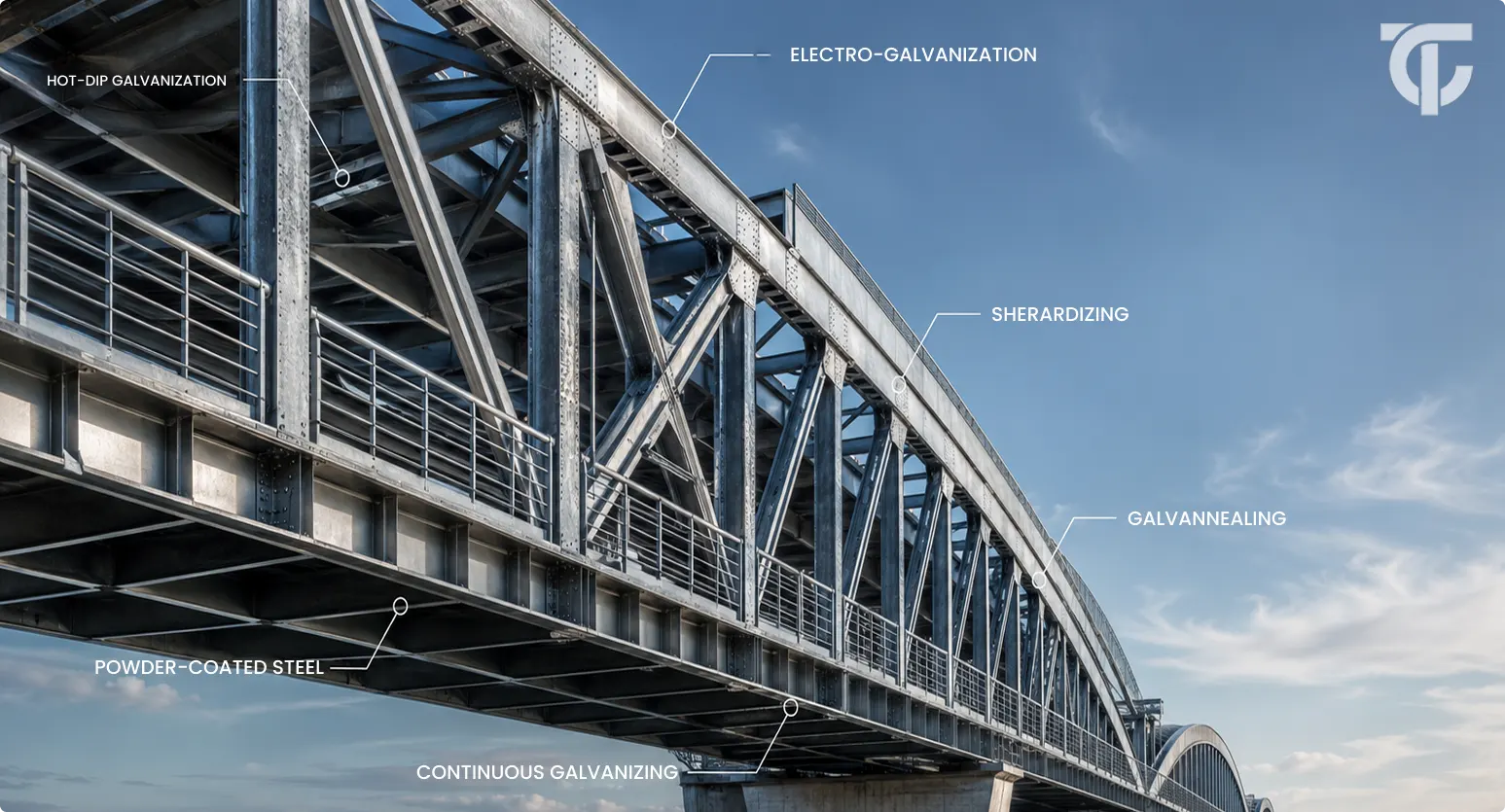
- Hot-Dip Galvanization
- Electro-Galvanization (Electroplating)
- Zinc Spraying (Metallizing)
- Sherardizing (Thermal Diffusion)
- Galvannealing
- Mechanical Plating (Zinc Flake Coating)
- Continuous Galvanizing
- Batch/Spin Galvanizing
- Cold Galvanizing (Zinc-Rich Paint)
Group B: Coating/Advanced Types
- Zinc-Aluminum Alloy Coatings (Galvalume)
Group C: Product/Finish Types
- Pre-Painted Galvanized Iron (PPGI)
- Powder-Coated Galvanized Steel
Group A: Process-Based Types
✅ Hot-Dip Galvanization
Hot-dip galvanization is the most common and reliable method of protecting steel from corrosion. In this process, steel is coated with a thick layer of zinc by immersing it in molten zinc, creating a strong metallurgical bond that provides long-lasting protection against rust and environmental damage.
Its Process
The steel is first cleaned to remove dirt, oil, grease, and mill scale. It is then treated with a flux solution to improve zinc adhesion before being immersed in molten zinc at approximately 450°C (842°F). During this galvanizing process, the molten zinc reacts with the steel surface to form several zinc-iron alloy layers, followed by an outer zinc coating that acts as a durable barrier against moisture and corrosion.
Benefits
- Forms a thick zinc coating, typically 70–100 microns, for superior corrosion protection.
- Provides excellent durability in harsh outdoor and industrial environments.
- Creates a strong metallurgical bond that resists peeling, chipping, and abrasion.
- Requires very little maintenance throughout its service life.
- It can protect steel structures for several decades, depending on environmental conditions.
Common Uses
- Bridges and highway infrastructure.
- Structural beams and steel frameworks.
- Utility and transmission poles.
- Guardrails and safety barriers.
- Industrial plants and warehouses.
- Large outdoor steel structures exposed to weather.
Best Choice For
- Construction projects require maximum durability.
- Coastal and high-humidity environments.
- Heavy industrial facilities.
- Infrastructure that is difficult or expensive to maintain.
- Long-term applications of galvanized steel where corrosion resistance is a top priority.
✅ Electro-Galvanization (Electroplating)
Electro-galvanization, also known as electroplating, is a galvanizing method that applies a thin and uniform layer of zinc to steel using an electric current. Unlike hot-dip galvanization, this process produces a smoother finish, making it ideal for products where appearance and precision are important.
Its Process
During this galvanizing process, steel components are placed in an electrolyte solution containing zinc salts. An electric current passes through the solution, causing zinc ions to bond evenly with the steel surface. The result is a smooth zinc coating on steel, typically 5-25 microns thick, that provides moderate corrosion resistance while maintaining dimensional accuracy.
Benefits
- Produces a smooth, clean, and visually appealing surface.
- Provides a uniform zinc coating with a typical thickness of 5–25 microns.
- Maintains tight dimensional tolerances for precision components.
- Offers good corrosion resistance for indoor and controlled environments.
- Creates an excellent surface for painting or additional finishing.
Common Uses
- Automotive body panels.
- Home appliances.
- Office furniture.
- Electrical cabinets and enclosures.
- Precision metal components.
- Decorative steel products.
Best Choice For
- Automotive manufacturing.
- Indoor equipment and machinery.
- Decorative steel applications.
- Precision-engineered parts.
- Products requiring a smooth surface finish.
✅ Zinc Spraying (Metallizing)
Zinc spraying, commonly called metallizing, is a protective coating method in which molten zinc is sprayed directly onto the steel surface rather than immersing the steel in a zinc bath. It is commonly used for large structures or components that cannot be hot-dip galvanized.
Its Process
Before applying the coating, the steel surface is abrasively blasted to remove contaminants and create a rough texture for better adhesion. Molten zinc is then sprayed onto the prepared surface using a flame or electric arc spray system. This galvanizing process forms a protective zinc coating on steel that helps prevent corrosion even in demanding environments.
Benefits
- Suitable for large or assembled steel structures.
- Can be applied on-site without dismantling equipment.
- Coating thickness can be adjusted according to project requirements.
- Excellent corrosion protection for exposed steel.
- Ideal for repairing and maintaining damaged galvanized coatings.
Common Uses
- Bridges
- Storage tanks
- Offshore structures
- Pipelines
- Water treatment facilities
- Large outdoor steel structures
Best Choice For
- Existing steel structures that require maintenance.
- Large industrial facilities.
- Infrastructure repair projects.
- Steel that cannot fit inside a galvanizing kettle.
- Long-span outdoor structures.
✅ Sherardizing (Thermal Diffusion)
Sherardizing is a thermal diffusion galvanizing method that coats steel with zinc powder instead of molten zinc. It creates a highly uniform zinc-iron alloy layer, making it particularly effective for small parts with complex shapes.
It’s Process
Steel components are placed inside a sealed rotating drum along with zinc powder. The drum is heated to a controlled temperature, allowing zinc to diffuse into the steel surface instead of simply covering it. This galvanizing process creates a durable zinc coating on steel with consistent coverage, even on threads and hard-to-reach areas.
Benefits
- Produces an even coating across the entire component.
- Excellent protection for threaded and precision parts.
- No excess zinc buildup that may affect dimensions.
- Strong resistance to abrasion and corrosion.
- Reduces the need for post-processing or finishing.
Common Uses
- Nuts and bolts
- Washers
- Fasteners
- Hinges
- Small engineering components
- Industrial hardware
Best Choice For
- Precision fasteners.
- Threaded components.
- Small fabricated steel parts.
- Engineering applications require dimensional accuracy.
- Hardware exposed to outdoor conditions.
✅ Galvannealing
Galvannealing is a modified galvanizing process that combines hot-dip galvanizing with heat treatment. That creates a zinc-iron alloy coating which provides excellent paint adhesion and improved weldability.
Its Process
The steel is first hot-dip galvanized, then passes through a controlled heating stage. During reheating, zinc reacts further with steel to form a zinc-iron alloy surface rather than a pure zinc layer. The finished coating has a matte appearance and is easier to paint than conventional galvanized steel.
Benefits
- Excellent surface for painting and powder coating.
- Improved weldability during fabrication.
- Strong adhesion between the coating and steel.
- Better resistance to coating damage during manufacturing.
- Suitable for products requiring additional finishing.
Common Uses
- Automotive body panels
- HVAC equipment
- Electrical cabinets
- Steel doors
- Painted construction products
- Industrial equipment
Best Choice For
- Components that require painting.
- Welded steel fabrications.
- Automotive manufacturing.
- Commercial building products.
- Finished steel products with decorative coatings.
✅ Mechanical Plating (Zinc Flake Coating)
Mechanical plating is a cold coating process that applies zinc to steel through mechanical impact rather than heat or electricity. It is commonly used for high-strength fasteners because it provides corrosion protection without increasing the risk of hydrogen embrittlement.
It’s Process
Steel parts are placed inside a rotating drum with zinc powder, glass beads, water, and chemical promoters. As the drum rotates, repeated impacts bond zinc particles to the steel surface, forming a protective zinc coating. Since no electrical current or high temperatures are involved, the steel retains its original mechanical properties.
Benefits
- Eliminates the risk of hydrogen embrittlement.
- Provides consistent corrosion protection.
- Maintains the strength of high-tensile steel.
- Suitable for threaded and precision components.
- Delivers a uniform coating without excessive buildup.
Common Uses
- Bolts
- Screws
- Washers
- Anchors
- Springs
- Heavy-duty industrial fasteners
Best Choice For
- High-strength fasteners.
- Structural hardware.
- Industrial machinery.
- Construction fixings.
- Engineering applications where mechanical strength must be preserved.
✅ Continuous Galvanizing
Continuous galvanizing is a high-speed manufacturing process used to apply a protective zinc coating to steel coils before they are fabricated into finished products. It is widely used in mass production because it delivers a consistent coating and excellent production efficiency.
Its Process
In this galvanizing process, steel coils pass through a cleaning and annealing stage before moving continuously through a molten zinc bath. As the steel exits the bath, air knives remove excess zinc, achieving a uniform, controlled-thickness zinc coating on the steel. The coated steel is then cooled, inspected, and recoiled for further manufacturing.
Benefits
- Produces a consistent and uniform zinc coating.
- Supports high-volume manufacturing with excellent efficiency.
- Improves corrosion resistance while maintaining surface quality.
- Reduces production time and manufacturing costs.
- Suitable for products requiring consistent dimensions and finish.
Common Uses
- Roofing sheets
- Wall panels
- Steel coils
- Household appliances
- Automotive components
- Building materials
Best Choice For
- Large-scale manufacturing.
- Roll-formed steel products.
- Roofing and cladding systems.
- Automotive production.
- Commercial building materials.
✅ Batch/Spin Galvanizing
Batch or spin galvanizing is a variation of hot-dip galvanizing specifically designed for small steel components such as fasteners and fittings. The spinning process removes excess zinc, resulting in a clean and evenly coated finish.
Its Process
Steel components are cleaned and immersed in molten zinc using the traditional hot-dip method. Immediately after coating, the parts are placed in a centrifuge or spinning basket to remove excess zinc before the coating solidifies. That ensures a smooth finish while preventing zinc from clogging threads and small openings.
Benefits
- Provides uniform coating on small steel parts.
- Prevents excess zinc buildup on threads.
- Offers excellent corrosion resistance.
- Improves the appearance of finished components.
- Extends the service life of small hardware.
Common Uses
- Nuts and bolts
- Threaded rods
- Washers
- Pipe fittings
- Clamps
- Small construction hardware
Best Choice For
- Threaded fasteners.
- Small fabricated components.
- Industrial hardware.
- Construction accessories.
- Steel parts require clean threads after galvanizing.
✅ Cold Galvanizing (Zinc-Rich Paint)
Cold galvanizing is a protective coating method that uses zinc-rich paint instead of molten zinc to protect steel from corrosion. Although it is not a true galvanizing process, it provides an effective barrier against moisture and is commonly used for repairs & maintenance.
Its Process
The steel surface is thoroughly cleaned before a zinc-rich coating containing a high percentage of zinc dust is applied using a brush, roller, or spray equipment. Once dry, the coating forms a protective layer that helps reduce corrosion and restore damaged galvanized surfaces.
Benefits
- Easy and quick to apply.
- Ideal for repairing damaged galvanized coatings.
- No specialized galvanizing equipment required.
- Cost-effective for maintenance work.
- Suitable for on-site corrosion protection.
Common Uses
- Repairing galvanized steel
- Structural steel maintenance
- Fencing
- Pipelines
- Steel railings
- Industrial maintenance projects
Best Choice For
- Touch-up repairs.
- Maintenance work.
- Small steel structures.
- Field applications.
- Areas where hot-dip galvanizing is not practical.
Group B: Coating/Advanced Types
✅ Zinc-Aluminum Alloy Coatings (Galvalume)
Galvalume is an advanced protective coating that combines zinc, aluminum, and silicon to provide superior corrosion resistance compared to traditional galvanized steel. It is especially effective in environments exposed to heat and moisture.
Its Process
During the coating process, steel passes through a molten alloy containing approximately 55% aluminum, 43.4% zinc, and 1.6% silicon. This combination creates a durable protective layer that offers both barrier protection from aluminum and sacrificial corrosion protection from zinc.
Benefits
- Superior corrosion resistance in harsh environments.
- Excellent heat reflectivity.
- Longer service life than standard galvanized steel in many applications.
- Improved weather resistance.
- Reduced maintenance requirements.
Common Uses
- Metal roofing systems
- Wall cladding
- Agricultural buildings
- Industrial warehouses
- HVAC equipment
- Outdoor construction panels
Best Choice For
- Roofing applications.
- Coastal regions.
- High-temperature environments.
- Commercial buildings.
- Agricultural structures.
Group C: Product/Finish Types
✅ Pre-Painted Galvanized Iron (PPGI)
Pre-Painted Galvanized Iron (PPGI) is galvanized steel with an additional factory-applied paint coating to enhance its appearance, durability, and weather resistance. It combines corrosion protection with decorative finishes in various colors.
Its Process
The galvanized steel is first cleaned and chemically treated before receiving primer and multiple coats of paint on a continuous coating line. The painted surface is then baked and cured to create a durable finish that resists fading, peeling, and environmental damage.
Benefits
- Combines corrosion protection with decorative finishes.
- Available in a wide range of colors and textures.
- Excellent weather and UV resistance.
- Reduces future painting and maintenance costs.
- Improves the overall appearance of steel structures.
Common Uses
- Residential roofing
- Wall panels
- Commercial buildings
- Garage doors
- Interior partitions
- Prefabricated buildings
Best Choice For
- Architectural projects.
- Residential construction.
- Commercial facades.
- Decorative steel products.
- Buildings require long-lasting color finishes.
✅ Powder-Coated Galvanized Steel
Powder-coated galvanized steel combines the corrosion resistance of galvanized steel with the durability and appearance of a baked-on powder coating. This dual-protection system offers enhanced resistance against moisture, chemicals, and surface wear.
Its Process
After galvanization, the steel surface is cleaned and prepared before being electrostatically coated with dry powder. The coated steel is then cured in an oven, where the powder melts and forms a smooth, durable protective finish over the galvanized surface.
Benefits
- Provides dual-layer corrosion protection.
- Highly resistant to scratches, chipping, and chemicals.
- Excellent color retention and UV resistance.
- Low maintenance and long service life.
- Available in numerous colors and finishes.
Common Uses
- Outdoor furniture
- Fencing systems
- Handrails
- Architectural features
- Playground equipment
- Public infrastructure
Best Choice For
- Decorative outdoor structures.
- High-traffic public spaces.
- Coastal environments.
- Premium architectural projects.
- Steel products require both durability and aesthetics.
Comparison of the Different Types of Galvanized Steel
While each galvanizing method serves the same purpose, protecting steel from corrosion, their coating thickness, durability, manufacturing process, and ideal applications can vary significantly. The table below compares the different types of galvanized steel side by side, making it easier to understand their strengths and choose the right solution based on your project requirements.
| Type of Galvanized Steel | Coating Method / Thickness | Corrosion Resistance | Common Applications | Best For |
| Hot-Dip Galvanization | Molten zinc (70–100 µm) | ⭐⭐⭐⭐⭐ Very High | Bridges, structural steel, utility poles, outdoor steel structures. | Heavy-duty outdoor and industrial projects. |
| Electro-Galvanization (Electroplating) | Electroplating (5–25 µm) | ⭐⭐⭐ Medium | Bridges, structural steel, utility poles, outdoor steel structures. | Indoor and precision applications. |
| Zinc Spraying (Metallizing) | Thermal zinc spray (variable thickness) | ⭐⭐⭐⭐ High | Bridges, storage tanks, pipelines. | Large structures and on-site maintenance. |
| Sherardizing (Thermal Diffusion) | Thermal diffusion zinc coating | ⭐⭐⭐⭐ High | Bolts, nuts, washers, fasteners. | Threaded and precision components. |
| Galvannealing | Heat-treated zinc-iron alloy | ⭐⭐⭐ Medium | Automotive parts, HVAC systems, painted products. | Components that require painting or welding. |
| Mechanical Plating (Zinc Flake Coating) | Mechanically bonded zinc particles | ⭐⭐⭐ Medium | High-strength fasteners, anchors, industrial hardware. | Precision hardware without hydrogen embrittlement. |
| Continuous Galvanizing | Continuous molten zinc coating | ⭐⭐⭐⭐ High | Roofing sheets, wall panels, steel coils. | High-volume manufacturing. |
| Batch/Spin Galvanizing | Hot-dip with centrifugal spinning | ⭐⭐⭐⭐ High | Pipe fittings, threaded rods, construction hardware. | Small galvanized components. |
| Cold Galvanizing (Zinc-Rich Paint) | Zinc-rich paint coating | ⭐⭐ Moderate | Repair work, maintenance, steel touch-ups. | Restoring damaged galvanized surfaces. |
| Zinc-Aluminum Alloy Coatings (Galvalume) | 55% Aluminum + 43.4% Zinc + 1.6% Silicon | ⭐⭐⭐⭐⭐ Very High | Roofing, wall cladding, agricultural buildings. | Long-lasting roofing systems. |
| Pre-Painted Galvanized Iron (PPGI) | Galvanized steel with factory-applied paint | ⭐⭐⭐⭐ High | Roofing, wall panels, commercial buildings. | Decorative and architectural applications. |
| Powder-Coated Galvanized Steel | Galvanized steel with baked powder coating | ⭐⭐⭐⭐⭐ Very High | Fencing, handrails, outdoor furniture, playground equipment. | Decorative outdoor structures. |
Looking to explore more construction products, tools, and material guides?
Continue exploring The Concrete Talk’s Products and Tools articles, featuring expert coverage of building materials, construction equipment, and industry essentials.
Which Type of Galvanized Steel Is Best for Your Project?
Choosing the right type of galvanized steel depends on more than just corrosion resistance. Every galvanizing method is designed to perform under specific environmental conditions, manufacturing requirements, and project budgets.
Whether you’re working on a residential roofing project, an industrial facility, an automotive component, or a large infrastructure development, selecting the appropriate type of galvanized steel can improve durability, reduce maintenance costs, and maximize long-term performance.
Recommended Types Based on Your Project
To simplify your decision, here are some general recommendations based on different project requirements:
- Hot-Dip Galvanization is the preferred option for bridges, structural steel, utility poles, transmission towers, and other heavy-duty outdoor structures that require maximum corrosion resistance.
- Electro-Galvanization works best for automotive body panels, household appliances, office furniture, and precision-engineered components where a smooth finish is essential.
- Zinc Spraying (Metallizing) is well-suited for large steel structures, storage tanks, bridges, and on-site maintenance projects where traditional galvanizing is not practical.
- Sherardizing is ideal for threaded fasteners, nuts, bolts, washers, and other precision components that require a uniform protective coating.
- Galvannealing is recommended for steel products that will be painted, welded, or further fabricated after galvanizing.
- Mechanical Plating performs well for high-strength fasteners and industrial hardware where maintaining the steel’s mechanical properties is important.
- Continuous Galvanizing is commonly used for roofing sheets, wall panels, steel coils, and other mass-produced construction materials.
- Batch/Spin Galvanizing is suitable for pipe fittings, threaded rods, and small construction hardware that require an even zinc coating.
- Cold Galvanizing is a practical solution for repairing damaged galvanized surfaces and carrying out maintenance or touch-up work.
- Galvalume is an excellent choice for roofing systems, wall cladding, and agricultural or commercial buildings exposed to changing weather conditions.
- Pre-Painted Galvanized Iron (PPGI) is best suited for residential, commercial, and architectural applications where appearance and corrosion protection are equally important.
- Powder-Coated Galvanized Steel is ideal for outdoor furniture, fencing, handrails, playground equipment, and decorative steel structures that require enhanced durability.
Final Thoughts
Choosing between the types of galvanized steel isn’t just about cost or availability. It usually comes down to environment, lifespan expectations, and how much maintenance is acceptable. Some projects need heavy-duty protection, and some need a clean finish with moderate durability. That’s why understanding the types of galvanizing and how they perform in real conditions makes a noticeable difference. In the end, galvanized steel isn’t about preventing rust. It’s about building something that lasts without constant attention.
Frequently Asked Questions
How many types of galvanized steel are there?
There are 12 major types, grouped by process, coating, and finish. These represent the most common types of galvanization used across industries.
What is the most durable type of galvanized steel?
Hot-dip galvanized steel is generally the most durable due to its thick zinc coating and strong corrosion resistance.
Does galvanized steel rust over time?
Yes, but only after the zinc layer wears off. Until then, sacrificial anode protection keeps the steel safe.
Where is galvanized steel commonly used?
It’s widely used in construction, automotive parts, roofing, fencing, and industrial equipment.