
The word “galvanized” covers more than one way of getting zinc onto steel. Electro-galvanized steel is one of them. It’s steel that receives a zinc coating through an electro-deposition (electrolytic) process, where an electrical current drives zinc out of a solution and onto the steel surface.
That zinc layer protects the steel from corrosion. It also gives the sheet a controlled surface finish, which matters for products that need forming, painting, or other fabrication.
In this guide, you’ll see how the process works, what properties the coating gives the steel, and where the material is used. We’ll also cover its limitations, how it’s tested, and whether it suits outdoor use.
What Is Electro Galvanized Steel?
In short, electro-galvanized steel is steel that has been given a zinc coating through an electro-deposition process. You’ll also see this called electrolytic zinc coating or electroplating.
The American Galvanizers Association (AGA) describes electrogalvanized coatings as zinc applied to steel sheet and strip by electro-deposition.
The basic idea follows five steps:
- The steel is prepared for coating.
- It enters an electrolytic plating system.
- Zinc ions in the electrolyte are electrically reduced, which means they become zinc metal.
- That zinc is deposited onto the steel surface.
- The finished zinc coating protects the steel from corrosion and gives it a controlled surface finish.
Notice what’s not happening here. Electricity doesn’t melt zinc and spread it over the steel. Zinc comes out of a solution as ions and is deposited as a solid coating, the same principle behind electroplating.
So why zinc? Because it protects the steel underneath from corrosion. That protection has limits, though. A zinc coating doesn’t make steel rust-proof, and it doesn’t come with a fixed service life. How well it performs depends on the coating and the conditions the steel faces.
Galvanized steel can be produced through different processes and in different forms. If you want the broader picture, our guide to the different types of galvanized steel is a good place to start.
How Does the Electro Galvanization Process Work?
The electrogalvanization process is easiest to follow in order. The steel is cleaned; it goes into a bath containing zinc ions, an electric current moves those ions to the steel, and the new coating is finished off. Let’s take each stage in turn.
1. Surface Preparation
Before any zinc goes on, the steel surface has to be prepared. The goal is to remove contaminants and leave a surface the zinc can bond to, so the coating forms properly.
According to the AGA, sheet and strip pass through washes and rinses before they enter the zinc plating bath. Cleaning sequences aren’t identical everywhere so that we won’t pin down a fixed list of chemicals here. What matters is the purpose: A clean, ready surface before plating begins.
2. The Electrolyte and Zinc Ions
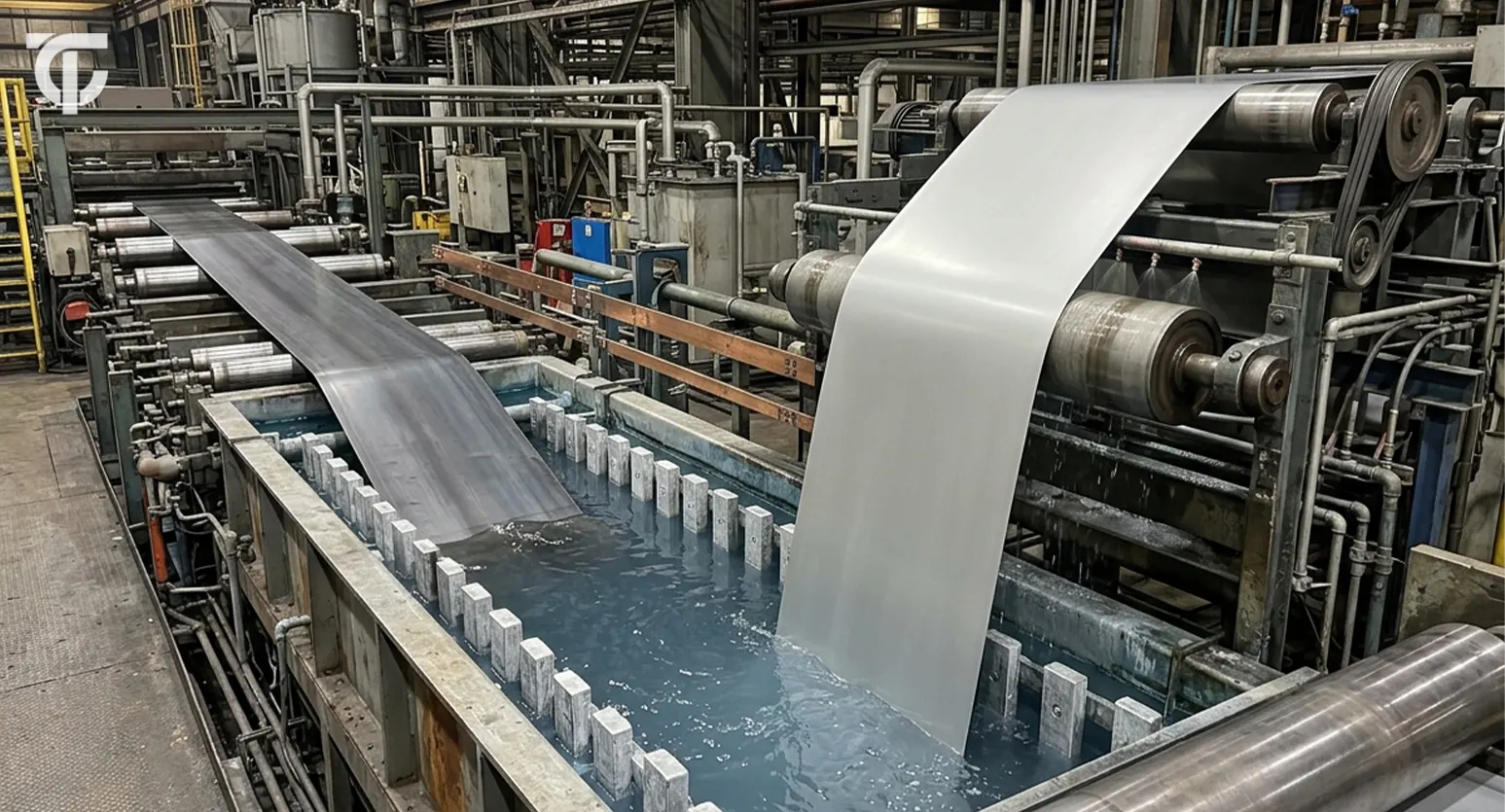
Next, the steel enters an electrolyte, which is the plating bath. This solution contains zinc ions, and those ions are the source of the zinc that ends up on the steel.
The electrolyte can be set up in different ways. The AGA notes that a common electrolyte-anode arrangement uses zinc sulfate electrolytes, and that soluble pure-zinc anodes may be used. Treat that as one common arrangement, not a rule for every electro galvanizing line.
3. The Cathode, Anode and Electric Current
This is where the mechanism becomes clear. Two electrodes and an electric current work together:
- The steel sheet acts as the cathode. It’s the surface that ends up coated.
- An anode forms the other half of the electrical system.
- Electric current drives the electrochemical reaction.
Once current flows, positively charged zinc ions move through the electrolyte toward the steel cathode. When they reach it, they’re reduced to metallic zinc. The AGA describes exactly this: zinc ions are electrically reduced to zinc metal and deposited on the steel cathode.
It’s an easy detail to flip. In this process, the zinc isn’t deposited at the anode. It’s the steel, acting as the cathode, that picks up the zinc.
4. Zinc Deposition and Coating Formation
As the reduced zinc builds up on the steel, the coating develops over the surface. Process conditions allow that coating to be controlled, so it can be built up in a closely managed way.
The AGA describes the resulting electro-deposited zinc as tightly adherent, with a smooth finish. In practical terms, the process allows controlled zinc deposition and can produce a smooth, consistent coating. How thick that coating is, and what it means for performance, comes up in the next section.
5. Rinsing, Post-Treatment and Finishing
Once the zinc is on, the material doesn’t necessarily go straight out the door. Depending on the product, it can go through rinsing, post-treatment, finishing, and drying where applicable.
Some product systems use treatments such as phosphate or chromate conversion coatings. Keep in mind that these are possible treatments in relevant products. They aren’t mandatory steps for every electrogalvanized product, and there’s no single post-treatment sequence that applies everywhere.
Key Characteristics of Electro Galvanized Steel
So the zinc is on. What does that give you? This section covers the coating and the properties that come with it.
Coating Thickness and Control
Electro-deposited zinc coatings can be relatively thin, and the process allows the deposition to be controlled. That makes coating thickness an important specification. It affects how much zinc is on the steel and, with it, the protection available.
The American Galvanizers Association (AGA) gives a figure for sheet and strip. Electro-deposited zinc coating weight can reach 60 g/m², which corresponds to thicknesses of up to 0.36 mil (9.1 µm) per side. A mil is one-thousandth of an inch, and a micrometer (µm) is one-millionth of a meter.
The wording matters here. Those are maximum figures the AGA states for sheet and strip, not a standard coating. They aren’t a rule for every electrogalvanized product either.
Two more points keep the numbers straight:
- Coating weight and coating thickness are related, but they aren’t the same measurement. The first describes how much zinc sits on a given area. The second describes how deep the layer is.
- Coating thickness isn’t steel thickness. The numbers above describe the zinc layer only, not the steel sheet underneath.
What the figures show is the general picture. On sheet and strip, electro-deposited zinc can be a thin, controlled layer.
Smooth Surface and Coating Uniformity
Electro-deposition can produce a smooth zinc finish. The AGA specifically notes the smoother surface of electro-deposited zinc coatings.
Why does that matter? Controlled deposition is useful where surface appearance and dimensional control count. It’s also relevant to products that go on to further fabrication or painting.
“Smooth” doesn’t mean “flawless,” though. The process can produce a smooth, consistent coating. However, the result still depends on the product and the conditions behind it.
Corrosion Protection
Zinc acts as a protective coating over the steel. It helps shield the underlying steel from corrosion.
How much protection you get depends on the amount and condition of the zinc coating. A thicker, intact coating and a thin or damaged one won’t behave the same way. We’re not putting a service life on it, because the sources don’t support a universal number. And as covered earlier, the coating doesn’t make steel immune to corrosion.
Formability and Ductility
Plenty of coated steel gets bent, pressed, or stamped into shape. In those cases, the zinc coating has to stay intact while the steel moves. A coating that cracks or flakes during forming defeats its purpose.
Two terms come up here:
- Formability is how well the material can be shaped through operations like bending, stamping, pressing, or deep drawing.
- Ductility is the ability to deform without breaking.
The World Steel Association describes electrogalvanised steel as having excellent forming properties, and says it suits forming, pressing, and bending. The AGA adds that the electro-deposited zinc coating is highly ductile and can stay intact after severe deformation.
That said, it doesn’t mean every grade and every coating condition can handle every forming operation. Suitability depends on the steel grade, the coating, the part’s geometry, and the manufacturing process.
Paintability
Electrogalvanized steel can be further treated for painting. That’s useful when the coated steel will get an additional finish on top of the zinc.
The AGA says these coatings can be treated to make them suitable for painting. It adds that this is often recommended because the zinc coating is so thin. Surface preparation and post-treatment can influence how well paint adheres, which ties back to the finishing stage in the process.
Don’t read this as “paint always sticks perfectly“. Nor is every electrogalvanized product painted. It simply means painting is an option, and the treatment before it matters.
Weldability
Electrogalvanized steel is used in products that go through fabrication and welding, including relevant automotive applications. The World Steel Association lists weldability among the relevant properties of electrogalvanised steel.
We’re keeping this one short on purpose. Welding settings depend on the specific steel, coating, and product, so this guide doesn’t give temperatures, pressures, or other parameters.
Electro Galvanized Steel Applications
Knowing the properties makes the applications easier to follow. Rather than just listing industries, each part below ties the use back to the characteristics covered above. The examples come from the AGA and the World Steel Association.
Automotive Components
The World Steel Association’s current 2026 profile lists automotive uses, including body-in-white for vehicles and underbody auto parts. Body-in-white refers to a vehicle’s body structure before it’s painted and fitted out. Where relevant, body panels come into the picture too, and the AGA lists automobiles among the common applications.
Why does the material fit? Look back at the properties. Formability, paintability, and weldability all matter for sheet parts that get shaped, joined, and finished. The sources describe the applications and the properties. They don’t say these are the only reasons the material gets chosen.
Appliance Bodies
The AGA identifies appliance bodies as another common application for electrogalvanized coatings. An appliance body is formed from a sheet and usually needs a finished surface. So the smooth zinc finish, formability, and paintability are relevant here.
We won’t name any appliance brands, since the sources don’t.
Fasteners
Fasteners are the third application the AGA identifies. That doesn’t mean every type of fastener is electrogalvanized, only that fasteners are an established use.
Building and Construction-Related Products
The World Steel Association profile identifies building applications such as wall elements and roofing applications. It also lists sections and profiled sheets among the uses. Its European profile supports the same construction context, which is useful for readers in Europe.
Formability is one of the properties the World Steel Association highlights, and it’s relevant to products shaped from sheet. A profiled sheet is a good example.
Still, this tells you where the material is used. It doesn’t make electrogalvanized steel the right choice for every roof or wall. That depends on the product specification and the exposure conditions, which we’ll look at in the outdoor-use section.
Other Product Applications
The World Steel Association’s global profile also names lighting fixtures and drums. We’ll stick to what the sources name and leave it there.
Advantages and Limitations of Electro Galvanized Steel
No coated steel suits every job. Here’s what electrogalvanized steel offers in practice and where you need to be careful.
Advantages
Each property covered earlier turns into a practical benefit:
Controlled coating
The process allows controlled zinc deposition, so the amount of zinc can be specified and then checked against a requirement.
Smooth surface
A smooth finish helps where appearance and dimensional control matter, and for parts that will be fabricated further or painted.
Formability
Relevant coated sheet products can be formed, pressed, and bent. One material can go from flat sheet to a finished part, as long as the grade and coating suit the forming operation.
Paintability
Relevant products can be treated for painting, which helps when the finished part needs a painted surface.
Corrosion protection
The zinc coating protects the underlying steel from corrosion.
Fabrication suitability
Weldability and formability are relevant properties in suitable applications, such as automotive parts.
Taken together, these line up with the applications above: sheet products that get formed, joined, and finished.
Limitations
A fair look at any coating includes its limits. Electrogalvanized steel has several.
The zinc coating can be relatively thin. That’s part of what makes the process controlled, but it also means the coating specified for a job really matters.
Protection also depends on where the steel ends up. The same coating doesn’t face the same demands in every environment, so the required level of protection comes from the exposure conditions.
This is why the word “galvanized” alone can’t settle whether a product suits outdoor use. The product specification and the coating requirements are what count. Some uses also call for extra finishing or treatment. Painting is one example, since the AGA says treatment for painting is often recommended because the zinc coating is so thin.
Finally, exact performance depends on the product and its service conditions. Electrogalvanized steel isn’t one identical material. Grade, coating specification, and manufacturing conditions all play a part.
How Is Electro Galvanized Steel Tested?
Quality control can look at different aspects of the coating. Each check answers a different question, and no single one tells the whole story. Here are the main ones.
Coating Thickness
The first question is simple: Is there enough zinc on the steel? Coating thickness, or coating mass, can be measured to verify that the coating meets the applicable specification.
Remember that these are two related but different measurements. The AGA gives both coating weight and thickness figures, and the ASTM standard covered below works with coating mass designations.
Coating Adhesion
Adhesion checks whether the zinc coating stays properly bonded to the steel surface. It matters because a coating that separates from the steel can’t protect it.
We’re not describing a specific adhesion test here. There’s no single procedure we can point to for every product.
Visual Inspection
A visual check looks at three things:
- surface appearance
- visible defects
- coating consistency
It’s a useful first look. But it has a limit. A surface that looks smooth and consistent tells you how the coating looks, not how it will hold up against corrosion. Visual inspection alone doesn’t prove corrosion performance.
Corrosion Testing
Corrosion testing evaluates how a coating performs under defined test conditions. Salt-spray testing is one type of corrosion test.
“Defined test conditions” is the key phrase. A salt-spray result tells you how the coating behaved in that test. It doesn’t tell you how many years the steel will last outdoors, because a laboratory test and real service exposure aren’t interchangeable.
ASTM A879/A879M
This is where a formal standard comes in. ASTM A879/A879M is the Standard Specification for Steel Sheet, Zinc Coated by the Electrolytic Process. It covers electrolytically zinc-coated steel sheets and addresses the coating mass designation on each surface.
ASTM’s listing also identifies steel sheet grades such as commercial, drawing, deep-drawing, structural, and high-strength steel sheet. It also covers coating-mass and test methods relevant to the standard.
Keep the scope in mind. A879/A879M applies to steel sheets zinc-coated by the electrolytic process. It isn’t a universal standard for every electrogalvanized product, and not every country uses it. It’s a relevant ASTM standard, most directly useful in a US context.
Is Electro Galvanized Steel Good for Outdoor Use?
It depends. Electrogalvanized steel has a zinc coating, and zinc protects the underlying steel from corrosion. But “outdoors” isn’t one single condition, so a flat yes or no wouldn’t help you. Three things shape the answer.
The exposure environment. The protection a coating has to provide depends on the conditions the steel will actually face. What suits one outdoor setting may not suit another.
The coating itself. The zinc coating on electrogalvanized sheets can be relatively thin, which is why the application needs careful thought. The AGA figures from earlier (up to 60 g/m² and 9.1 µm per side) are maximums for sheet and strip. They don’t describe every product, so the actual product specification is what counts.
The required protection. The level of protection a project needs comes from its service conditions, not from the word “galvanized” on a label.
Before choosing the material for an outdoor job, it helps to ask:
- What conditions will the product face?
- What level of protection do those conditions call for?
- What coating does the product specification actually provide?
- Does the product need additional finishing or treatment, such as painting?
For a demanding outdoor environment, the coating system should be selected based on the real service conditions. A laboratory corrosion test, such as salt-spray testing, can’t predict how many years the steel will last outdoors.
Since the right answer varies from project to project, this is a decision that needs the actual specification and conditions in front of you. A general guide like this one can’t settle it.
Final Thoughts
Electrogalvanized steel gets its zinc coating through electrodeposition. Zinc ions in an electrolyte are reduced at the steel cathode and deposited as a coating. That coating can be relatively thin, smooth, and controlled. It also goes with properties like formability, paintability (with suitable treatment), and weldability.
You’ll find the material in automotive parts, appliance bodies, fasteners, and building-related products such as wall elements, roofing applications, and profiled sheets.
The limits matter just as much. The coating can be thin, and protection depends on the product specification and the exposure environment. So whether it suits a particular job, outdoors especially, comes down to the actual conditions and requirements, not the word “galvanized” alone.
Frequently Asked Questions
What Is Electro Galvanized Steel?
Electro-galvanized steel is steel that has received a zinc coating through an electro-deposition (electrolytic) process. An electrical current deposits zinc onto the steel surface, and the coating provides corrosion protection and a controlled surface finish.
How Does Electro Galvanization Work?
The steel enters an electrolyte that contains zinc ions. When electric current is applied, the positively charged zinc ions move through the electrolyte toward the steel, which acts as the cathode. There, they’re reduced to metallic zinc and deposited on the surface as a coating. The steel is cleaned before this step, and it can be rinsed and post-treated afterward.
Is Electro Galvanized Steel Good for Outdoor Use?
It can be, depending on the conditions. The zinc coating protects the steel from corrosion, but the coating on electrogalvanized sheets can be relatively thin. Suitability therefore depends on the exposure environment, the required protection, and the product specification. The outdoor-use section above covers this in more detail.
Can Electro Galvanized Steel Be Painted?
Yes, with the right treatment. The AGA says electrogalvanized coatings can be treated to make them suitable for painting, and that this is often recommended because the zinc coating is so thin. Surface preparation and post-treatment can influence paint adhesion, so the result depends on that treatment as well as the zinc itself.
How Is Electro Galvanized Steel Tested?
Quality control can look at coating thickness or mass, coating adhesion, and surface appearance through visual inspection. Corrosion testing, including salt-spray testing, evaluates performance under defined test conditions. ASTM A879/A879M is a specification for steel sheet zinc coated by the electrolytic process, and it addresses coating mass designation on each surface.