
A contractor bids low, wins the job, then watches costs creep past budget by month two. Nine times out of ten, the real problem isn’t bad luck; it’s the contract that got signed before work even started.
Construction contracts decide who pays for what, who carries the risk, and how disagreements get resolved once they show up. Understanding the types of construction contracts before signing anything protects your budget, your schedule, and your working relationship with everyone on the job.
Pick the wrong structure, and you’ll likely run into cost overruns, payment disputes, unclear scope of work, or arguments over who’s responsible for delays. Pick the right one, and most of these problems never happen in the first place.
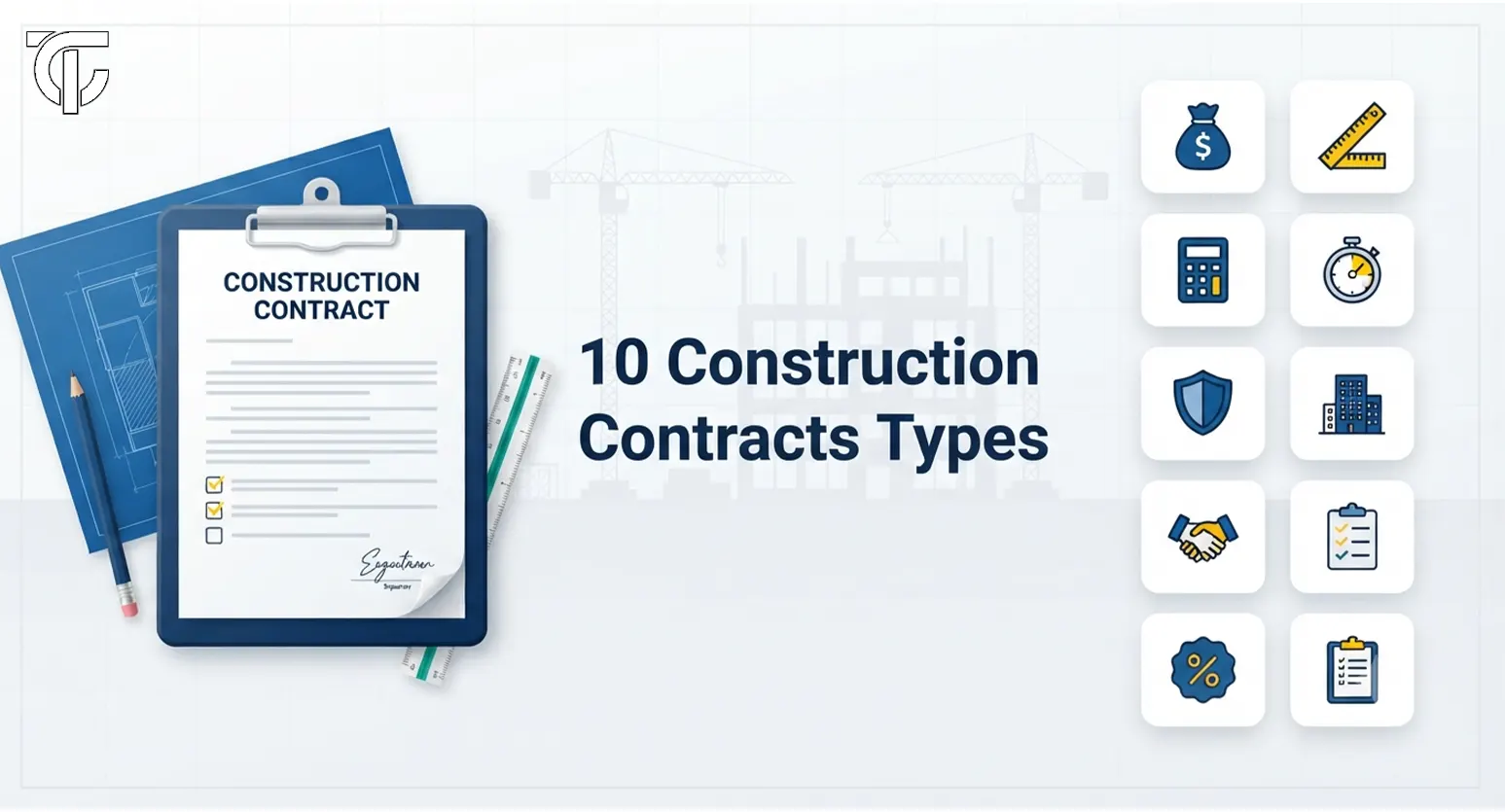
This guide walks through 10 contract types used across residential, commercial, and government projects, each with a practical example, so you can figure out which one actually fits your next job, along with how payment terms, risk allocation, and project budget considerations come into play in nearly every one of them.
What Is a Construction Contract?
A construction contract is a legally binding agreement between an owner and a contractor or between a contractor and a subcontractor that spells out exactly what work will be done, how much it costs, and who’s responsible for what.
At its core, every contract needs to define the scope of work: the specific tasks, materials, and standards the project must meet. Without a clear scope, contractors and owners often disagree about what was actually promised. That disagreement usually surfaces halfway through the job, right when it’s most expensive to fix.
Beyond scope, a solid contract typically includes:
- Contract Documents: Drawings, specifications, and any referenced standards defining the work.
- Payment Terms: How and when the contractor gets paid.
- Construction Schedule: Milestones, deadlines, and completion dates.
- Contractor Responsibilities: Labor, materials, permits, safety compliance.
- Owner Responsibilities: Site access, approvals, timely payments.
- Contract Clauses: Provisions covering delays, changes, disputes, and termination.
Skip any of these, and you’re left guessing. A missing payment schedule leads to cash flow arguments. A vague scope of work invites scope creep. Loose contract clauses around delays mean nobody agrees on who’s at fault when the schedule slips.
Think of the contract as the rulebook for the entire project. Every owner, contractor, and subcontractor refers back to it whenever a decision needs to be made. Get it right at the start, and most day-to-day conflicts resolve themselves because the answer is already written down.
Why Choosing the Right Construction Contract Matters
The contract type you choose affects nearly everything that happens afterward: the budget, the schedule, and how smoothly the project runs day to day.
Financial protection is the most obvious reason to get this right. A fixed-price contract protects an owner from cost overruns, but it can push a contractor to cut corners if the price was bid too low. A cost-plus contract protects the contractor from underestimating expenses, but it removes the owner’s cost certainty. Neither is “better“; the right choice depends on how much risk each side is willing to carry.
Risk management works the same way. Every contract allocates risk somewhere: weather delays, material price increases, unforeseen site conditions. The type of contract you pick decides who absorbs those costs when things don’t go as planned.
Project planning also depends heavily on contract structure. A well-written contract makes it easier to sequence work, coordinate subcontractors, and track progress against a schedule everyone agreed to upfront.
💡 Did You Know?
Disputes are one of the highest hidden costs in construction, and the numbers back this up.
HKA’s 2025 CRUX Insight Report, which reviewed more than 2,200 projects across 114 countries worth a combined $2.43 trillion, found that disputed costs averaged around one-third of total contract budgets, with cash flow and payment issues becoming an increasingly common driver of disputes.
That’s not a small number. Disputes can create significant financial exposure for construction projects, making clear contract terms especially important. A well-defined scope, clear payment schedules, practical change-order procedures, and clearly allocated responsibilities can help reduce uncertainty when issues arise during construction. Choosing an appropriate contract structure from the start and documenting the terms clearly can give both owners and contractors a clearer framework for managing changes, costs, and disputes.
Construction Contract Types
Every project has different needs: budget certainty, speed, flexibility, or shared risk, and different contract types in construction exist to match those needs. Some prioritize cost certainty for the owner. Others give contractors room to adjust as the work progresses. A few are built around collaboration rather than a strict price agreement.
Here are the contract types commonly used across residential, commercial, and government construction projects, along with examples of when each one makes sense.
✅ Contracts Based on Pricing
1. Lump Sum (Fixed Price)
2. Unit Price
3. Cost Plus
4. Time & Materials
5. Guaranteed Maximum Price (GMP)
✅ Contracts Based on Project Delivery
6. Design-Build
7. Integrated Project Delivery (IPD)
✅ Contracts Based on Pricing/Tender Structure
8. Percentage Rate Contract
9. Item Rate Contract
✅ Performance-Based Contract
10. Incentive Contract
1. Lump Sum (Fixed Price) Contract
A lump sum contract sets one fixed price for the entire project before work begins. The contractor agrees to complete everything in the scope of work for that amount, regardless of how their actual costs turn out.
How it works:
The contractor estimates total costs labor, materials, overhead, profit and submits one number. Once signed, that price generally doesn’t change unless the owner requests work outside the original scope.
Best used for:
Projects with a clearly defined scope and stable design, like a residential build with finalized drawings or a small commercial renovation.
Pros & Cons:
| Advantages | Disadvantages |
| Predictable project budget for the owner. | Contractors may cut corners if the price was bid too low. |
| Simple to administer and compare across bids. | Little flexibility if the scope needs to change mid-project. |
| Strong incentive for the contractor to control costs and finish efficiently. | Disputes over what counts as a “change” versus original scope. |
Risk allocation:
The contractor carries most of the cost risk. If material prices spike or the job takes longer than expected, that’s typically the contractor’s problem, not the owner’s.
Real-world example:
A homeowner building a 2,000-square-foot house with completed architectural drawings signs a lump sum contract for $380,000. The contractor delivers the home for that price even if lumber costs rise during construction unless the owner requests upgrades beyond the original plan.
2. Unit Price Contract
A unit price contract breaks the project into measurable units: cubic yards of concrete, linear feet of piping, and square footage of flooring. It sets a price per unit instead of one lump sum.
Payment method:
The contractor gets paid based on the actual quantity of work completed, measured and verified against the bid documents submitted at the start.
Suitable projects:
Work where exact quantities are hard to predict upfront, such as excavation, road construction, or utility installation, where soil conditions or site variables can change the amount of material needed.
Pros & Cons:
| Advantages | Disadvantages |
| Fair pricing when quantities are uncertain at the bidding stage. | Total project costs aren’t fixed until the work is finished. |
| Easier to adjust payment if quantities shift. | Requires careful measurement and verification. |
| Fewer disputes over minor quantity variations. | Owners need to track quantities to avoid overpayment actively. |
Risk allocation:
Quantity estimation risk shifts partly to the owner. If more units are needed than originally estimated, the owner pays for the extra quantity.
Real World Example:
A municipality contracts a firm to install storm drainage pipe at $85 per linear foot. The bid documents estimate 2,000 feet, but soil conditions require rerouting, bringing the actual total to 2,300 feet. The contractor gets paid for all 2,300 feet at the agreed unit rate.
3. Cost Plus Contract
A cost-plus contract reimburses the contractor for actual project costs, labor, materials, and equipment, plus an additional fee covering overhead and profit.
Cost reimbursement:
The owner pays for verified expenses as they occur, usually backed by receipts, invoices, and timesheets.
Fee structures:
The added fee can be a fixed dollar amount, a percentage of total costs, or a fixed fee with an incentive for finishing under a target cost.
Pros & Cons:
| Advantages | Disadvantages |
| Works well when the scope isn’t fully defined yet. | The owner carries most of the cost risk. |
| Less incentive for contractors to cut corners on materials or labor costs. | Requires strong cost control and documentation to avoid overspending. |
| More flexibility to make changes as the project develops. | Total project cost is harder to predict at the outset. |
Risk allocation:
Without close oversight, costs can climb quickly, especially when there’s little incentive for the contractor to manage labor costs and material costs efficiently.
Real World Example:
A commercial renovation with an incomplete design starts under a cost-plus contract with a 15% fee. As the project progresses and design details firm up, the owner and contractor may switch to a guaranteed maximum price for more cost certainty.
4. Time and Materials Contract
A time-and-materials contract pays the contractor based on actual hours worked plus the cost of materials used, rather than a fixed total.
Billing method:
Labor is billed at an agreed hourly or daily rate, and materials are billed at cost, often with a small markup for handling and procurement.
Best situations:
Repair work, small renovations, or projects where the scope isn’t fully known upfront, or a homeowner who says “fix whatever’s causing the leak” without knowing what that will actually involve.
Pros & Cons:
| Advantages | Disadvantages |
| Easy to start work quickly without a detailed scope. | The owner has little cost certainty until the job wraps up. |
| Flexible enough to handle unexpected site conditions. | Requires trust in the contractor’s time-tracking and invoicing. |
| Straightforward billing tied to actual work performed. | Costs can run higher if work drags on. |
Risk allocation:
The owner carries most of the cost risk here. Since payment terms are tied to hours and materials rather than a set price, an inefficient crew or extended timeline directly affects the final bill.
Real World Example:
A plumbing contractor is called in to diagnose and fix a recurring leak in a commercial building. Since the source isn’t known until walls are opened up, the owner agrees to pay $95 per hour for labor plus the cost of materials, capped with a not-to-exceed clause at $6,000.
5. Guaranteed Maximum Price (GMP) Contract
A GMP contract sets a ceiling on what the owner will pay, while still reimbursing the contractor for actual costs up to that maximum.
Maximum cost:
The contractor estimates total project costs and adds a fee, then commits to a cap. Costs below that number pass through to the owner; costs above it are usually the contractor’s responsibility.
Owner protection:
This structure gives the owner the flexibility of a cost-plus arrangement without the open-ended risk; the number can go lower, but it won’t go higher.
Contractor incentives:
Many GMP contracts include a shared-savings clause, where the contractor keeps a percentage of the difference if the project finishes under the guaranteed price.
Pros & Cons:
| Advantages | Disadvantages |
| Combines cost transparency with a hard budget ceiling. | Contractors may build in a cushion when estimating the GMP, raising the initial number. |
| Encourages the contractor to control costs. | Requires detailed cost tracking and open-book accounting. |
| Reduces owner risk compared to a pure cost-plus setup. | Change orders outside the original scope can still increase the cap. |
Real World Example:
A hospital wing renovation is set up as a GMP contract with a cap of $4.2 million. The project finishes at $3.9 million, and under a 50/50 savings split, the contractor keeps $150,000 of the $300,000 difference, with the rest returned to the owner.
6. Design-Build Contract
A design-build contract puts design and construction under a single contract with one point of responsibility, instead of hiring an architect and contractor separately.
Single contract approach:
The owner signs one agreement covering both the design phase and the construction phase, usually with a design-build firm or a contractor partnered closely with an in-house design team.
Collaboration:
Because designers and builders work together from day one, constructability issues tend to surface earlier before they turn into expensive change orders on-site.
Pros & Cons:
| Advantages | Disadvantages |
| Faster overall timeline since design and construction phases overlap. | The owner has less direct control over design decisions. |
| Single point of accountability if problems arise. | Fewer competitive checks since one firm handles both roles. |
| Fewer disputes between separate designers and contractors over who’s at fault. | Requires trust in the design-build team’s judgment. |
Real World Example:
A retail chain expanding into a new city hires a design-build firm for a new store location. The design team and construction crew coordinate from the first site visit, shaving roughly six weeks off the schedule compared to a traditional design-bid-build approach.
7. Incentive Contract
An incentive contract adds performance-based rewards to a base contract price, encouraging the contractor to meet specific targets such as cost, schedule, or quality.
Incentive payments:
These are usually structured as a bonus for finishing early, coming in under budget, or exceeding defined performance standards.
Performance rewards:
Some contracts also include penalties for missing targets, creating a two-sided arrangement rather than a one-way bonus.
Pros & Cons:
| Advantages | Disadvantages |
| Motivates contractors to actively look for efficiencies. | Contractors may prioritize the incentivized metric over other quality considerations. |
| Aligns contractor and owner goals around shared outcomes. | Requires clear, measurable performance standards to avoid disputes. |
| Can shorten project timelines when speed is a priority. | Can get complicated if multiple incentives conflict with each other. |
Real World Example:
A highway repaving project includes a $10,000-per-day bonus for early completion, capped at 15 days, to minimize traffic disruption. The contractor finishes 9 days early and earns a $90,000 incentive payment on top of the base contract price.
8. Integrated Project Delivery (IPD)
IPD is a collaborative contract structure in which the owner, architect, and contractor sign a single agreement and share both risk and reward for the project’s outcome.
Shared responsibilities:
Instead of separate contracts with separate liabilities, all key parties are bound by one agreement and work toward shared project goals from day one.
Collaborative planning:
Design, budgeting, and scheduling decisions are made jointly, often through regular sessions involving the owner, designers, and builders together rather than in separate silos.
Pros & Cons:
| Advantages | Disadvantages |
| Encourages early problem-solving before issues become expensive. | Requires a high level of trust and coordination between parties. |
| Aligns incentives across everyone involved in the project. | More complex to set up than traditional contract structures. |
| Reduces adversarial disputes since all parties share the outcome. | Not well suited for owners who prefer strict separation of responsibilities. |
Real World Example:
A university partners with an architecture firm and a general contractor under an IPD agreement to build a new research facility. All three parties share a project pool of funds, with savings or overruns split according to a pre-agreed formula, encouraging everyone to solve problems collaboratively rather than pointing fingers.
9. Percentage Rate Contract
A percentage rate contract pays the contractor a percentage above or below an estimated project cost, commonly used in government and public works bidding.
Pricing method:
Contractors bid a percentage, say 8% above or 3% below, relative to a department’s estimated cost for the work, rather than submitting a standalone total price.
Suitable projects:
Common in public infrastructure and government tenders where a standardized estimate already exists and bidders compete on their percentage variation from it.
Pros & Cons:
| Advantages | Disadvantages |
| Simplifies the bidding process against a known baseline estimate. | Relies heavily on the accuracy of the original cost estimate. |
| Easy to compare bids across multiple contractors. | Less flexibility if actual site conditions differ from assumptions. |
| Transparent method commonly required for public procurement. | Not commonly used outside public sector projects. |
Real World Example:
A state transportation department estimates a bridge repair at $2 million. A contractor bids “4% below estimate,” committing to complete the work for $1.92 million based on the department’s baseline figures.
10. Item Rate Contract
An item rate contract, also known as a schedule of rates contract, sets a fixed price for each item of work, with the final total based on actual quantities completed.
Unit-based pricing:
Similar to a unit price contract, each work item brickwork, plastering, flooring has its own predetermined rate.
Measurement process:
Quantities are measured on-site as work progresses, and the contractor is paid according to verified measurements against the agreed rate for each item.
Pros & Cons:
| Advantages | Disadvantages |
| Works well for projects where exact quantities can’t be finalized in advance. | Requires ongoing measurement and verification, adding administrative work. |
| Offers pricing transparency for each work item. | Total cost isn’t confirmed until the project is complete. |
| Allows adjustments without renegotiating the entire contract. | Disputes can arise over measurement accuracy. |
Real World Example:
A public school renovation uses an item rate contract with rates set for flooring at $12 per square foot and painting at $2.50 per square foot. As renovation scope expands to include an additional classroom wing, the contractor is paid using the same agreed rates rather than renegotiating a new price.
Construction Contract Comparison Table
| Contract Type | Best For | Risk Allocation | Cost Certainty | Flexibility | Main Advantage | Main Disadvantage |
| Lump Sum (Fixed Price) | Well-defined, stable-scope projects | Contractor | High | Low | Predictable budget | Little room for scope changes |
| Unit Price | Projects with uncertain quantities | Shared | Medium | Medium | Fair pricing for variable work | Total cost unknown until completion |
| Cost Plus | Projects with undefined or evolving scope | Owner | Low | High | Flexible as scope develops | Owner carries most cost risk |
| Time & Materials | Repairs, small or unclear-scope jobs | Owner | Low | High | Fast start, no detailed scope needed | Costs can run high without a cap |
| Guaranteed Maximum Price (GMP) | Mid-to-large projects needing a cost ceiling | Shared | Medium – High | Medium | Cost cap with shared savings | Contractors may pad the cap upfront |
| Design-Build | Fast-track projects needing single accountability | Contractor | Medium | Medium | Faster overall timeline | Less owner control over design |
| Incentive Contract | Projects prioritizing speed or performance | Shared | Medium | Medium | Motivates efficiency and early finish | Can shift focus from other quality factors |
| Integrated Project Delivery (IPD) | Complex projects needing deep collaboration | Shared | Medium | High | Aligned incentives, fewer disputes | Requires high trust and coordination |
| Percentage Rate Contract | Public sector and government tenders | Contractor | Medium | Low | Simple, transparent bidding | Depends on accuracy of baseline estimate |
| Item Rate Contract | Projects with items measured as work proceeds | Shared | Medium | Medium | Transparent per-item pricing | Requires ongoing measurement and verification |
This table is meant as a quick reference; pull it up when comparing options for a specific project rather than re-reading every section above.
Different Forms of Construction Contracts
Not every project fits neatly into one category. Larger or more complex jobs often combine contract structures depending on procurement strategy, budget constraints, and how much risk each party is willing to take on.
- Procurement method plays a big role here. A government project might require competitive bidding under a percentage rate structure. At the same time, a private commercial build might favor a negotiated GMP contract based on an existing relationship with a contractor.
- Project delivery method also shapes which contract makes sense. Design-bid-build projects typically pair with lump sum or unit price contracts, since design is finalized before pricing. Design-build and IPD projects, by contrast, often use cost-plus or GMP structures because design and construction overlap.
- Contract flexibility matters most on projects where scope isn’t fully known at signing. A renovation with unknown existing conditions might start as time and materials, then shift to a fixed price once the scope is confirmed after demolition reveals what’s actually behind the walls.
📌 The Takeaway: Contract types aren’t always locked in from day one. Many real projects blend elements of two structures, or transition from one to another as the design and site conditions become clearer.
How to Choose the Right Construction Contract
The right contract depends on the project type, not a one-size-fits-all rule. Here’s how that plays out across common project categories:
- Residential Homes: A lump sum contract usually works best once drawings are finalized, since homeowners generally want cost certainty and a fixed number to budget against.
- Commercial Buildings: GMP or design-build contracts are common, especially when the owner wants cost control but also needs design flexibility as the project develops.
- Renovation Projects: Time and materials or cost-plus contracts often make more sense here, since existing conditions behind walls or under floors aren’t fully known until demolition begins.
- Government Projects: Percentage rate or unit price contracts are typical, largely because public procurement rules often require transparent, competitive bidding against a baseline estimate.
- Infrastructure Projects: Unit price or item rate contracts fit well, since quantities like earthwork, piping, or paving are hard to pin down exactly before groundwork starts.
- Fast-track Projects: Design-build or IPD contracts help compress timelines by letting design and construction overlap instead of running sequentially.
The pattern across all of these is that the more uncertain the scope of work at signing, the more flexibility the contract needs to allow for.
Common Mistakes When Choosing a Construction Contract
Even experienced owners run into the same handful of problems when selecting a contract type:
- Choosing based only on price: The cheapest bid isn’t always the safest one; a contractor bidding unrealistically low on a lump sum job may cut corners later to protect their margin.
- Poorly defined scope of work: Vague language around what’s included leads to disagreements the moment something falls into a gray area.
- Ignoring change orders: Contracts that don’t spell out how changes get approved and priced tend to generate disputes the first time the scope shifts.
- Weak payment terms: Unclear payment schedules create cash flow problems for contractors and trust issues for owners.
- Ignoring risk allocation: Signing a contract without understanding who absorbs cost overruns, weather delays, or material price spikes is asking for trouble later.
- Poor documentation: Contracts without clear contract documents, drawings, specs, and referenced standards leave too much open to interpretation.
- Unrealistic schedules: A construction schedule that doesn’t account for permitting delays or material lead times sets the project up to fail from day one.
Change orders deserve extra attention here because they’re becoming more common, not less.
📈 A 2026 Dodge Construction Network and Clearstory study found that 48% of general contractors reported an increase in change order frequency.
That trend makes one thing clear: Contracts without a defined change-order process are increasingly likely to run into friction. A short clause outlining how changes are requested, priced, and approved can prevent much of the back-and-forth that otherwise slows a project down.
Best Practices for Managing Construction Contracts
Signing a solid contract is only half the job; managing it well afterward matters just as much.
- Contract administration means someone on the team is actually responsible for tracking obligations, deadlines, and deliverables instead of letting the contract sit in a drawer after signing.
- Change orders should follow a clear, written process: request, cost estimate, approval, then a documented change to the contract. Skipping any step tends to create disputes later.
- Documenting daily logs, photos, correspondence, and inspection reports protects both sides if a disagreement ever needs to be resolved.
- Communication between owner, contractor, and subcontractors should be regular and, ideally, in writing. Verbal agreements about scope changes are difficult to enforce later.
- Progress tracking against the construction schedule helps catch delays early, while they’re still manageable, rather than discovering a problem near the deadline.
- Contract compliance and dispute resolution clauses round things out. Knowing in advance whether disagreements go to mediation, arbitration, or litigation saves time and legal costs if a conflict does arise.
- Payment verification matters more than most people realize. According to PYMNTS Intelligence, research published in 2026 found that around 70% of contractors and subcontractors regularly experience payment delays.
That statistic points to a real, ongoing problem in the industry. Clearly defined payment terms, invoicing schedules, retainage percentages, and approval timelines reduce the chance of disputes and help keep cash flow steady for the contractors doing the work.
👉To explore more practical guides, planning strategies, and best practices for successful project execution, visit our Project Management articles on The Concrete Talk.
Final Thoughts
Every construction project comes with its own scope, budget, and risk profile, which is exactly why no single contract type works for every situation.
Choosing the right one comes down to how well-defined the project is, how much flexibility it needs, and how much risk each party can reasonably take on. Get that match right, and it becomes far easier to control costs, avoid disputes, and keep the project moving toward a successful finish.
Before signing anything, take the time to evaluate the project’s scope, budget, timeline, and risk tolerance. That upfront review is what separates a smooth project from one that ends up in a dispute over something that should have been spelled out from the start.
Frequently Asked Questions
What is the most commonly used construction contract?
Lump sum contracts are the most widely used, particularly for residential and smaller commercial projects where the scope of work is well-defined before construction starts.
How do I choose the right construction contract for a project?
Start by assessing how well-defined the scope is, how much risk each party is willing to take on, and how much flexibility the project needs. A fixed scope favors lump sum; an uncertain one favors cost-plus, time and materials, or GMP.
Which construction contract places the most risk on the contractor?
Lump sum contracts place the most risk on the contractor, since they’re responsible for absorbing any cost overruns once the price is set.
What should every construction contract include?
At minimum, a clear scope of work, payment terms, a construction schedule, defined contractor and owner responsibilities, and contract clauses covering delays, changes, and disputes.
Can a construction contract be modified after it has been signed?
Yes, through a formal change order process. Most contracts require written approval and an agreed cost or schedule adjustment before any modification takes effect.