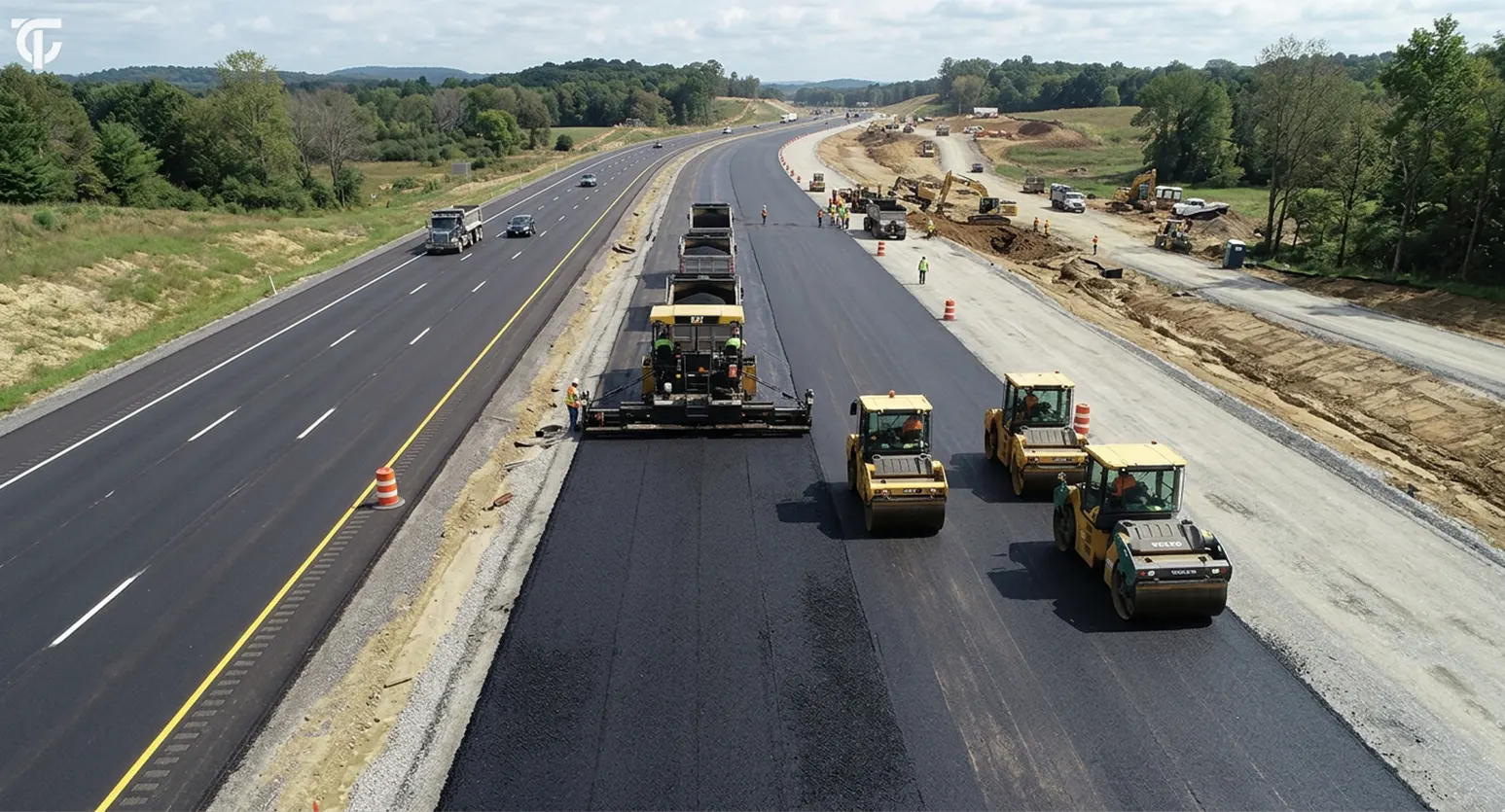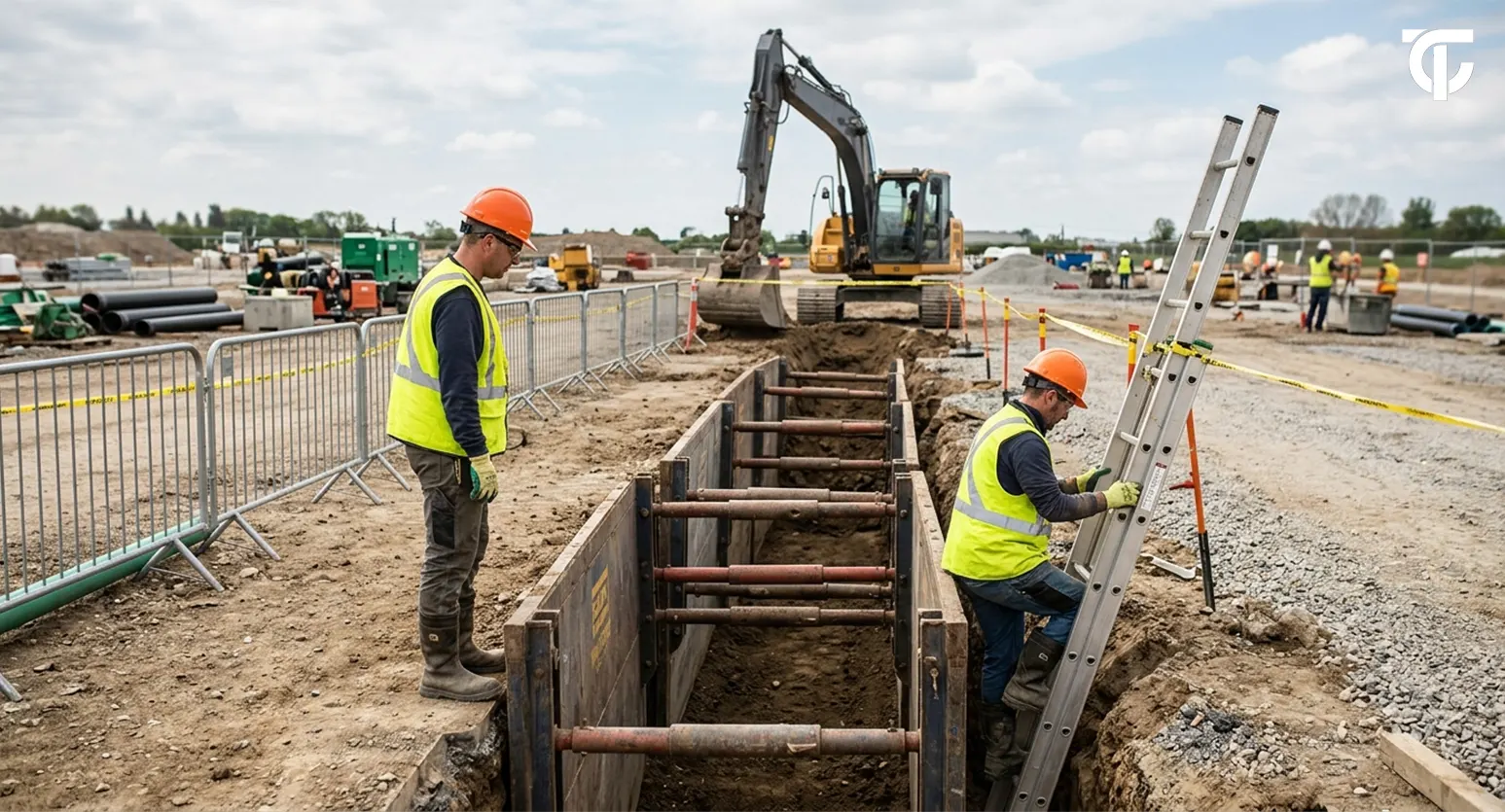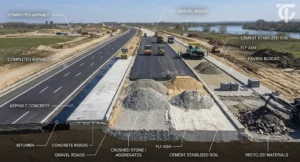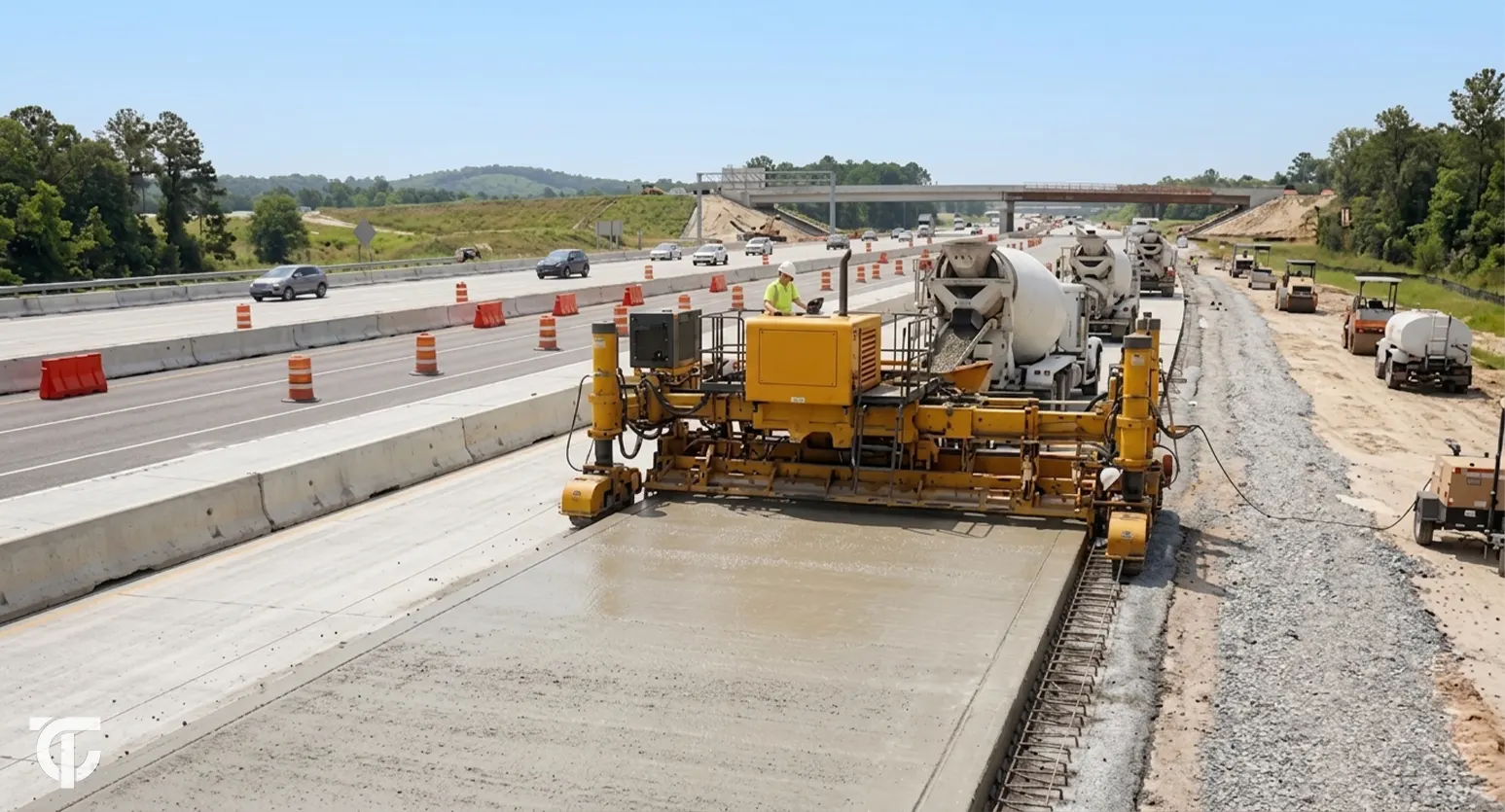

Every time a truck rolls onto an interstate on-ramp or a city bus pulls away from a downtown intersection, the pavement underneath is doing real structural work. In the United States, concrete road construction is one of the ways engineers meet that demand, especially on stretches of highway where heavy, repeated traffic and long-term performance matter most.
Concrete pavement isn’t a single, one-size-fits-all system. The design changes depending on traffic volume, climate, soil conditions, and how an agency plans to maintain the road over the years ahead. A rural county road and a busy interstate corridor won’t necessarily use the same pavement structure, even if both happen to be built with concrete.
This article looks at how concrete actually functions within a road, where it tends to show up across the U.S. network, and why engineers select it for certain projects rather than treating it as a default choice. Along the way, we’ll break down what a concrete pavement system consists of, the different pavement types in use today, and how the construction process actually unfolds on site.
What Role Does Concrete Play in U.S. Road Construction?
At its core, concrete pavement acts as the rigid layer that carries and distributes traffic loads. When a vehicle moves across the road, its wheels apply a load to the surface. That load has to go somewhere, and in a concrete pavement system, the slab itself absorbs and spreads that force before passing a reduced load down to the layers underneath.
This is different from just pouring concrete on the ground and calling it a road. A concrete pavement is an engineered system with several working parts:
- A prepared subgrade that provides the foundation.
- A base or subbase layer where the design calls for one.
- The concrete pavement slab itself.
- Joints and, in some designs, reinforcement.
- Drainage and other supporting features.
Each piece plays a role in how the pavement performs under traffic loading over time. FHWA technical material identifies Portland Cement Concrete (PCC), reinforcing steel, joint load-transfer devices, and joint-sealing materials among the basic components associated with rigid pavement systems.
Pavement design determines exactly how thick the slab needs to be, what materials go into it, and how joints or reinforcement get laid out. None of this is arbitrary; it’s based on the loads the road is expected to carry and how long it needs to perform before major rehabilitation is required. Repeated wheel loads, in particular, are a key factor engineers weigh when sizing a concrete pavement for a given corridor.
Where Is Concrete Used in U.S. Road Construction?
Concrete pavement doesn’t show up everywhere, and it isn’t meant to. Where it does get used usually comes down to traffic volume, load type, and how critical long-term performance is to that specific corridor. Some of the more common contexts include:
High-traffic Highways
Where repeated heavy traffic and pavement performance are priorities, concrete is one of the materials engineers consider.
Interstate and Highway Corridors
The U.S. Interstate Highway System carries an enormous share of the country’s freight and passenger traffic, which makes it an important context for concrete pavement. However, that doesn’t mean every interstate mile is built with concrete.
Urban and High-traffic Routes
Depending on local agency requirements and pavement design, certain urban routes with heavy or repeated traffic can also use concrete.
Intersections and Areas with Repeated Heavy Loading
Locations where vehicles are constantly braking, accelerating, or idling under load, like signalized intersections, face different stresses than a straight stretch of open highway, and that can influence pavement selection.
Industrial and Heavy-duty Areas
Concrete shows up in some industrial and heavy-duty applications as well. However, it isn’t universally preferred in that context either.
💡 Did You Know?
According to FHWA’s Our Nation’s Highways 2026 Report, People in the United States traveled more than 3.3 trillion vehicle-miles on public roads in 2024.
That volume of traffic places enormous demand on the entire road network, asphalt and concrete alike. It doesn’t mean concrete is the automatic answer wherever traffic is heavy; it simply illustrates why pavement selection is such a consequential decision, with agencies weighing project-specific factors for each corridor individually.
What Does a Concrete Road Consist Of?
This is where it helps to move past “concrete” as a single word and look at the road as a full system. A concrete road isn’t just a slab sitting on the ground; it’s a layered structure, and each layer has a job to do.
Subgrade
The subgrade is the natural or prepared soil foundation the entire pavement structure sits on. Before anything else happens, crews grade and compact this layer to create stable, uniform support. If the subgrade isn’t consistent, the layers built on top of it won’t perform consistently either, which is why this often-overlooked step matters as much as anything that happens later in construction.
Base or Subbase
Not every concrete pavement uses the same foundation setup. Depending on the project, a base or subbase layer sits between the subgrade and the concrete slab, and it can serve a few different purposes: extra structural support, improved drainage, or protection against subgrade movement. The specific design depends on site conditions and what the pavement needs to handle; there’s no single, universal configuration used on every project.
Concrete Pavement Slab
The concrete pavement slab is the principal rigid layer, the part most people actually picture when they think of a “concrete road“. This is the layer that carries and distributes traffic loads directly. Its thickness and the properties of the concrete mix aren’t guesswork; they’re determined through pavement design based on expected traffic and performance requirements.
Joints and Load-Transfer Features
Concrete pavement includes joints by design, not by accident. Transverse joints run across the road, while longitudinal joints run along it, and both help manage how the slab handles shrinkage and temperature-related movement.
Two components often get confused here: Dowel bars and tie bars.
- Dowel bars are used for load transfer across transverse joints; they help one slab share load with the next.
- Tie bars, on the other hand, are meant to hold adjacent slabs or lane sections together; they aren’t designed to serve as the primary load-transfer device.
FHWA specifically draws this distinction, and mixing the two up is a common misunderstanding worth avoiding.
Types of Concrete Pavement Used in the United States
“Concrete road” doesn’t refer to just one design. In practice, U.S. agencies build several different types of concrete pavement, and each one handles joints, reinforcement, and cracking a little differently.
1. Jointed Plain Concrete Pavement (JPCP)
JPCP is built as a series of concrete slabs separated by transverse joints, spaced at regular intervals. It generally doesn’t rely on continuous structural reinforcement running through the slab. Instead, dowels may be placed at transverse joints to help transfer load from one slab to the next, and tie bars may be used at longitudinal joints to hold adjacent lanes together.
FHWA describes JPCP as the most common type of concrete pavement being constructed today, and notes that the use of dowels or tie bars depends on how the joints in a given design are configured.
2. Jointed Reinforced Concrete Pavement (JRCP)
JRCP takes a different approach. It includes reinforcement within the slab itself, which allows for longer spacing between joints than you’d typically see in JPCP. That reinforcement doesn’t eliminate cracking between joints; its job is to help control those cracks and keep them tight once they form.
3. Continuously Reinforced Concrete Pavement (CRCP)
CRCP skips conventional transverse contraction joints altogether. Instead, it uses continuous longitudinal reinforcement running the length of the pavement. That doesn’t mean the slab stays crack-free; controlled transverse cracks still develop, but the reinforcement holds them tightly together so they don’t widen into a structural problem. Some agencies use CRCP on high-traffic urban routes, an application FHWA specifically notes.
Beyond these three main types, a few specialized systems show up in specific situations:
Prestressed or precast concrete pavement, and concrete overlays such as whitetopping, where a concrete layer is placed over an existing pavement. These are worth knowing about, but they’re a smaller part of the overall picture next to JPCP, JRCP, and CRCP.
Concrete Road Construction Process
Understanding how concrete road construction actually happens on site helps explain why the finished pavement behaves the way it does. It isn’t a single step; it’s a sequence, and rushing or skipping any part of it can affect how the pavement performs for years afterward.
Site Preparation and Subgrade Work
Before any concrete gets placed, crews handle surveying and layout, clear the site where needed, and grade the area to the design profile. The subgrade then gets compacted to achieve the uniform support the pavement design calls for. This stage doesn’t get much attention in most conversations about concrete roads, but it sets the tone for everything built on top of it.
Preparing the Base or Subbase
Where the design includes one, the base or subbase gets placed, graded, and compacted next. Depending on the project, this layer may be there to add structural support, improve drainage, or both. How well this foundation performs directly affects how the concrete pavement performs later. A well-prepared base gives the slab consistent support, while an inconsistent one can create problems down the line.
Concrete Mix and Quality Requirements
Pavement concrete isn’t the same mix you’d use for a sidewalk or a foundation wall; it’s engineered specifically for the loads and conditions a road has to handle.
That means paying close attention to aggregate selection, cementitious materials, water content, and admixtures, all balanced to hit the right workability, strength, and durability. Pavement quality isn’t just about compressive strength, either. Flexural strength is how well the slab resists bending under load matters just as much in pavement design.
FHWA research identifies compressive strength, flexural strength, and other material properties as relevant to how concrete pavement performs over time. Concepts like water-cement ratio and air entrainment also come into play, particularly when a pavement needs to hold up in freeze-thaw climates.
Concrete Placement and Finishing
Once the mix is ready, it gets delivered and placed according to the project’s paving method, whether that’s slipform paving or another approach. Paving equipment spreads and consolidates the concrete, bringing the surface to the grade and profile the design specifies. From there, finishing and texturing work shapes the surface characteristics the pavement needs, including the texture that affects skid resistance once traffic starts using the road.
Curing
Curing isn’t a formality; it’s the process that protects fresh concrete while it develops the strength and durability it’s designed for. Controlling moisture and temperature during this window matters a lot, because early-age conditions can influence how the pavement performs for years afterward. Proper curing supports strength development over time; it doesn’t make the concrete instantly stronger the moment it’s applied.
FHWA identifies environmental conditions and construction operations among the factors that affect how concrete pavement performs, which is part of why curing gets so much attention in project specifications.
Joint Formation and Load Transfer
Joints exist because concrete naturally wants to crack as it shrinks and reacts to temperature changes. Rather than let that happen randomly, engineers plan joint layout as part of the pavement design, giving the concrete predictable places to crack instead. Dowels, where used, help transfer loads across transverse joints, while tie bars serve a different purpose, holding adjacent slabs together rather than transferring load. FHWA lays out this distinction clearly in its pavement guidance.
Quality Control and Opening to Traffic
Before a new concrete road opens, it typically goes through material testing, thickness and grade checks, and surface quality evaluation. Strength and performance requirements have to be met, and the specific project specifications determine when the pavement is actually ready for traffic; there’s no universal number of days that applies across every project. Some pavements can open sooner than others, depending on the mix design, curing conditions, and the specifications set for that particular job.
Why Are American Roads Made of Concrete?
It’s a fair question, especially if you’ve noticed concrete showing up on certain stretches of highway and not others. The short answer isn’t that concrete is “better“; it’s that concrete offers a specific combination of structural and performance characteristics that make sense for particular roads and applications. Engineers choose it when those characteristics line up with what a project needs.
Heavy Traffic and Repeated Loads
Concrete pavement can provide high structural capacity, which matters most on roads that see repeated wheel and axle loading over time. Freight corridors and truck routes, in particular, put a road through a lot of repeated stress, and pavement engineers factor that traffic loading into their material and design decisions.
That said, heavy traffic alone doesn’t automatically mean a road gets built with concrete. Plenty of heavily trafficked corridors use asphalt too. Traffic volume is one input among several that shapes the final decision, not a rule that decides it on its own.
Resistance to Rutting and Deformation
Concrete and asphalt behave differently under load. Asphalt is a flexible material, while concrete’s rigid structure gives it resistance to permanent deformation commonly known as rutting under appropriate design conditions. That doesn’t mean concrete never deforms; every pavement material has limits, and poor design, inadequate support, or unusual loading can still cause problems in a concrete pavement.
Durability and Long-Term Performance
Concrete pavement can be designed with long-term performance in mind, but “can be” is the operative phrase; actual performance depends on the materials used, the design itself, local climate, traffic levels, and how well the pavement was built in the first place. Even a well-designed concrete road still needs maintenance over its life. Left unaddressed, ordinary pavement distress can shorten a road’s service life and eventually call for rehabilitation work.
Climate and Environmental Conditions
U.S. pavement design has to account for a wide range of environmental conditions, including freeze-thaw cycles, thermal expansion and contraction, moisture, and exposure to deicing chemicals in colder regions.
FHWA explains that air entrainment, tiny air bubbles introduced into the concrete mix, helps improve resistance to freeze-thaw deterioration. In contrast, joint sealing helps keep water from working its way into joints during thermal movement.
Concrete isn’t automatically ideal for every U.S. climate. Instead, pavement design and materials get selected with local climate and environmental exposure specifically in mind, which is one more reason a “one design fits all states” mindset doesn’t hold up in practice.
👉🏻 Curious about what other materials are used to build roads? Explore our guide on different types of road materials to see how concrete, asphalt, and other options compare and where each one is commonly used.
What Makes U.S. Road Design Different?
There’s no single, universal way that concrete road construction in the US happens. Different states, agencies, and individual projects make different choices, shaped by their own traffic patterns, climate, soil conditions, and budget realities. A few things drive that variation:
- Highway Agencies: State DOTs and local agencies each maintain their own specifications and design standards, which means practices can differ from one state line to the next.
- Traffic and Climate Differences: A pavement designed for a freeze-thaw climate in the Midwest faces different demands than one built for a hot, dry Southwestern corridor.
- Available Materials: Local aggregate sources and material availability can influence mix design and, in some cases, which pavement type gets used.
- Design and Cost Considerations: Agencies weigh construction cost, expected traffic, and maintenance strategy differently depending on the project and their long-term budget priorities.
Because of all this, it’s misleading to describe any single construction method as “the American way” of building a concrete road. What actually happens is closer to a shared set of engineering principles applied differently, project by project, based on what that specific road needs to handle.
How Much Concrete Pavement Is Actually Used in the USA?
When we talk about concrete pavement in the US at a national level;
FHWA’s 2024 national summary classified 53,354 miles of public roads as Concrete Pavement.
That figure comes from Highway Statistics 2024, Table HM-12. It covers all 50 States along with Puerto Rico and the District of Columbia.
However, FHWA itself notes that some of the underlying data may be incomplete, and some figures involve estimation.
It’s worth being precise about what that classification actually includes. FHWA’s concrete category isn’t limited to one pavement type; it covers JPCP, JRCP, and CRCP, along with unbonded jointed concrete overlays, bonded PCC overlays, and other applications such as whitetopping.
In other words, “Concrete Pavement” in national statistics represents a fairly broad family of pavement systems, not one uniform design applied everywhere.
Concrete Pavement vs. Asphalt Pavement
Neither material comes out as the clear winner across the board; the right choice depends on the specific project. Here’s how the two generally compare:
| Factors | Concrete Pavement | Asphalt Pavement |
| Structural Behavior | Rigid | Flexible |
| Heavy Loading | Can perform well under heavy loads | Also widely used for heavy traffic |
| Rutting/Deformation | Generally resistant to rutting under appropriate design | Can be more susceptible to permanent deformation under some conditions |
| Construction | Different placement and curing requirements | Different paving and compaction process |
| Initial Cost | Project-dependent | Project-dependent |
| Maintenance | Different repair and rehabilitation needs | Different repair and rehabilitation needs |
| Service Life | Design and project dependent | Design and project dependent |
| Climate | Requires climate-specific design | Also requires climate-specific design |
The takeaway isn’t that concrete beats asphalt, or the other way around. The appropriate pavement material depends on traffic, climate, site conditions, construction requirements, cost, and long-term performance goals, and that’s exactly why agencies use both materials extensively across the U.S. road network, often within the same state or even the same corridor.
👉🏻 Want a closer look at Asphalt Pavement? Read our detailed guide to asphalt pavement to learn how it is constructed, where it is commonly used, and what factors affect its performance over time.
Concrete Road Maintenance and Common Problems
No pavement material is maintenance-free, and concrete is no exception. Understanding what typically goes wrong and how agencies address it gives a more honest picture than treating concrete pavement as an install-it-and-forget-it solution.
Joint-Related Problems
Joints are necessary, but they’re also where a lot of maintenance issues start. Over time, joint deterioration can develop, sealants can fail or wear out, and faulting, where one side of a joint sits slightly higher or lower than the other, can show up as traffic passes over the joint repeatedly.
Surface and Slab Problems
Cracking can appear beyond the joints that were designed to control it, particularly if the subgrade shifts, the mix wasn’t right for the conditions, or the load exceeds what the pavement was designed for. Spalling, small chunks breaking away near joints or cracks, and general surface deterioration are other common issues agencies watch for during inspections.
Rehabilitation
When problems do show up, the fix depends on what’s actually wrong. Options range from targeted repairs and slab replacement to diamond grinding, which restores a smoother riding surface, or overlays in situations where that approach makes sense.
There isn’t one universal treatment that solves every type of concrete pavement distress; the right fix depends on the specific problem, its extent, and the pavement’s overall condition.
How Long Do Concrete Roads Last in the United States?
This is one of the most natural questions to ask, and it doesn’t have a single, tidy answer. There’s no universal lifespan that applies to every concrete road in the country.
It helps to separate two different ideas here: Design Life and Actual Service Life.
Design life is the performance period a pavement is engineered for. Actual service life is how long it really lasts in practice, which can end up longer or shorter depending on real-world conditions. A handful of factors shape that outcome, including the original design, traffic levels, the materials used, local climate, drainage, how well the pavement was built, and how consistently it’s been maintained.
Because so many variables are involved, this isn’t the place to hand you a blanket number like “concrete roads last 40 to 50 years“. That kind of claim sounds authoritative, but it glosses over just how much a road’s actual lifespan depends on its specific circumstances. Any credible service-life figure needs to be tied to a specific agency, pavement type, or study, not treated as a universal fact.
Role of Concrete Pavement Technology in the U.S. Roads
Concrete pavement today isn’t built the same way it was decades ago. U.S. practice has evolved through better pavement design methods, improved joint layouts, and a stronger understanding of how subgrade and base support affect long-term performance.
Air-entrained concrete is one example of that evolution, a development that specifically improved how pavements hold up against freeze-thaw damage. Construction practices have also advanced, including fast-track and rapid construction approaches that let agencies reopen roads to traffic sooner without cutting corners on quality.
On the rehabilitation side, techniques like diamond grinding and specialized overlay systems give agencies more options for extending a pavement’s service life instead of starting over from scratch.
None of this is meant as a full history lesson. The point is simpler:
Modern Concrete Pavement is the product of decades of engineering refinement, not a static material that’s been built the same way forever.
Advantages and Limitations of Concrete Pavement
Advantages
- Durability, when designed and built appropriately for the project.
- Resistance to rutting and deformation under proper design conditions.
- Strong performance under heavy, repeated loads.
- Long-term performance potential.
- Depending on the design and project, some maintenance activities may occur less frequently than with other pavement types.
Limitations
- Initial construction costs can run higher on some projects.
- Curing time affects when the pavement can open to traffic.
- Joint-related maintenance is an ongoing consideration.
- Construction quality has a significant effect on how the pavement performs.
- Repairs, when needed, can be more involved than with some other pavement types.
- Climate and design factors have to be accounted for during planning.
It’s tempting to boil this down to “concrete costs more“, but that’s an oversimplification. Initial and lifecycle costs are project-specific and depend on design, materials, construction, traffic, and maintenance requirements, not a fixed rule that applies to every job.
Final Thoughts
Concrete road construction isn’t about one material beating another; it’s about matching a pavement system to what a specific road actually needs to handle. Traffic volume, climate, subgrade conditions, and long-term maintenance plans all factor into that decision, which is why concrete shows up on some corridors and not others across the U.S. network.
Understanding how concrete pavement works from the layers beneath the slab to the joints that manage cracking makes it easier to see why agencies choose it for certain projects. It’s not a universal answer, and it was never meant to be one. It’s one well-engineered option among several, selected when its particular strengths fit the job at hand.
Frequently Asked Questions
Why are American Roads Made of Concrete?
Concrete gets used where heavy traffic, structural capacity, and durability line up with what a specific project needs. Its resistance to deformation makes it a fit for certain highway segments, intersections, and heavy-load applications, but the decision is always project-specific. Concrete is selected for certain roads and applications where its performance characteristics fit the project requirements, not because American roads are generally built from concrete.
Is Concrete Better Than Asphalt for U.S. Roads?
Neither material is universally better. The right choice comes down to traffic levels, climate, site conditions, cost, maintenance planning, and the performance an agency expects from that particular road.
What Types of Concrete Pavement Are Used in the United States?
The three main types are Jointed Plain Concrete Pavement (JPCP), which uses transverse joints without continuous reinforcement; Jointed Reinforced Concrete Pavement (JRCP), which adds reinforcement to allow longer joint spacing; and Continuously Reinforced Concrete Pavement (CRCP), which skips conventional joints in favor of continuous reinforcement that holds controlled cracks tightly together.
How Long Do Concrete Roads Last in the United States?
There’s no universal number. Design life and actual service life aren’t the same thing, and real-world performance depends on the specific project’s design, traffic, materials, climate, and maintenance history.
Where Are Concrete Roads Commonly Used in the U.S.?
Concrete shows up on certain Interstate and highway sections, high-traffic routes, heavy-load corridors, intersections that see repeated braking and acceleration, and some industrial or heavy-duty applications. That doesn’t mean every road in these categories is built with concrete; it simply reflects where concrete tends to be a strong contender when agencies are weighing pavement options.