
Walk past a building with a jagged, sculpted roofline or a façade that seems to twist upward like something carved rather than built, and you’re probably looking at German Expressionist Architecture. This style didn’t play by the usual rules of straight lines and predictable symmetry. Instead, it treated buildings almost like large-scale sculpture shapes stretched, compressed, or angled to create a strong emotional reaction the moment you see them.
In early 20th-century Germany, a group of architects decided that a building’s job wasn’t just to stand up and serve its function. It could also make you feel something. That idea shaped a movement now studied for its bold, almost theatrical approach to form.
This article breaks down 10 defining traits that make German Expressionist Architecture instantly recognizable, from distorted geometry to expressive brickwork, using real buildings as examples. By the end, you’ll know exactly what to look for the next time you come across a building that doesn’t look like anything else.
What Is German Expressionist Architecture?
German Expressionist Architecture is a design movement that emerged in Germany in the early 1900s, growing directly out of Expressionist painting and visual art. Where Expressionist painters distorted color and form to convey raw emotion, architects working in this style tried to do something similar with buildings, using shape, texture, and mass to communicate feeling rather than just function.
This wasn’t architecture built purely for practicality. Architects associated with German Expressionist Architecture wanted their buildings to carry symbolic weight, almost like standalone works of art. A structure might reference something spiritual, dramatic, or even utopian, depending on the architect’s vision.
What sets this movement apart is its willingness to break from convention. Straight lines and standard proportions took a back seat to unusual geometry, sculptural massing, and forms that seemed inspired by nature, crystals, or pure imagination. Some of these ideas became real, physical buildings. Others stayed on paper, existing only as visionary sketches meant to challenge what architecture could look like.
The movement found its strongest foothold in Germany in the years around World War I, when a wave of artistic experimentation reshaped how architects thought about design.
How German Expressionist Architecture Emerged
By the early 1900s, plenty of German Architects had grown tired of sticking to the same rigid, symmetrical templates. Expressionist painting was already breaking rules around color and form, and it didn’t take long for that same restless energy to spill over into architecture.
Architects started asking a different question: What if a building could express something, the way a painting or sculpture does?
World War I and the years that followed only intensified that restlessness. The upheaval surrounding the war and its aftermath formed an important cultural backdrop for Expressionist experimentation. However, it didn’t single-handedly cause the movement. Some architects tied their ideas to bigger social visions, imagining new kinds of buildings for what they hoped would be a better, more idealistic society.
Not every one of these ideas made it off the drawing board, and that’s actually part of the story. Between 1919 and 1920, a group known as the Gläserne Kette, or Glass Chain, exchanged visionary architectural drawings and letters exploring bold, imaginative designs. Records held by the Deutsche Digitale Bibliothek document this correspondence, including work connected to architects like Bruno Taut and Hermann Finsterlin.
The Glass Chain wasn’t a construction program; it was a network of architects trading ideas and sketches, pushing each other toward more experimental thinking. That distinction matters, because it shows Expressionism was as much about imagination as it was about anything actually built.
10 Defining Traits of German Expressionist Architecture
These traits often overlap. A single building may display several at once, and not every Expressionist building will show all ten. Think of them less as a checklist and more as a set of recurring tendencies you’ll start noticing once you know what to look for.
1. Dramatic Distortion of Conventional Forms
German Expressionist Architects often moved away from simple rectangular geometry, predictable symmetry, and conventional building proportions. Instead of a building that looks like a straightforward box, you get forms that appear stretched, compressed, angled, curved, or sharply articulated.
That said, “distortion” doesn’t mean the building looks unstable or randomly shaped. It means architects deliberately transformed familiar architectural forms to create a stronger visual and emotional effect. The goal was impact, not chaos.
You can see this kind of unconventional building geometry in the Einstein Tower. This structure reads more like a sculpted object than a typical building. Erich Mendelsohn developed the Einstein Tower in the early 1920s, and its curved, almost molten profile marks a clear departure from architectural convention. It’s a strong early example of the dramatic architectural composition this movement became known for.
2. Sculptural and Unusual Building Massing
Distortion and massing are related, but they’re not the same thing. Where the first trait is about bending or reshaping individual forms, this one is about how the overall building mass reads as a single sculptural object.
Instead of treating a building like a simple box, Expressionist Architects shaped volumes that appear carved, moulded, or assembled from distinct sculptural parts. The façade and the building’s mass work together, so the whole structure reads as a visual object first and a functional space second.
This kind of sculptural building design shows up across Mendelsohn’s broader body of work, where volume itself becomes the main event rather than a backdrop for surface decoration.
3. Organic and Crystalline Inspiration
A lot of Expressionist Architecture pulls inspiration from natural or even imagined forms caves, mountains, rock formations, crystals, plants, and flowing, biomorphic shapes. You’ll notice architects reaching for these references instead of sticking to rigid, man-made geometry.
Not every curved building deserves the “organic” label, though. The connection has to go deeper than a rounded corner or a curved wall. Architects working this way wanted their buildings to feel alive and dynamic, carrying an emotional charge that a purely mechanical, conventional structure couldn’t match.
This kind of organic-inspired architecture often overlaps with biomorphic forms and sculptural façades, and it ties back to the same experimental spirit that fuelled visionary groups like the Glass Chain architects imagining structures that behaved more like living forms than static buildings.
4. Emotional and Symbolic Expression
This is arguably the most important trait on this list, conceptually speaking. A building designed under Expressionist principles wasn’t just there to provide space and satisfy a function. It could also communicate mood, emotion, symbolic meaning, cultural ideas, or even spiritual and utopian aspirations.
At its core, Expressionism took an inner, emotional experience and gave it an external, physical form. That’s a fairly ambitious goal for a building to carry, and it’s part of what makes this style feel so different from more restrained architectural movements.
It’s worth being careful with how far you take this idea, though. Not every Expressionist building hides some deep symbolic meaning waiting to be decoded. It’s more accurate to say that many Expressionist Architects used architectural form to create emotional or symbolic effects, sometimes subtle, sometimes dramatic, but rarely universal across the entire movement.
5. Gothic and Medieval Influences Reinterpreted
Expressionist architects didn’t build in a vacuum. Many drew inspiration from Gothic Architecture, Medieval Forms, Romanesque Traditions, and Historical Craftsmanship.
But here’s the key part: They weren’t copying medieval buildings. They were reinterpreting elements of that history through modern experimentation.
Influence isn’t the same as imitation, and that distinction matters here. You’ll see this reinterpretation in pointed forms, towers, strong verticality, dramatic silhouettes, and the mystical or spiritual associations Gothic architecture has always carried.
It would be inaccurate to call German Expressionism a revival of Gothic architecture. It borrowed a mood and a handful of recognizable elements of Expressionist design, then pushed them somewhere entirely new, filtered through early 20th-century experimentation rather than historical reproduction.
6. Expressive Brickwork and Material Artistry
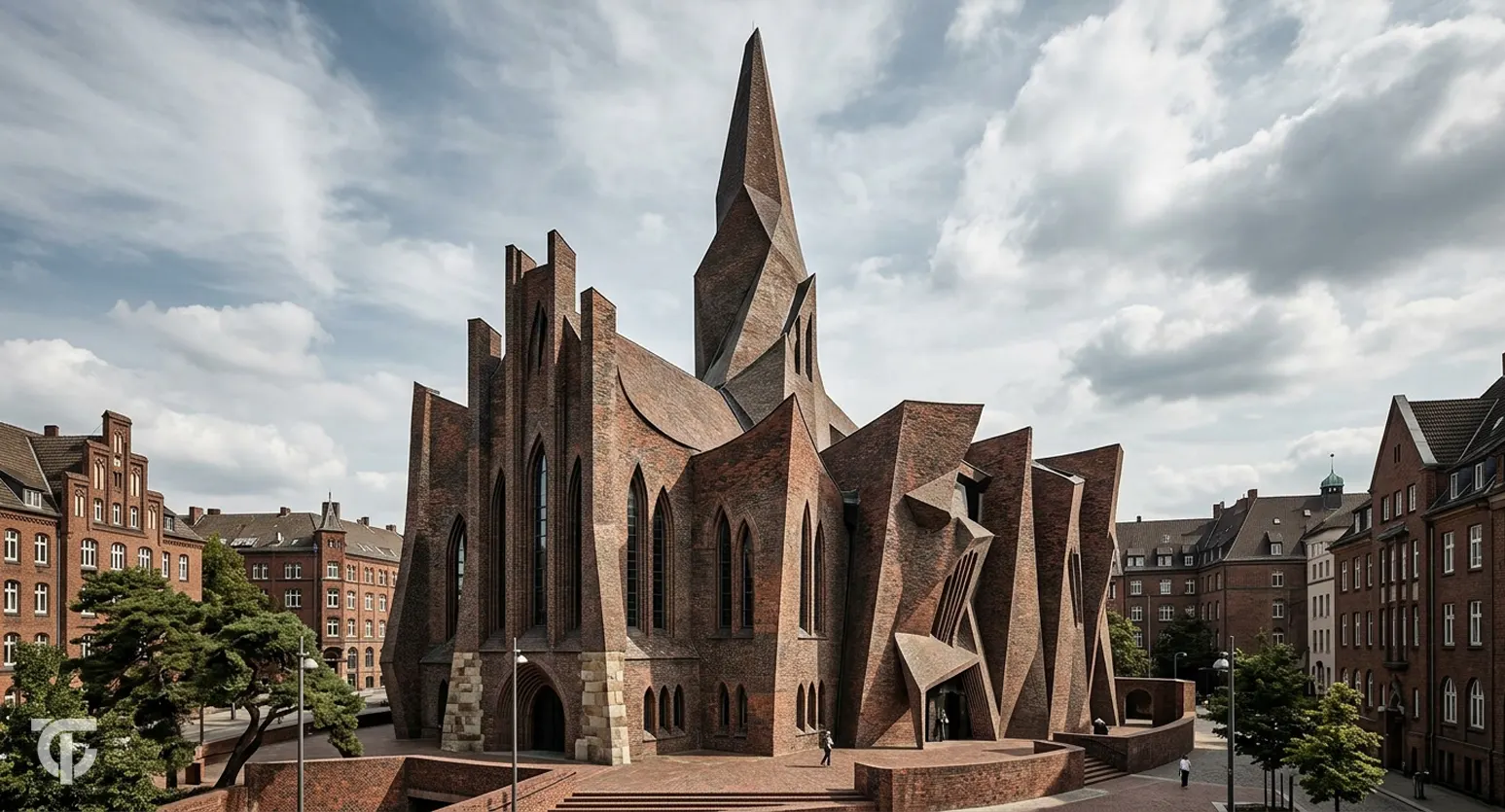
Not every German Expressionist building relied on sweeping curves or sculpted concrete. In parts of northern Germany, architects expressed the same restless, artistic spirit through brick instead. Brick Expressionism became one important regional expression of the broader movement, built around clinker brick, ornamental brickwork, and detailed masonry.
Here, the façade itself carries the artistry. You’ll find textured surfaces, decorative patterns, and sculptural reliefs worked directly into the brick, turning what’s normally a purely structural material into something closer to a canvas.
Hamburg’s Chilehaus is the building most people point to when discussing this trait. Designed by architect Fritz Höger and built between 1922 and 1924, it’s widely treated as an icon of Expressionist brickwork.
The scale of the façade detailing becomes easier to appreciate once you look at the numbers behind it. Chilehaus has 2,800 windows, and according to the building’s official history, Henry Brarens Sloman purchased 4.8 million bricks for the project.
Those aren’t just impressive figures for their own sake; they help explain why the building’s brick detailing feels so dense and deliberate rather than incidental. Producing that kind of texture and pattern across a structure this size required enormous material and careful craftsmanship.
7. Dramatic Verticality and Dynamic Lines
Height and direction matter a lot in this style. Towers, strong vertical emphasis, pointed forms, and rising silhouettes show up again and again, often paired with angular or flowing lines that create a real sense of visual movement.
Verticality does a lot of work here. A building that reaches upward with sharp, deliberate lines tends to feel taller than it is, while also feeling more dramatic, dynamic, and monumental. That’s part of why so many Expressionist structures lean into height rather than sprawling horizontally.
The Einstein Tower is another useful example, this time for its rising, pointed profile rather than its overall massing. Its silhouette pulls your eye upward, contributing to the same dynamic building silhouettes and dramatic architectural composition you’ll notice across other towers from this period.
8. Dramatic Use of Light, Glass and Surface
Expressionist experimentation wasn’t limited to a building’s shape. Architects also explored how light, glass, reflection, and surface texture could change the way a structure felt throughout the day. Shadow, transparency, and shifting visual effects became design tools in their own right.
Glass carried real symbolic weight in parts of Expressionist architectural thinking, tied to ideas about clarity, spirituality, and transformation. That’s worth keeping separate from how glass gets discussed in later movements like Bauhaus, where transparency was mostly about function and efficiency. Expressionist architects could treat glass and light as expressive elements, using them to create mood and atmosphere rather than simply letting daylight into a room.
The result is architecture that changes character depending on how light hits it, a quality that adds to the experimental façades and overall visual impact of architecture this movement is known for.
9. Architecture as an Artistic or Social Statement
By this point, it’s clear that German Expressionist Architecture was never just about visual style. For some architects, it was tied to bigger questions about art, society, and what buildings could mean for the people living around them.
This is where the movement connects most directly to utopian architectural visions. Some Expressionist Architects and groups linked architectural experimentation with broader utopian or social ideas, imagining buildings that could help shape a better, more idealistic future rather than simply meeting practical needs.
The Glass Chain fits naturally into this trait. The Deutsche Digitale Bibliothek documents Glass Chain material as visionary architectural designs and drawings from 1919 to 1920, created by architects who saw building design as connected to social reform through architecture, not just aesthetics.
German Expressionism was part of a broader tradition of architectural experimentation, one where form, materials, and new construction ideas could challenge conventional design altogether.
For a broader look at how experimental architecture uses materials such as GFRC, steel, carbon fiber, CLT, and other emerging options, readers can explore our guide to avant-garde architecture materials.
10. Individuality Over Strict Design Rules
This last trait ties everything else together, and it’s worth sitting with for a second. German Expressionist Architecture doesn’t come with one universal visual formula. Different architects, working with different priorities, produced buildings that look almost nothing alike.
One structure might lean entirely on brickwork. Another emphasizes sculptural, almost carved masonry. A third reaches for dramatic vertical towers, while a fourth stays purely visionary, never leaving the drawing board at all.
The movement is better understood through recurring tendencies than through a single fixed architectural template. That’s exactly why individual artistic expression sits at the heart of this style: It rewarded architects who pushed toward genuinely experimental architectural design, rather than converging on one shared look.
So, with all ten traits on the table, how do you actually spot German Expressionist Architecture in the wild? Tell us in the comments below!
How to Recognize German Expressionist Architecture at a Glance
If you’re standing in front of an unfamiliar German building and trying to figure out whether it fits this style, run through a few quick questions.
- Does the building reject ordinary geometry? Look for curves, sharp angles, unusual proportions, or forms that feel deliberately distorted rather than standard.
- Does the building feel sculptural? Ask yourself whether it reads as a visual object in its own right, rather than a simple box with a function.
- Is there strong visual movement? Watch for vertical lines, pointed forms, dynamic silhouettes, and dramatic massing that pull the eye in a particular direction.
- Does the façade have unusually expressive detail? This includes brick patterns, textured masonry, sculptural details, or windows that break from a standard grid.
- Is there an obvious emotional or symbolic quality? Does the building seem to be reaching for a particular mood, rather than just enclosing space?
- Does it reinterpret historical forms rather than copy them? Keep an eye out for Gothic or medieval references that have been reworked into something more modern.
- Is there evidence of experimental architectural thinking? This could show up in unusual geometry, surfaces, materials, light, or spatial arrangement.
No single feature automatically proves that a building is Expressionist. The classification depends on the building’s broader design language, historical context, and architectural intent, which is exactly why the case studies coming up next are so useful.
Two Buildings That Show Expressionist Traits in Practice
Reading about traits in the abstract only gets you so far. Looking at two real buildings that took very different approaches makes the whole style click into place.
Einstein Tower, Potsdam
Erich Mendelsohn developed and designed the Einstein Tower during the early 1920s, and it remains one of the most sculptural, expressive buildings associated with this movement. Rather than looking like a conventional observatory, the tower reads more like a single flowing form, with curves that seem to pour from one section into the next.
Function and form come together here in an unusual way. The building wasn’t just an artistic gesture; it served a genuine scientific purpose. Research activity at the Einstein Tower began in 1924, tied to an astrophysical research complex focused on solar observation. Official Potsdam planning documentation places its construction within the 1919 to 1924 window, describing its role as both a telescope tower and a solar research facility.
It’s worth being careful with a couple of common claims about this building. Rather than pinning the tower to one exact construction date, it’s more accurate to describe it as developed and constructed during the early 1920s, since official sources use slightly different date conventions. And while Mendelsohn explored ideas around reinforced concrete in his design thinking, the building’s actual construction history is more nuanced than simply calling it “a reinforced-concrete building“.
Chilehaus, Hamburg
Where the Einstein Tower leans into a sculptural, almost organic form, Chilehaus takes a completely different path: Expressive brickwork rather than curved plaster.
Architect Fritz Höger designed Chilehaus, and it was built between 1922 and 1924 as a large-scale commercial office building in Hamburg. Its most famous feature is the ship-like, pointed eastern end, which gives the whole structure a sense of forward motion despite being a solid, static building. Detailed craftsmanship runs throughout the façade, making this one of the best-known examples of Brick Expressionism anywhere in Germany.
The numbers behind Chilehaus help explain why the brickwork feels so intricate. The building has 2,800 windows, and according to its official history, Henry Brarens Sloman purchased 4.8 million bricks for the project. Chilehaus received protected building status on 27 September 1983, recognizing its architectural and historical significance.
Its heritage status extends even further. Chilehaus is part of the Speicherstadt and Kontorhaus District, which was inscribed on the UNESCO World Heritage List in 2015. That’s a meaningful distinction: The listing covers the broader historic district, not Chilehaus as a standalone site.
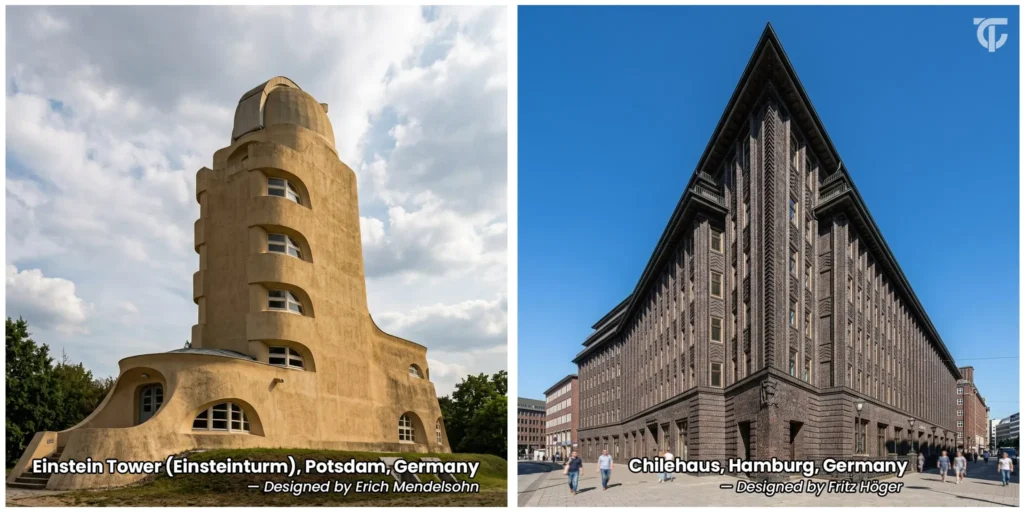
Einstein Tower vs. Chilehaus: Two Different Sides of Expressionism
| Comparison | Einstein Tower | Chilehaus |
| Architect | Erich Mendelsohn | Fritz Höger |
| Location | Potsdam | Hamburg |
| Period | Early 1920s | 1922–1924 |
| Architectural Character | Sculptural, organic character | Brick Expressionism |
| Building Function | Observatory, scientific function | Commercial office building |
| Design Approach | Experimental form | Expressive masonry |
| Key Visual Quality | Strong architectural plasticity | Strong façade craftsmanship |
Side by side, these two buildings barely look like they belong to the same movement. That’s actually the point. German Expressionist Architecture never settled on one signature look, and comparing these two structures makes that individuality obvious rather than theoretical.
Why German Expressionist Architecture Still Matters
This movement pushed back against conventional geometry at a time when most architecture stuck closely to established rules. That willingness to experiment made architecture more expressive, opening the door for visual emotion to matter just as much as function.
Craftsmanship and experimentation didn’t have to compete with each other, either. Buildings like Chilehaus show that intricate, labor-intensive detail work and bold artistic ambition could coexist in the same structure.
Even the ideas that never made it past the drawing board played a role. Visionary, unbuilt designs expanded what architects believed a building could be, feeding into later generations of experimental thinking. The buildings that did survive continue to shape how architects approach form today, proving that a century-old movement can still influence modern design conversations.
Final Thoughts
German Expressionist architecture is easier to recognize once you know what to look for. Distorted forms, sculptural massing, and organic or crystalline inspiration all point toward the same underlying goal: Making a building feel like more than just a functional container.
Emotion and symbolism run through this style, alongside reinterpreted medieval references and expressive brickwork that turns ordinary materials into art. Verticality, experimental light, and unusual surfaces add even more range to what counts as Expressionist.
Above all, this movement valued individuality over strict rules. That’s exactly why buildings as different as the Einstein Tower and Chilehaus both belong under the same umbrella and why German Expressionist architecture still rewards a closer look today.
Frequently Asked Questions
What is German Expressionist Architecture?
German Expressionist architecture is an early 20th-century architectural movement from Germany that treated buildings as artistic and emotional statements rather than purely functional spaces. Architects working in this style leaned into unusual forms, sculptural massing, and experimental thinking to give buildings a stronger visual and emotional presence.
What are the defining traits of Expressionist architecture?
A few characteristics show up again and again: dramatic distortion of conventional forms, sculptural building massing, organic or crystalline inspiration, emotional and symbolic expression, and expressive brickwork. Dramatic verticality and an emphasis on individuality over strict design rules round out the strongest, most recognizable traits.
How many German Expressionist buildings still exist today?
There’s no single reliable total for surviving German Expressionist buildings, so it’s best to avoid treating any specific number as authoritative. What’s clear is that surviving examples exist across several German cities, with Berlin, Hamburg, and Potsdam among the places known for notable buildings. Preservation varies from building to building, and some structures, including Chilehaus, hold official protected or heritage status.
It’s also worth remembering that some of the movement’s most visionary designs were never built in the first place, so they were never part of any surviving count to begin with.
Who were the leading German Expressionist architects?
Erich Mendelsohn designed some of the movement’s most sculptural built work, including the Einstein Tower. Fritz Höger became closely associated with Brick Expressionism through projects like Chilehaus. Hans Poelzig contributed to the era’s experimental architectural thinking.
At the same time, Bruno Taut and Hermann Finsterlin are better known for visionary, correspondence-based ideas connected to groups like the Glass Chain rather than large-scale construction projects.
What made the Einstein Tower’s design so innovative?
Erich Mendelsohn designed the Einstein Tower in the early 1920s as a highly sculptural, almost flowing structure, which was unusual for a building meant to serve a scientific purpose.
It functioned as part of an astrophysical research complex, connecting experimental architectural expression directly to real scientific research rather than treating the artistic form as decoration alone.
Why is the Chilehaus in Hamburg considered a brick-expressionist icon?
Fritz Höger designed Chilehaus, built between 1922 and 1924, using expressive brick detailing across its entire façade. Its pointed, ship-like eastern end remains one of the most recognizable features in Brick Expressionist architecture.
The building has 2,800 windows, and according to its official history, 4.8 million bricks were purchased for the project. Chilehaus is also part of the Speicherstadt and Kontorhaus District, which received UNESCO World Heritage status in 2015, reinforcing its significance within this architectural style.