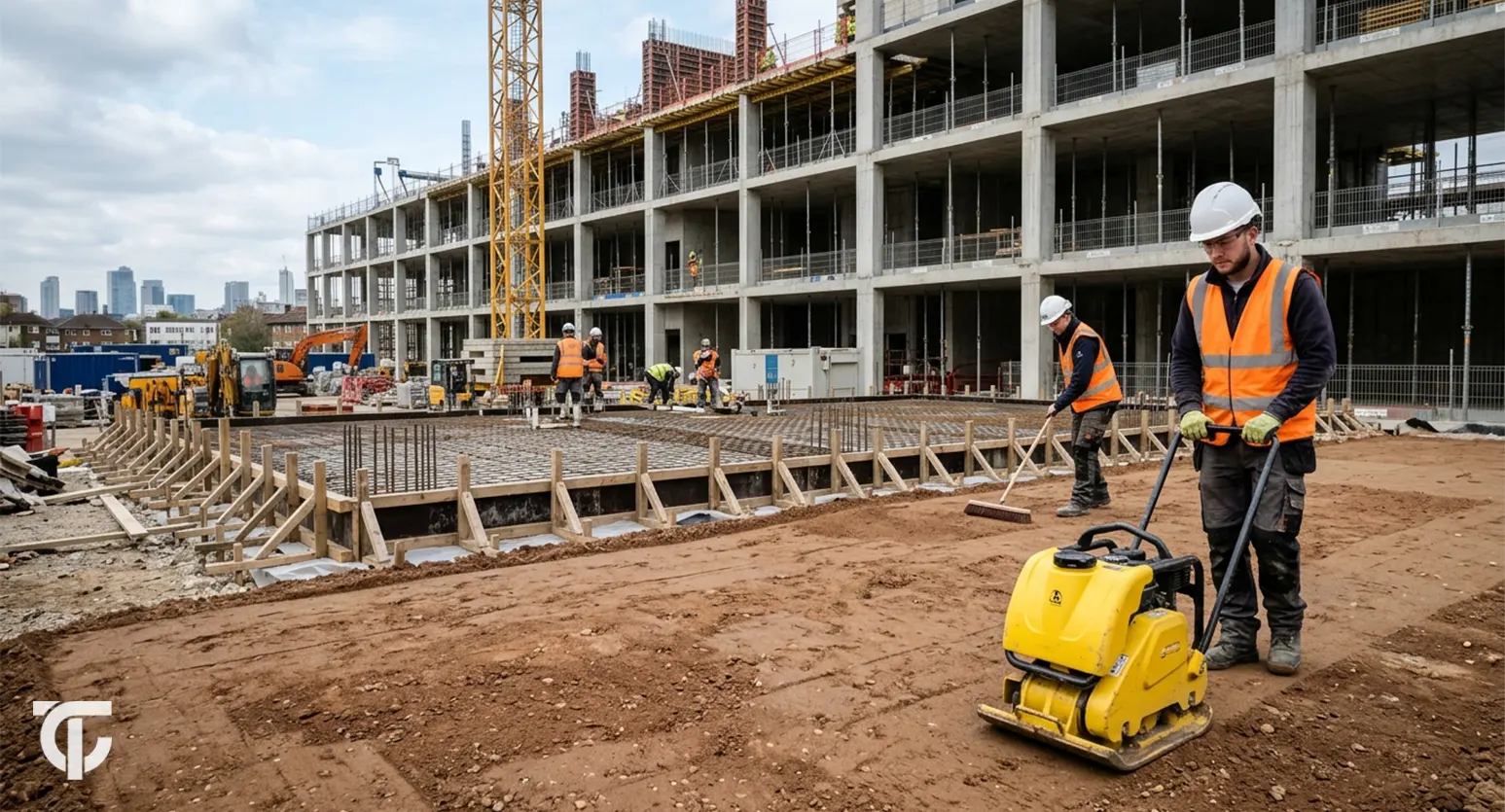

People often judge concrete slabs and pavements by what they can see: cracking, settlement, joint performance, surface finish, and durability. Yet many performance problems begin beneath the concrete, where subgrade quality determines how evenly loads transfer and how the structure responds to moisture and seasonal changes.
A well-designed concrete section can still perform poorly if it sits on weak, disturbed, poorly compacted, or moisture-sensitive soil. Proper subgrade preparation is therefore not simply an earthworks activity. It is an important part of concrete performance.
Start by Understanding What Is Beneath the Slab
The term subgrade generally refers to the prepared soil surface or subsurface that supports the pavement, slab, or overlying granular base. Its performance depends on more than soil type. Important considerations include:
- Soil Strength and Stiffness
- Moisture Content
- Degree of Compaction
- Presence of Uncontrolled Fill
- Organic or Otherwise Unsuitable Material
- Groundwater and Drainage Conditions
- Frost Susceptibility
- Variability Across the Construction Area
Two areas that appear similar at the surface may behave very differently under load.
For example, one portion of a building pad may consist of dense native granular soil. At the same time, another contains several feet of variable fill. If you don’t identify and address that difference, the finished concrete may be supported unevenly.
Early geotechnical engineering services can help establish the subsurface profile and identify conditions that may require excavation, improvement, drainage measures, or engineered fill before concrete work begins.
Remove Unsuitable and Disturbed Material
Concrete should not be placed over soil simply because the required elevation has been reached. The exposed subgrade should be reviewed for unsuitable conditions such as:
- Soft or Pumping Soil
- Loose Fill
- Organic Material
- Frozen Ground
- Standing Water
- Heavily Disturbed Soil
- Localized Weak Zones
Excavation equipment and construction traffic can disturb otherwise competent soils, particularly fine-grained materials when they are wet.
Identify soft spots before installing base material or reinforcement. Depending on the conditions, corrective work may involve removing and replacing unsuitable material, drying or moisture-conditioning the soil, recompaction, or using stabilization or reinforcement where appropriate.
Once subsequent layers are placed, identifying and correcting a weak subgrade becomes more difficult and expensive.
👉 Proper ground preparation is equally important when constructing foundations. If you want to understand how strip foundations transfer building loads to the supporting soil, read our guide to what a strip footing foundation is.
Moisture Content Matters as Much as Compaction
Compaction specifications are often expressed as a percentage of the material’s laboratory maximum dry density. However, density alone doesn’t tell the whole story. The soil’s moisture condition during compaction is critical.
If cohesive soil is excessively dry, achieving the specified density may require substantial compactive effort and may still produce an inconsistent fill. If it is excessively wet, the soil may pump, rut, or deform under construction equipment rather than compact properly.
Moisture-sensitive clay soils deserve particular attention. Rainfall or uncontrolled site drainage can significantly reduce their near-surface strength, even if the material was previously acceptable. Construction sequencing should therefore minimize how long prepared subgrades remain exposed.
Engineered Fill Should Be Placed in Controlled Lifts
Where fill is required beneath slabs or pavements, it should be placed as engineered fill rather than deposited to grade.
Successful fill placement typically depends on controlling:
- Material Type
- Lift Thickness
- Moisture Content
- Compaction Equipment
- Required Density
Placing lifts that are too thick can produce a compacted surface while leaving the lower portion of the lift inadequately densified. This condition may not be obvious during construction but can contribute to future settlement.
The appropriate lift thickness depends on the soil type and compaction equipment being used. Granular material compacted with heavy vibratory equipment behaves differently from cohesive soil compacted with a padfoot roller or smaller equipment in confined areas.
Field Testing Confirms Whether the Work Meets the Design Intent
Visual observation is useful, but it cannot reliably confirm compaction. Field density testing provides objective information on whether placed material meets specified requirements before it is buried beneath the next lift or the concrete section. A typical quality-control program may include:
- Laboratory Moisture-density Relationships
- Field Density and Moisture Testing
- Observation of Fill Placement
- Evaluation of Questionable Areas
- Documentation of Test Locations and Results
Testing frequency should reflect the project specifications, fill variability, placement rate, and consequences of inadequate compaction.
For contractors and project teams, timely construction material testing can identify deficiencies. In contrast, the affected material remains accessible and relatively easy to correct.
Testing is not merely about producing a passing result. It is providing information early enough for the construction team to act on it.
Drainage Is Part of Subgrade Performance
A properly compacted subgrade can deteriorate if water is allowed to accumulate. Positive drainage should be maintained throughout construction so that precipitation and runoff are directed away from prepared areas. Where water becomes trapped beneath a slab or pavement system, it can contribute to:
- Softening of Moisture-sensitive Soils
- Loss of Subgrade Support
- Pumping of Fines
- Frost-related Movement in Cold Climates
- Localized Settlement
The granular base above the subgrade can improve load distribution and provide a more uniform working surface. Still, it should not be treated as a substitute for correcting poor underlying soil.
If the subgrade is unstable, simply placing additional aggregate over it may conceal rather than resolve the problem.
Protect the Subgrade After It Is Approved
Subgrade preparation does not end when density testing is completed. Heavy equipment, repeated vehicle traffic, precipitation, freezing temperatures, or utility installation can damage an approved surface before concrete placement.
Therefore, review the final condition if significant construction activity or weather exposure occurred between initial approval and concrete placement. Correct ruts, disturbed areas, standing water, or newly exposed soft zones before proceeding.
This is particularly important for large commercial slabs and exterior concrete pavements, where localized loss of support may not become evident until after the concrete has been placed and loaded.
Good Concrete Performance Begins Below the Concrete
Concrete thickness, reinforcement, strength, and jointing all matter, but the supporting ground remains part of the overall system. A reliable subgrade begins with understanding the soil, removing unsuitable materials, controlling moisture, placing fill in manageable lifts, verifying compaction, and protecting the finished surface.
These steps are relatively straightforward during earthworks. They become much more complicated after reinforcement is installed or concrete is placed. For that reason, one of the most effective ways to reduce future slab and pavement problems is also one of the simplest: make sure the ground is ready before the concrete arrives.
Frequently Asked Questions
What is subgrade preparation before concrete placement?
Subgrade preparation is the process of preparing the soil beneath a concrete slab or pavement to provide a stable foundation. It includes removing unsuitable material, controlling moisture, compacting the soil, and inspecting the prepared surface before placing concrete.
Why is subgrade compaction important for concrete slabs?
Proper compaction helps create more uniform support beneath a concrete slab. Inadequate compaction can let soil or fill settle, potentially causing cracking, uneven surfaces, and localized loss of support.
How does soil moisture affect subgrade preparation?
Soil moisture affects how effectively a material can be compacted. Excessively wet or dry soil may not achieve the specified density under the intended compaction procedure, so moisture conditioning may be necessary.
What happens if concrete is placed on an unstable subgrade?
An unstable subgrade can provide uneven support and may contribute to differential settlement, cracking, or localized deformation. The actual effects depend on the soil conditions, concrete design, loading, and other factors.
Is subgrade compaction tested in the field?
Field density and moisture tests can help determine whether compacted soil or fill meets the project’s specified requirements. Testing methods and frequency depend on the material, project specifications, and applicable standards.
Why is drainage important beneath concrete slabs and pavements?
Proper drainage helps prevent water from accumulating in or around the supporting soil. Excess moisture can weaken susceptible soils, reduce support, and contribute to movement or other performance problems.