
Digging a trench sounds straightforward until the ground gives way. Excavation work is routine on almost every construction project, from utility installation to building foundations, but it exposes workers to hazards that can turn deadly within seconds. Cave-ins and trench collapses are the most serious of these risks, though they’re far from the only ones.
Underground utilities, falling materials, heavy equipment, hazardous atmospheres, standing water, and falls into open trenches all add to the danger, which is why excavation safety rules exist in the first place.
Getting excavation work safety rules right takes more than digging carefully. It means proper site inspection, the correct protective systems, safe access, utility verification, and hazard control that continues throughout the job, not just before the first shovel hits the ground. These rules for safe excavation cover every stage of that process.
This guide walks through 12 practical rules that workers and site teams can apply on site.
Why Excavation Safety Matters
Excavation hazards can turn fatal in seconds, which is exactly why following the right rules matters so much.
According to OSHA, 11 trench-related fatalities had already been reported in 2025 as of July 28 of that year.
That number alone shows this isn’t a theoretical risk; it’s an active, ongoing problem on job sites right now. Proper protective measures matter before a single worker steps into an excavation, not after something goes wrong. The rules below exist because cutting corners on inspection, protective systems, or basic hazard awareness has real, immediate consequences.
12 Safety Rules for Excavation Work that Every Worker Should Know
The following rules cover the hazards that come up most often on excavation sites, from what’s underground to what’s overhead. Some are tied to specific U.S. OSHA requirements, which we’ll flag clearly since regulations vary by country. Together, they’re meant to be practical enough to apply on an actual job site, not just check boxes on paper.
- Have a Competent Person Inspect the Excavation
- Identify Underground Utilities Before Digging
- Protect Workers From Cave-Ins
- Provide Safe Access and Egress
- Keep Spoil Piles and Materials Away From the Excavation Edge
- Keep Heavy Equipment and Vehicles Away From Excavation Edges
- Protect Workers From Falling or Rolling Materials
- Prevent Falls Into the Excavation
- Test for Hazardous Atmospheres When Required
- Control Water Accumulation
- Protect Nearby Structures and Surrounding Areas
- Stop Work When Unsafe Conditions Develop
🛑 Rule 1. Have a Competent Person Inspect the Excavation
A competent person needs to inspect the excavation before anyone starts work inside it. OSHA defines this role as someone capable of identifying existing and predictable hazards and who has the authority to take prompt corrective action when something isn’t right.
That inspection isn’t limited to the hole itself. It should cover the excavation, the adjacent ground, and any protective systems already in place, checking for cracks, water seepage, spoil placement, and anything else that signals instability.
Conditions on a job site rarely stay the same all day. Rain, nearby equipment movement, or a shift in soil behaviour can turn a safe excavation into a dangerous one within hours, so re-inspection after any of these changes isn’t optional. The competent person’s authority matters here too: spotting a hazard means little if that person can’t stop work or order a fix on the spot.
This rule goes beyond a daily inspection checklist. It’s really about hazard recognition paired with the authority to act on what’s found. This distinction comes up again later when we cover what to do if conditions change mid-shift.
🛑 Rule 2. Identify Underground Utilities Before Digging
Every excavation should start with a clear picture of what’s underground. That means checking for electrical lines, gas lines, water and sewer connections, telecommunications cables, and any other buried services before the first cut is made.
Locating these lines isn’t just a formality; crews need to mark and verify them, not assume a utility “probably isn’t there“. Hitting an unmarked line can cause electrocution, a gas leak, fire or explosion, flooding, or a costly service disruption for the surrounding area.
Once utilities are located, excavation methods near them need extra care. Hand-digging or vacuum excavation close to a gas line is a very different approach than running a mechanical excavator through open ground. Planning this step before work begins, rather than reacting once a line is exposed, keeps the crew safer and avoids expensive delays down the line.
🛑 Rule 3. Protect Workers From Cave-Ins
Cave-ins are the single biggest danger in excavation work. OSHA puts it plainly: trench collapses and cave-ins “pose the greatest risk to workers’ lives“. That’s why this rule gets more attention than any other on this list.
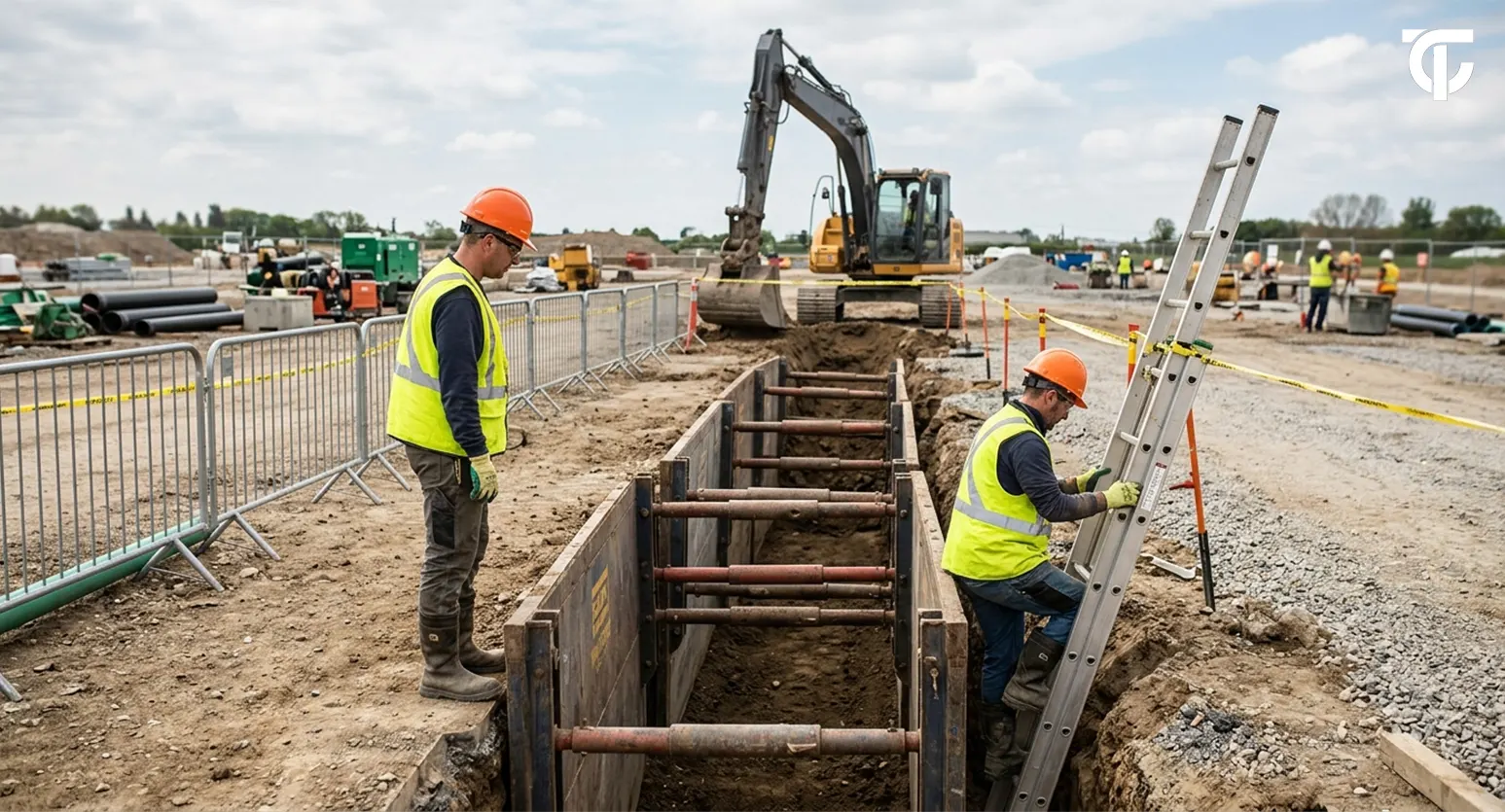
OSHA recommends four main ways to protect workers from cave-ins: sloping, benching, shoring, and shielding.
- Sloping means cutting the excavation wall back at a safe angle so it can’t collapse inward.
- Benching shapes the sides of the excavation into a stepped configuration, spreading out the load instead of concentrating it at one point.
- Shoring uses supports, like hydraulic or timber systems, to hold the excavation walls in place.
- Shielding relies on a trench box or shield to protect workers inside the excavation even if the surrounding soil does give way.
Which method makes sense depends on soil type, moisture, depth, and other site conditions; there’s no single answer that fits every excavation. A crew working in dense clay has different options than one working in loose, sandy soil.
One rule stays constant no matter the soil type: workers should never enter an unprotected excavation where a protective system is required. A trench box sitting unused on the truck bed doesn’t protect anyone.
🛑 Rule 4. Provide Safe Access and Egress
Workers need a safe way to get in and out of an excavation, including a fast way out if something goes wrong. That usually means a ladder, stairway, ramp, or another approved means of egress positioned where crews can reach it quickly.
Under U.S. OSHA requirements, trench excavations 4 feet (1.22 m) or deeper need a stairway, ladder, ramp, or other safe means of egress. That access point has to be close enough that no worker travels more than 25 feet (7.62 m) laterally to reach it. A single ladder at one end of a long trench doesn’t cut it if someone at the far end needs to escape quickly.
A ladder used for access should also be set up according to the applicable requirements for safe access and egress; under U.S. OSHA rules, ladders used for access generally need to extend at least 3 feet above the landing surface.
This requirement reflects U.S. regulations specifically. Other countries and jurisdictions may set different depth thresholds or distance limits, so it’s worth checking local rules rather than assuming this number applies everywhere.
🛑 Rule 5. Keep Spoil Piles and Materials Away From the Excavation Edge
Where the excavated soil ends up matters almost as much as the digging itself; piling spoils right at the edge adds weight the excavation wall wasn’t built to hold, and that extra load can trigger a collapse that wouldn’t have happened otherwise.
There’s a second risk too: Material sitting close to the edge can fall or roll in, striking anyone working below. This isn’t limited to soil; tools, pipes, and stored equipment near the lip of an excavation can create the same hazard.
OSHA’s excavation requirements address materials and equipment that could pose a hazard by falling or rolling into the excavation, and they call for appropriate protection. Under U.S. OSHA requirements, excavated materials or equipment that could fall or roll into an excavation must be kept at least 2 feet from the edge or otherwise restrained with sufficient retaining devices.
This 2-foot requirement reflects U.S. OSHA rules and should not be treated as a fixed global standard. Other countries and jurisdictions may have different requirements, so always check the rules that apply to your site.
🛑 Rule 6. Keep Heavy Equipment and Vehicles Away From Excavation Edges
Heavy machinery near an excavation edge creates a similar problem to spoil piles, just on a much bigger scale. An excavator or loader parked too close adds serious load to ground that’s already been disturbed. That load can be enough to trigger a collapse.
Moving equipment brings its own risks. A truck backing up near an unmarked edge, or an operator with limited visibility around the excavation, can end up putting a vehicle where it shouldn’t be. Establishing clear exclusion zones helps prevent this; barriers, stop blocks, and visible signage all give operators a hard boundary they can see, not just a verbal warning they might forget.
This matters for public traffic too, especially on sites near roads or pedestrian areas. Keeping unnecessary equipment away from the edge and controlling where vehicles are allowed to travel cuts down on struck-by incidents and reduces the load risk at the same time. None of this replaces a full equipment-safety plan, but it’s a piece that gets overlooked more often than it should.
🛑 Rule 7. Protect Workers From Falling or Rolling Materials
This rule is similar to Rule 5, but it’s not the same. Rule 5 is about where spoil piles and stored materials sit relative to the edge. Rule 7 is about actually stopping objects from entering the excavation once work is underway. Tools, pipes, rocks, loose materials, even parts of equipment being used nearby.
Loads being lifted or moved near the excavation deserve extra attention here too. A pipe swinging on a crane, or a stack of materials shifting on uneven ground, can end up falling in without much warning. Securing loose items, keeping unnecessary tools away from the edge, and being deliberate about where materials get staged all reduce this risk.
Workers should also think about where they’re standing, not just what’s around them. Positioning yourself directly below a load being moved, even briefly, puts you in the path of anything that could come loose. It’s a simple habit, but one that gets skipped when a job feels routine.
🛑 Rule 8. Prevent Falls Into the Excavation
Rule 7 covers objects falling in. Rule 8 covers people, workers, or anyone else on site falling into the excavation itself.
Barricades and warning signs around open excavations give people a clear, visible boundary, which matters most in areas with foot traffic or limited visibility. Guardrails add another layer of protection where they’re practical to install. Beyond physical barriers, site layout plays a role too: separating vehicle routes from pedestrian paths, keeping lighting adequate in low-visibility conditions, and restricting access to anyone who doesn’t need to be near the excavation.
It’s worth keeping these three hazards separate in your head, since they call for different fixes. Rule 4 deals with safe entry and exit for workers who are supposed to be in the excavation. Rule 7 covers materials falling in. This rule is about preventing an unplanned fall into the hole altogether by a worker, a visitor, or anyone passing by the site.
🛑 Rule 9. Test for Hazardous Atmospheres When Required
Not every excavation carries an atmospheric risk, but some do, and it’s not always obvious from the surface. Low oxygen levels, toxic gases, flammable vapors, and fumes can all build up in an excavation, sometimes because nearby utility lines or underground services are leaking into the space.
OSHA notes that excavations may present hazardous-atmosphere risks, including conditions that can lead to suffocation, toxic exposure, fire, or other serious harm. Where there’s reason to suspect one of these conditions: deep excavations, proximity to gas lines, or a history of contamination on the site, for example- testing should happen before workers go in, not after someone starts feeling unwell.
If testing shows the atmosphere isn’t safe, workers shouldn’t enter until it’s addressed, whether that means ventilation, further monitoring, or another control measure specific to the hazard found. This isn’t meant to turn into a full confined-space protocol; it’s really about knowing when atmospheric testing is called for and not skipping it because the excavation “looks fine” from above ground.
🛑 Rule 10. Control Water Accumulation
Water and excavations don’t mix well. Rainwater, groundwater, surface runoff, or even a leaking underground service can all lead to standing water inside an excavation, and each of these brings its own set of problems.
The dangers go beyond the obvious drowning risk. Water weakens soil structure, which raises the odds of a collapse that wouldn’t have happened in dry conditions. It can also hide other hazards below the surface, make access and egress harder, and in some cases create electrical hazards if wiring or equipment is nearby.
A trench with a few inches of water in it can look manageable from the surface, but that’s not a judgment call workers should make on their own. Any change in water conditions should trigger another look from a competent person, and pumping or dewatering equipment may be necessary before anyone goes back in. OSHA specifically addresses water accumulation in excavations and requires precautions to protect workers from it; this isn’t a hazard that gets a pass just because it seems minor.
🛑 Rule 11. Protect Nearby Structures and Surrounding Areas
Excavation work doesn’t just affect what’s happening inside the hole. It can also destabilise what’s around it: nearby buildings, walls, roads, pavements, foundations, retaining structures, and even other excavations close by.
Digging removes support that surrounding ground and structures may have depended on, sometimes in ways that aren’t obvious until cracks or shifting appear. Before and during the work, it’s worth assessing what’s nearby, considering how ground movement could affect it, and using appropriate support or protection where the risk is real.
Monitoring doesn’t stop once digging starts. If surrounding stability looks questionable as work progresses, that’s a reason to stop or adjust the approach rather than push ahead and hope it holds. This isn’t about running structural calculations on site; it’s about staying aware of what’s around the excavation, not just what’s inside it.
🛑 Rule 12. Stop Work When Unsafe Conditions Develop
Excavation safety isn’t a one-time check before digging starts. Conditions can shift for all kinds of reasons: rain, water intrusion, soil movement, new cracks, equipment working nearby, a utility discovered mid-dig, or a protective system that’s been damaged.
When something changes, the response should follow a clear sequence: recognise the unsafe condition, get out of the hazardous area if needed, tell the competent person or responsible party, reassess the excavation, fix the hazard, and only go back to work once it’s genuinely safe again. Skipping a step in that process, especially the reassessment, is how a manageable situation turns into a serious one.
This rule works alongside Rule 1 rather than repeating it. Rule 1 is about inspecting before and throughout the work. This rule is about what happens the moment an inspection or observation turns up something dangerous: the action that follows the finding.
👉🏻 For more practical guidance on construction regulations and workplace safety, explore The Concrete Talk’s Regulation and Safety Articles.
Cave-In Risk Is Still a Serious Concern
Cave-ins remain the top hazard in excavation work, and the numbers back that up year after year.
💡 Did You Know?
OSHA-related reporting identified 13 trench-collapse deaths in 2024, compared with 15 in 2023 and 39 in 2022. The trend is moving in the right direction, but the risk clearly hasn’t gone away.
That drop from 39 to 13 deaths over two years suggests that protective systems and awareness are making a real difference. Still, more than a dozen preventable deaths in a single year is a reminder that Rule 3 isn’t optional: sloping, benching, shoring, or shielding needs to be in place every time it’s required, not just on the jobs where a crew happens to remember.
What to Check Before Entering an Excavation
Before stepping into any excavation, it helps to run through a quick mental check rather than relying on habit alone. This isn’t a full checklist article; that’s a separate topic on its own, but these questions cover the core points from the 12 rules above:
✅ Has a competent person inspected the excavation?
✅ Is the protective system (sloping, benching, shoring, or shielding) in place where required?
✅ Have underground utilities been identified and marked?
✅ Is there safe access and egress in place?
✅ Are spoil piles and materials kept away from the edge?
✅ Is heavy equipment positioned safely away from the excavation?
✅ Are falling-object risks controlled?
✅ Are fall hazards into the excavation controlled?
✅ Has atmospheric testing been done, if required?
✅ Is water accumulation being controlled?
✅ Are nearby structures and surrounding areas protected?
✅ Have conditions changed since the last inspection?
If the answer to any of these is “no” or “not sure“, that’s the signal to stop and get a competent person involved before anyone goes in.
Understanding OSHA Excavation Safety Requirements
Most of the specific numbers referenced throughout this article come from one place: OSHA’s 29 CFR Part 1926, Subpart P, Excavations. This is the regulation that governs excavation work in the United States, and it’s worth understanding at a high level even if you’re not memorising the full text.
Subpart P covers soil classification, the sloping and benching requirements discussed in Rule 3, shoring specifications, and how to select the right protective system for a given site. It’s detailed enough to guide engineering decisions, but the core idea is simple: match the protection to the conditions, and don’t guess.
Requirements can differ by country and jurisdiction, so workers and employers should follow the regulations that apply to their specific project location. A crew working outside the U.S. may be operating under a different framework entirely, even if the underlying hazards cave-ins, utilities, falls, water stay the same everywhere.
Final Thoughts on Excavation Safety
Excavation safety starts long before the first cut into the ground; it begins with proper inspection and continues through every stage of the work. Cave-in protection remains the most critical piece, but utilities, access and egress, equipment placement, water, and atmospheric conditions all need attention too.
These excavation safety rules for workers only hold up if site conditions get monitored continuously, not just checked once at the start of the day. Conditions change, and safety checks need to keep pace with them. No worker should ever step into an excavation that doesn’t look right. Recognising that and acting on it is what keeps these rules effective on a real job site, not just on paper.
Frequently Asked Questions
What are the most important excavation safety rules?
Cave-in protection sits at the top of the list, since collapses cause more fatalities than any other excavation hazard.
Beyond that, competent-person inspection, utility identification, safe access and egress, and keeping materials away from the edge round out the rules that matter most day to day.
Conditions can shift quickly on a job site, so staying alert to changes rather than treating a single inspection as enough ties all of these together.
What is the 5-foot rule for excavation safety?
Under U.S. OSHA requirements, 5 feet is a commonly referenced depth tied to cave-in protection under Subpart P. That said, it’s not accurate to say every excavation deeper than 5 feet automatically needs shoring.
Protective systems can include sloping, benching, or shielding depending on soil type and site conditions, and OSHA’s rules include specific exceptions and details beyond just depth. This threshold reflects U.S. regulatory context, not a universal rule that applies everywhere.
How deep can you excavate without shoring?
There’s no single number that answers this safely, because shoring is only one type of protective system among several. OSHA’s protective-system requirements depend on excavation depth, soil classification, site conditions, and which protection method gets selected; sloping or benching may be acceptable alternatives where permitted.
For excavations deeper than 20 feet, the requirements get more involved: protective systems must be designed by a registered professional engineer under the applicable OSHA provisions. Again, this reflects the U.S. OSHA context specifically.
What is the biggest hazard in excavation work?
Cave-ins and trench collapses. OSHA states plainly that trench collapses and cave-ins pose the greatest risk to workers’ lives, which is why Rule 3 gets more attention than any other rule on this list.
Who is responsible for excavation safety on a construction site?
Responsibility doesn’t rest on one person alone. Employers and site management set the overall safety framework.
The competent person handles hazard identification and has the authority to take corrective action. Supervisors oversee daily conditions, and individual workers are responsible for following the protective measures in place.
Contractors and subcontractors share in this too whenever their crews are working in or near the excavation. It’s a shared responsibility rather than a single point of accountability.