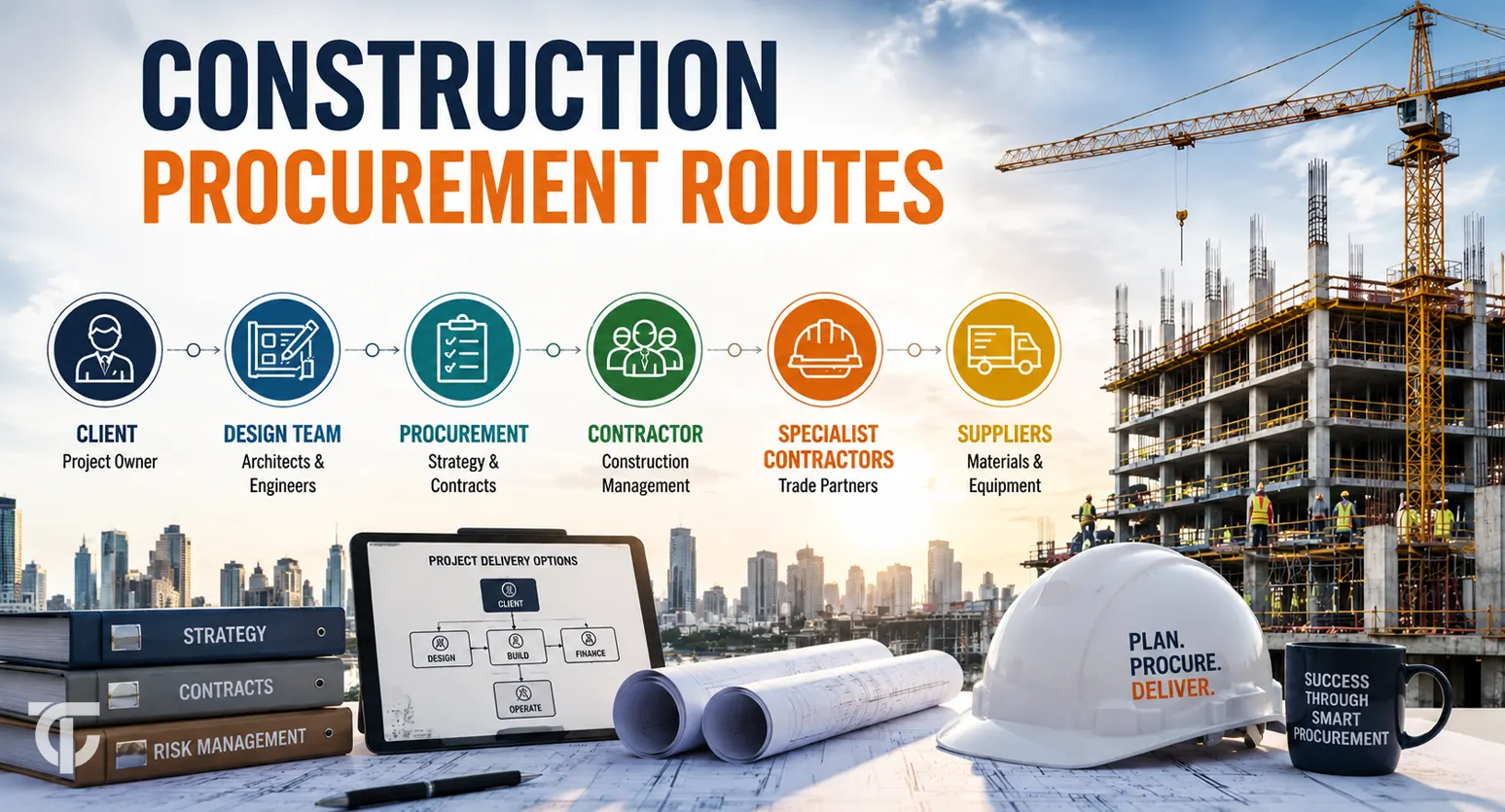

Picking a contractor rarely decides how well a construction project turns out. The bigger decision happens earlier, before ground even breaks. A client must decide who’s responsible for design, who carries the risk when things go wrong, and how much control they want to keep as the project moves forward. That decision is exactly what construction procurement routes are built to answer.
Different routes create very different working relationships. In one, the client keeps a design team on their own payroll and brings in a contractor only once drawings are finished. In another, a single contractor takes on design and construction together. Hence, the client deals with one point of contact instead of two. The route a client picks affects who holds design responsibility, how risk is shared, how much say the client keeps over design decisions, and how confident anyone can be about final cost and completion date before work even starts. The scale of what’s at stake here is hard to overstate.
💡 Did You know?
The U.S. Census Bureau estimated total U.S. construction spending at a seasonally adjusted annual rate of $2.2102 trillion in May 2026. That figure breaks down into private construction at $1.6690 trillion (residential at $930.2 billion and non-residential at $738.7 billion) and public construction at $541.2 billion.
Worth Noting: This is an annualized rate based on the month’s data, not a claim that $2.21 trillion changed hands in May alone.
Still, across a market that size, the procurement decisions made on individual projects add up to enormous consequences for cost, schedule, and quality industry-wide.
This article walks through the seven main procurement routes used on construction projects today, explains how each one allocates design responsibility and risk, and looks at related approaches like partnering, EPC, and two-stage tendering that often get confused with the main routes but actually serve a different purpose.
Along the way, you’ll find practical guidance on matching a route to your project’s priorities, whether that’s cost certainty, speed, design control, or something else entirely.
What Is a Construction Procurement Route?
In plain terms, a procurement route in construction is the structure that determines how a project is organized and delivered: who designs it, who builds it, and how those two groups relate contractually. It sets the pattern for the entire project before a single tender document goes out. Think of it as the blueprint for relationships, not the blueprint for the building.
The procurement route decides whether the client hires a design team directly or leaves design to the contractor. It decides whether the contractor gets involved early, while the design is still taking shape, or only after the drawings are locked in.
It also determines how risk shifts between parties: if a design error causes a delay, does that land on the client, the designer, or the contractor?
The answer depends almost entirely on which route was chosen at the outset. It helps to separate procurement route from three terms people often lump in with it:
- Procurement route: The overall way the project is organized and delivered: who’s responsible for design, who’s responsible for construction, and how those roles connect.
- Contract type or pricing mechanism: How payment gets structured once a route is chosen. A lump sum, a cost-reimbursable contract, or a guaranteed maximum price are pricing arrangements, not procurement routes.
- Tendering method: How contractors get invited and selected, such as single-stage or two-stage tendering. This is a mechanism for reaching a contract, not the delivery structure itself.
- Procurement strategy: The broader plan a client uses to hit their project objectives, which usually includes the chosen route alongside decisions about contract type, tendering method, and client requirements.
Mixing these up is one of the most common sources of confusion in construction planning, which is why some online articles describe things like two-stage tendering as a standalone route alongside Design & Build. It isn’t. It’s a tendering method that can be used within several different routes.
Getting the terminology right matters because it shapes how a project delivery method actually gets applied on site. A client’s procurement strategy has to account for their project objectives, their appetite for risk, and how much they want the design team and contractor to interact. The contractual relationships that follow who reports to whom, who signs off on what all trace back to this one early decision.
How Do You Choose a Procurement Route?
Before looking at the seven individual routes, it helps to understand what makes one route a better fit than another. Every client weighs the same handful of factors, even if they don’t always call them by these names.
Project Cost and Cost Certainty
The budget rarely stays fixed once real numbers start coming in, so the real question is how much price certainty a client needs before committing. That depends on the client’s own risk tolerance, how far the design has progressed, and whether scope is likely to change once construction starts. No procurement route can promise a guaranteed final cost on its own; cost certainty depends as much on how well-developed the design is and how the contract handles change.
Project Programme and Speed
Some projects need to open by a fixed date, whether that’s a school term, a retail launch, or a lease deadline. Construction speed often depends on whether design and construction can overlap. Early contractor involvement can unlock fast-track opportunities that a strictly sequential process can’t, since packages of work can start before every last design detail is finished.
Design Control
How much control does the client actually want to keep? Some clients want their own design team steering every decision through to completion. Others are happy to hand design responsibility to the contractor in exchange for a single point of contact and less day-to-day involvement. Neither preference is wrong; it depends on whether design flexibility or design certainty matters more to that particular client.
Risk Allocation
Every procurement route allocates risk differently between the parties. Who carries design risk if drawings turn out to be flawed? Who carries construction risk if the work itself runs into trouble? Who absorbs cost risk if prices move? Some clients want a single point of responsibility so there’s no ambiguity about whom to hold accountable; others are comfortable managing several relationships in exchange for more direct control.
Project Complexity and Scope Certainty
A straightforward warehouse extension behaves very differently from a hospital with specialist medical equipment and complex technical coordination. Simple, well-defined projects can move through almost any procurement route without much trouble. Projects with an evolving scope, specialist requirements, or uncertain design elements usually need a route that allows more flexibility as details become clearer.
Client Experience and Involvement
An experienced client who has run dozens of projects can often manage multiple direct contracts without much difficulty. A first-time client, by contrast, may prefer a route that concentrates responsibility into fewer relationships, or one that brings in outside management expertise to fill the gap. This isn’t about capability in a general sense; it’s about how comfortable a client is running a construction project versus running their core business.
Supply Chain and Contractor Involvement
Some projects depend heavily on specialist subcontractors; think curtain walling, mechanical and electrical systems, or specialist foundations. Bringing contractor knowledge into the process early can improve buildability and help avoid costly redesigns later. Where specialist packages carry real technical risk, early supply-chain involvement often matters more than almost any other factor on the list.
None of these factors point to one universally correct answer. A route that works brilliantly for an experienced developer running a straightforward retail fit-out might be entirely wrong for a first-time client building a technically complex facility. The right procurement route depends on how these constraints and priorities line up for that specific project, which the next section covers, route by route.
The 7 Main Construction Procurement Routes
- Traditional / Design-Bid-Build
- Design and Build / Design-Build
- Management Contracting
- Construction Management
- CM at Risk
- IPD
- PPP/P3
Now that the selection factors are clear, here’s how each of the seven main routes actually works, what makes each one distinct, and where each one tends to fit best.
1. Traditional Procurement / Design-Bid-Build
How It Works
Traditional procurement follows a straightforward sequence. The client appoints a design team first architects, engineers, and other consultants who develop the design to a substantial level of detail. Only once that design work is largely finished does the client go out to tender for a contractor. The contractor then prices and builds according to a design they had no hand in creating.
The Relationship Structure
This route keeps design and construction cleanly separated:
Client → Designer
Client → Contractor
The client holds two separate sets of contracts rather than one combined relationship. The design team answers to the client throughout, and the contractor is brought in afterward to execute a design that’s already been settled.
Who Controls the Design
The client, working through their design team, retains design control from start to finish. The contractor’s design responsibility is generally limited; it may extend to specific elements like temporary works, depending on what the contract specifies, but the core design decisions sit with the client’s own consultants.
Where the Risk Sits
Because the contractor is pricing a completed design, they can offer more competitive, more accurate pricing at the tender stage. But if the design itself contains errors or gaps, that risk generally sits with the client and their design team, not the contractor. The contractor is responsible for building what they were given, not for identifying flaws in the underlying design.
Cost and Time Certainty
Cost certainty tends to be reasonably strong at tender, since the contractor prices a defined scope rather than guessing at unfinished drawings. Programme certainty, on the other hand, depends heavily on how disciplined the client stays about changes after the tender is signed; late changes are one of the most common sources of disruption under this route.
Advantages
- Strong client control over design decisions throughout the process.
- A clear, complete design before contractors are asked to price the work.
- Competitive pricing, since contractors bid against a known scope.
- A familiar, well-understood structure that most contractors and consultants recognize.
- Clear separation between design responsibility and construction responsibility.
Limitations
- Contractor input arrives relatively late, after most design decisions are locked in.
- Changes requested after tender can create cost and programme complications.
- Interface issues between design intent and buildability sometimes only surface once construction starts.
- Little opportunity for early contractor involvement or buildability advice.
- Programme length can suffer if the design has to be substantially complete before tender can even begin.
Best Suited To
Traditional procurement tends to work well when the project scope is well-defined and unlikely to shift, the design is stable, and the client wants to keep strong design control in-house. It also suits clients or design teams with enough experience to manage the process confidently from design through to tender.
Understanding construction procurement routes at this level of detail matters because Traditional procurement is often the reference point everyone else gets compared against. Almost every other route on this list represents some kind of departure from this sequential, separated structure.
2. Design and Build / Design-Build
How It Works
Design & Build flips the structure for the client. Instead of hiring a separate design team, the client engages a single contractor responsible for both design and construction, subject to the specific contract structure agreed. That contractor might design in-house, subcontract design work, or take over a design that the client’s own team started and then hand it off; the exact arrangement varies from project to project.
The Relationship Structure
Traditional:
Client → Designer + Contractor
Design & Build:
Client → Design-and-Build Contractor
That single line captures the whole shift. Instead of managing two separate relationships, the client deals with one contractor who’s accountable for the entire delivery process. It’s worth being careful not to oversimplify this. However, the contractual arrangements behind that single relationship can still be fairly intricate, especially when the client’s own consultants are novated to the contractor partway through.
The Core Concept: Single Point of Responsibility
This is the idea Design & Build is really built around. If something goes wrong, whether it’s a design flaw or a construction defect, there’s one contractor to hold accountable, rather than a design team and a contractor pointing fingers at each other.
Where the Risk Sits
Design responsibility, and the risk that comes with it, transfers substantially to the contractor. That’s the trade-off clients make: less day-to-day design control in exchange for a cleaner risk position and one point of contact for the whole project.
Cost and Time Certainty
Because the contractor commits to both design and construction earlier, design and construction activities can often overlap, supporting a faster programme. Cost certainty can also improve, since the contractor is pricing their own design rather than someone else’s. However, this depends heavily on how clearly the client defined the requirements at the outset.
Advantages
- A single point of responsibility for design and construction combined.
- Earlier contractor involvement in the overall process.
- Potential programmes benefit from overlapping design and construction.
- Greater integration between design intent and construction execution.
- Often clearer accountability for coordinating the two.
Limitations
- The client typically has less direct control over detailed design decisions.
- Design and quality outcomes depend heavily on how well the employer’s requirements were written, plus the contractor’s own design capability.
- Changes become more complicated once design responsibility has transferred to the contractor.
- Comparing competing bids can be harder, since different contractors may propose genuinely different design solutions rather than pricing an identical scope.
Design-build’s momentum in the broader market backs this up:
DBIA’s 2025 Design-Build Data Sourcebook, based on FMI research, projects design-build to represent more than 47% of U.S. construction spending by 2028, with about $2.6 trillion in spending during 2024–2028 across the assessed construction segments.
That’s a significant projection, but it’s exactly that: a projection, not a promise. Design-build isn’t automatically faster or better for every project; it’s a research-based forecast of where the industry is heading, not a guarantee for any individual job.
Best Suited To
Design & Build tends to fit clients who want to minimize the number of relationships they’re managing and who are comfortable trading some direct design control for a single accountable party. It also suits projects where overlapping design and construction would genuinely help meet a tight programme.
3. Management Contracting
How It Works
Management Contracting introduces a different kind of intermediary. The client appoints a management contractor, who then manages and lets contracts to individual works contractors, effectively package-contracting the works on the client’s behalf.
Here’s the detail that trips up a lot of people: The management contractor occupies a different contractual position than a construction manager under the next route on this list. The management contractor typically holds contracts with the works contractors directly, rather than the client.
Why Clients Use It
This route exists mainly to unlock earlier starts. Because the management contractor can begin letting work packages before every design detail is finalized, design and construction can genuinely overlap. Specialist packages can be procured and started as soon as they’re ready, rather than waiting for the entire design to be signed off.
Where the Risk Sits
Risk allocation here depends heavily on the specific contract structure in place. The client typically retains involvement in and exposure to certain risks depending on how the arrangement is written, since price certainty is harder to pin down at the early stage when the management contractor is first appointed.
Cost and Time Certainty
Programme potential is one of the strongest arguments for this route; early management input and overlapping work packages can genuinely compress a schedule. Price certainty, though, is weaker at the outset than under Traditional procurement, since many work packages are priced later as the design develops.
Advantages
- An early start on site, well before full design completion
- Potential programme savings from overlapping activities
- Early management input into how the works packages are sequenced and let
- Flexibility to adjust as the design continues developing
Limitations
- Less price certainty in the early stages of the project
- The client may retain or require greater involvement in certain risks, depending on the specific structure
- More complex management coordination across multiple work packages
- Requires a client team capable of engaging with that complexity
Best Suited To
Management Contracting tends to suit clients with a genuinely complex or fast-track project, who need to start on site early and are comfortable with less price certainty in exchange for programme flexibility.
One important note before moving on: Management Contracting should not be confused with Construction Management. The two names sound almost interchangeable, but the contractual position of the intermediary management contractor versus construction manager is meaningfully different, as the next section makes clear.
4. Construction Management
How It Works
Construction Management takes a different contractual shape entirely. The client directly appoints each trade contractor; no intermediary is holding those contracts on the client’s behalf. A construction manager is brought in separately to manage and coordinate the trade contractors, but typically acts on behalf of the client rather than occupying the same contractual position as a main contractor.
Designing Buildings describes construction management as multiple trade contractors contracted to the client and managed by a construction manager, which captures the structural difference well.
The Relationship Structure
The client ends up holding a contract with every individual trade contractor for groundworks, structural steel, mechanical and electrical, and so on while the construction manager sits alongside, coordinating the whole effort without being a contracting party to those trade packages.
Who Controls the Design
Client involvement and control run high throughout this route. Because the client holds every trade contract directly, they’re positioned to make (or at least sign off on) far more decisions than they would under Traditional procurement or Design & Build.
Where the Risk Sits
This trade-off defines Construction Management: the client carries considerably more risk than under most other routes, precisely because they’re the contracting party for every trade package. If a specific trade contractor underperforms or a package runs into trouble, that risk lands with the client directly rather than being absorbed by an intermediary.
Cost and Time Certainty
Early specialist input and the ability to start trade packages as they become ready can support a faster programme. But cost certainty is generally weaker early on, since the full picture of trade contractor pricing only comes together as packages get let over time.
Advantages
- High client involvement and control over the whole delivery process
- An early start on site, similar to Management Contracting
- Real flexibility to adjust packages as the project develops
- Early specialist input from trade contractors
- Potential programme benefits from overlapping activities
Limitations
- The client carries substantially more risk than under most other routes
- Multiple direct contractual relationships to manage simultaneously
- Requires an experienced, well-resourced client team
- Less cost certainty in the early stages
- Greater overall management responsibility falling on the client
It’s worth being precise here, because “the construction manager manages the construction” doesn’t actually explain much on its own. What matters is who holds the contracts. Under Construction Management, that’s the client, package by package. That single fact drives almost every difference between this route and Management Contracting.
Best Suited To
This route tends to suit experienced clients who want direct control over individual trade packages and have the internal resources or are willing to build them to manage multiple contractual relationships at once.
5. Construction Manager at Risk (CM at Risk / CMAR)
CM at Risk is worth including here even though the term shows up more often in U.S. project delivery conversations than in UK-based procurement literature. It’s related to Management Contracting and Construction Management, but it isn’t identical to either, so it deserves its own explanation rather than a passing mention.
How It Works
The client appoints a construction manager early in the process, often while design is still underway, who provides preconstruction services during that early phase. Preconstruction input might include cost estimating, scheduling advice, and buildability feedback as the design develops.
Later, once the project moves toward construction, that same construction manager takes on construction responsibility under the agreed contract structure. A Guaranteed Maximum Price or a similar commercial arrangement may come into play at that stage, depending on how the contract is written.
How This Differs from Ordinary Construction Management
This is the comparison worth sitting with for a moment, because the two get confused constantly:
Construction Management → the client contracts directly with each trade contractor, and the construction manager coordinates without holding those contracts.
CM at Risk → the construction manager takes on greater contractual and construction risk, often stepping into something closer to the main contractor’s role once construction begins.
The name itself is a decent clue: “At Risk” signals that this construction manager carries more exposure than one acting purely as the client’s agent.
Where the Risk Sits
Risk shifts meaningfully toward the CM once construction responsibility transfers, particularly where a GMP arrangement is in place. That said, the client still needs to stay engaged, since final risk allocation depends entirely on how the specific contract terms are written.
Cost and Time Certainty
Because the CM is involved from the preconstruction phase, there’s a real opportunity for early buildability input and better integration between design and construction decisions. Cost management tends to improve as a result. However, it depends closely on how well the GMP or equivalent arrangement is negotiated.
Advantages
- Early contractor involvement, well before construction starts
- Preconstruction input on cost, schedule, and buildability
- Practical buildability advice while design is still adjustable
- Potential for better cost management through early estimating
- Stronger integration between design and construction phases
Limitations
- A more complex commercial arrangement than straightforward Construction Management
- Cost certainty depends heavily on how the contract and GMP terms are structured.
- The client still needs strong oversight, even with a CM handling construction.
- Final risk allocation varies from contract to contract.
Best Suited To
CM at Risk tends to fit clients who want early contractor input and buildability advice during design, but also want a clearer construction-phase commitment than pure Construction Management offers, without taking on full design responsibility the way Design & Build does.
6. Integrated Project Delivery (IPD)
Saying IPD means “everyone works together” doesn’t really explain anything. What actually sets this route apart is the structure behind that collaboration.
How It Works
Under IPD, the client, designer, contractor, and other key participants operate within a collaborative structure built around shared objectives. Depending on how the specific IPD arrangement is written, incentives can align across the whole team rather than sit with each party separately.
Key Characteristics
- Early involvement from all major participants, not just the contractor.
- Shared decision-making rather than decisions flowing one direction down a hierarchy.
- Genuine collaboration built into the contract structure itself.
- Shared risk and reward mechanisms, where the arrangement provides for them.
- An integrated project team working from a common set of goals.
- Early coordination between design and construction activities.
- Open information sharing across the team.
Where the Risk Sits
Risk and reward are distributed according to the specific IPD agreement; this can range from lightly shared incentives to deeply integrated risk-sharing structures, so it’s not a single fixed formula like GMP or lump-sum pricing.
Cost and Time Certainty
Early, coordinated problem-solving across the whole team can reduce the kind of late-stage rework that drives up cost and delay under more siloed routes. That’s a real potential benefit, not a guaranteed outcome; it depends on how well the collaboration actually functions in practice.
Advantages
- Better collaboration across designer, contractor, and client
- Earlier problem-solving, before issues become expensive to fix
- Improved coordination between design and construction
- Potential reduction in adversarial behavior between parties
- Stronger integration between design intent and construction execution
Limitations
- Requires a high level of trust between all participants
- Contractual arrangements tend to be more complex than traditional structures
- Not a good fit for every client or every project team
- Demands a genuine collaboration culture, not just a collaborative-sounding contract
- Participants need reasonably aligned objectives from the outset
It’s tempting to describe IPD as automatically cheaper or faster than other routes, given how much emphasis it puts on early collaboration. That’s not a safe claim. IPD offers potential benefits under the right conditions; it doesn’t guarantee results on its own.
Best Suited To
IPD tends to work best for complex projects where the client, designer, and contractor already have or are willing to build a strong working relationship, and where the added contractual complexity is worth the potential coordination benefits.
7. Public-Private Partnership (PPP / P3)
PPP, sometimes written as P3, sits apart from the other six routes on this list. It isn’t just a way of organizing design and construction; it can extend into financing and long-term operation, which changes the entire shape of the arrangement.
How It Works
Depending on the specific PPP model, the private side may take on responsibility for design, construction, financing, and even operation or maintenance over an extended period. That’s a meaningfully different scope than any of the routes covered so far, most of which end once the building is handed over.
The Typical Structure
Public authority → private partner / private consortium
The private partner may take on several project stages under one long-term contractual arrangement design and build, certainly, but potentially financing and ongoing operation as well, depending on how the deal is structured.
Where PPP Is Commonly Used
PPP arrangements show up most often on:
- Major infrastructure projects
- Public buildings
- Transport schemes
- Healthcare facilities
- Schools
- Utilities
These tend to be projects where long-term performance matters as much as initial delivery, which is exactly where a PPP structure earns its complexity.
Advantages
- Access to private finance and private-sector capability, where that’s part of the arrangement
- A long-term performance focus, since the private partner may be involved well beyond handover
- Integration across multiple project stages under a single arrangement
- Risk transfer to the private partner in certain areas of the project
Limitations
- Highly complex contracts, often running to hundreds of pages
- Long procurement periods before a deal is even signed
- Financing costs that can add up over the life of the arrangement
- Long-term commitments that outlast the original decision-makers on either side
- Detailed risk allocation that requires careful negotiation
- Ongoing value-for-money considerations throughout the contract term
A Note on Terminology
PPP and P3 generally describe the same broad category of arrangement, though exact terminology and models differ by jurisdiction. Not every PPP is structured identically; some involve financing and long-term operation, others focus more narrowly on design and construction with a shorter private-sector role. Check the specific model in play before assuming how any given PPP is structured.
Best Suited To
PPP tends to apply to large-scale public infrastructure or public-facility projects where long-term private-sector involvement, whether through financing, operation, or both, genuinely adds value that a standard public procurement process wouldn’t.
👉🏻 For more insights on construction procurement and supply chain topics, explore The Concrete Talk Procurement and Supply Chain Articles.
Procurement Routes in Construction Example
Numbers and definitions only go so far. Here’s how route selection plays out when you apply a real set of priorities to a real project.
Scenario: A client is planning a large commercial building, a mid-rise office development with a mix of standard and specialist spaces. Several procurement routes could technically work here. The best fit depends entirely on what the client cares about most.
- If design control is the priority → Traditional procurement may be more suitable when the client wants their own design team steering every decision and has the time to let design finish before tender.
- If single-point responsibility is the priority → Design & Build may be more suitable when the client wants one accountable party for the whole project and is comfortable trading some design control for that simplicity.
- If early work packages and overlapping design and construction are needed → Management Contracting may be more suitable when programme speed matters more than early cost certainty.
- If the client is experienced and wants direct trade contracts → Construction Management may be more suitable when the client has the internal capability to manage multiple contractual relationships and wants that level of control.
- If early construction-manager involvement plus greater construction-risk responsibility is desired → CM at Risk may be more suitable when the client wants preconstruction input without giving up as much oversight as Design & Build would require.
- If collaborative, integrated delivery is a priority → IPD may be more suitable when the client, design team, and contractor already have or are prepared to build the trust that integrated delivery depends on.
- If the project involves public infrastructure with long-term private participation or financing → PPP/P3 may be more suitable when the project’s scope extends beyond construction into long-term financing or operation.
None of these routes is automatically “the best” for this office development. Each one becomes the stronger option depending on which priority design control, single-point accountability, speed, direct oversight, preconstruction input, collaboration, or long-term private involvement matters most to that particular client.
How to Choose the Right Construction Procurement Route
The factors covered earlier apply just as much once you’re actually choosing between the seven routes. Here’s how each one plays out in practical terms.
Cost Certainty
How much price certainty do you need locked in before committing to construction? A route like Traditional gives more certainty at the tender stage; something like Management Contracting trades that certainty for earlier starts.
Programme
How important is speed? If overlapping design and construction genuinely matters for your timeline, routes that allow early contractor or construction-manager involvement Design & Build, Management Contracting, CM at Risk deserve a closer look.
Design Control
How much control do you want to keep over design decisions? This is often the single biggest factor separating Traditional from Design & Build.
Risk
Which risks are you actually prepared to retain, and which would you rather transfer to a contractor or construction manager? Construction Management asks the client to hold more risk directly; Design & Build shifts much of it to the contractor.
Scope Certainty
Is the project fully designed already, or still evolving? A firm, complete design supports routes like Traditional. A design that’s still taking shape often suits a more flexible approach.
Project Complexity
How technically complicated is the build? Highly technical or specialist work often benefits from early contractor input, regardless of which route delivers it.
Client Capability
Can you or your team manage multiple direct contracts, or would a single point of responsibility serve you better? Be honest here. Construction Management demands real capacity; Design & Build shifts more of that complexity to the contractor.
Contractor Involvement
Would early contractor input genuinely add value on this project, or is the design straightforward enough that late-stage tendering works fine?
Supply Chain
Are specialist contractors or suppliers central to getting this right? Projects that lean heavily on specialist packages often benefit from routes that bring those parties in earlier.
Project Type
Commercial, infrastructure, public-sector, industrial: the project type narrows the realistic options. A public infrastructure scheme with long-term operational requirements points toward PPP/P3 in a way a private commercial fit-out never would.
A Simple Decision Framework: This is a general guide, not a universal rule; every project has its own wrinkles that can shift the answer.
| Priority | Routes That May Be Worth Considering |
| Maximum design control | Traditional |
| Single point of responsibility | Design & Build |
| Early contractor/management input | Management Contracting / CMAR |
| Direct control over trade contractors | Construction Management |
| Collaborative integrated delivery | IPD |
| Long-term public/private arrangement | PPP/P3 |
Use this as a starting point for narrowing the field, not as a final answer. The right choice still comes down to weighing your specific priorities against each route’s trade-offs.
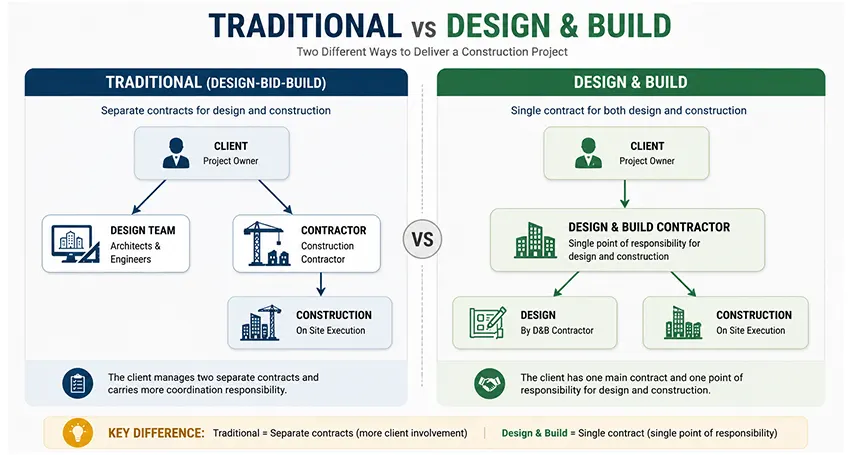
Traditional vs Design & Build | Short Comparison
These two routes come up against each other more than any other pairing, mostly because they represent opposite ends of the same basic question: Does the client keep design in-house, or hand it to the contractor?
| Factor | Traditional | Design & Build |
| Design Responsibility | Stays with the client’s design team | Transfers substantially to the contractor |
| Client Control | Strong, direct control over design decisions | Reduced day-to-day control once responsibility transfers |
| Contractor Involvement | Comes later, after design is largely complete | Starts earlier, often overlapping with design |
| Cost Certainty | Generally strong at tender, since scope is defined | Can be strong too, but depends on how clearly requirements were written |
| Programme | Sequential design finishes, then construction starts | Design and construction can overlap, often supporting a faster programme |
| Risk | Design risk generally sits with the client and their design team | Design risk shifts largely to the contractor |
| Contractual Responsibility | Two separate relationships: Designer and Contractor | One relationship: The design-and-build contractor |
Neither route is superior across the board. Traditional keeps the client closer to design decisions; Design & Build trades some of that control for a single accountable party and potential programme gains.
Construction Management vs Management Contracting
These two names sound almost identical, which is exactly why they get mixed up so often. The intermediary’s contractual position is where they actually diverge.
| Factor | Construction Management | Management Contracting |
| Who contracts with trade contractors? | Client | Management Contractor |
| Main Management Role | Construction Manager | Management Contractor |
| Client Involvement | High | High, but the Structure Differs |
| Risk Position | Client Generally Retains More | Management contractor takes a defined management role/risk under contract |
| Early Involvement | Yes | Yes |
The wording in that table matters more than it might look at first glance. Exact contractual terms vary by contract form and jurisdiction, so verify the specific language before publishing anything based on this comparison.
The Short Version:
- Under Construction Management, the client contracts for every trade package, with the construction manager coordinating from the sidelines.
- Under Management Contracting, the management contractor sits between the client and the trade contractors and holds those contracts directly.
That single structural difference explains most of what separates the two: different risk exposure for the client, different day-to-day dynamics, and different levels of direct control.
Related Procurement Approaches and Arrangements
Construction procurement terminology isn’t always classified consistently across countries, professional bodies, and contract systems. The five approaches below often get lumped in with the seven main routes, but they serve a different purpose; some can sit alongside a chosen route rather than replace it entirely.
Partnering
Partnering describes a collaborative relationship between the client, contractor, and often suppliers or designers, built around shared objectives and improved communication. It can be set up formally through explicit contractual terms or informally through a non-contractual working agreement; the exact shape depends on what the parties agree to.
It’s worth being clear about one thing: Partnering isn’t automatically a standalone procurement route. It’s more of an approach to how relationships function within whichever route has already been chosen.
Alliancing
Alliancing takes collaboration a step further. Multiple parties, client, designer, contractor, sometimes key suppliers work under shared objectives with genuinely shared risk and reward, and decision-making gets handled jointly rather than by any single party alone. This tends to show up on complex programmes or projects where the level of coordination required makes a more integrated approach worth the added complexity.
EPC
EPC stands for Engineering, Procurement, and Construction. Under this arrangement, a single entity takes responsibility for all three: Engineering Design, Procurement of Materials & Equipment, and Construction. It’s common on major industrial and infrastructure projects, where performance and completion obligations are typically strict and well-defined.
EPC is often described as similar to Design & Build, and there’s real overlap: A single contractor handles both design and construction. But Designing Buildings notes that EPC contracts are similar to design and build contracts but can give the client less say over the design and place more risk with the contractor. That distinction matters. EPC generally means less client input into design and a heavier construction responsibility resting on the contractor than a typical Design & Build arrangement.
Two-Stage Tendering
Two-stage tendering, unsurprisingly, works in two stages. The first stage allows a contractor to be appointed early, often based on preliminary information. Meanwhile, detailed pricing and design work continues. The second stage then develops and negotiates the final price and contract terms once the design has matured further.
This is a genuinely important distinction to hold onto: Two-stage tendering is a tendering and procurement mechanism, not a separate procurement route sitting alongside Traditional, Design & Build, and the others. Designing Buildings makes a similar point, explaining that two-stage tendering may be adopted for traditional or design and build contracts. In other words, it’s a method you can layer onto more than one of the main routes; it doesn’t replace them.
Framework Arrangements
Framework arrangements suit organizations with repeated construction requirements rather than a single one-off project. Multiple suppliers or contractors may be appointed to a framework, and specific pieces of work get called off from that framework as they arise, rather than running a fresh procurement process every time. For organizations with an ongoing programme of work, this can meaningfully reduce repeated procurement effort and speed up supplier selection for each new package.
As with the other approaches in this section, framework arrangements aren’t equivalent to the seven main project delivery routes. A framework determines how suppliers get selected and engaged over time; the actual delivery of any individual project called off that framework would still follow one of the seven routes already covered.
Quick Comparison Table | All 7 Routes
Here’s a single reference table pulling together how each route handles design responsibility, control, involvement, cost certainty, and risk. These are deliberately worded as descriptions rather than absolute ratings, since exact positions like “high” or “low” only really mean something once you know the specific contract terms in play.
| Route | Design Responsibility | Client Control | Contractor Involvement | Cost Certainty | Risk Position | Typical Strength |
| Traditional (Design-Bid-Build) | Stays largely with the client’s design team | Client retains significant design control | Contractor involved after design is largely complete | Generally strong at tender, once scope is fixed | Design risk sits mainly with client and design team | Strong design control before construction begins |
| Design & Build | Contractor takes substantial design responsibility | Reduced once responsibility transfers to contractor | Greater early contractor involvement | Depends heavily on how clearly requirements were defined | Design and construction risk shift largely to the contractor | Single point of responsibility |
| Management Contracting | Design responsibility stays outside the management contractor’s remit; sits with client’s design team | Client retains involvement depending on structure | Early management input, overlapping work packages | Weaker early on; firms up as packages are let | Risk depends on contract terms and structure | Early starts and programme flexibility |
| Construction Management | Design responsibility stays with client’s design team | Client contracts directly with trade contractors | Early trade contractor involvement | Weaker early on; firms up as packages are let | Client retains more risk directly | Direct client control over trade packages |
| CM at Risk (CMAR) | Design responsibility generally stays with client’s design team; CM contributes preconstruction input | Client retains oversight; CM manages construction phase | Early involvement through preconstruction services | Depends on GMP or equivalent arrangement | Construction manager takes on greater construction risk | Early buildability input with defined construction commitment |
| Integrated Project Delivery (IPD) | Shared across the integrated team | Shared decision-making across participants | Early involvement from all key parties | Depends on the specific IPD agreement | Risk depends on contract terms | Collaboration and early problem-solving |
| Public-Private Partnership (PPP/P3) | Varies by model; can include design, financing, and operation | Reduced during the private partner’s involvement period | Private partner involved from early stages through long-term arrangement | Depends on contract and financing structure | Risk transfer to private partner in defined areas | Long-term integration of financing, delivery, and operation |
Use this table as a quick-reference starting point, not a final answer; the specific contract terms on any real project can shift how these factors play out.
Final Thoughts
Every one of these seven routes answers the same underlying question in a different way: Who’s responsible for design, who carries the risk, and how much control does the client keep?
Traditional keeps design and construction separate and puts control in the client’s hands. Design & Build consolidates responsibility into a single contractor. Management Contracting and Construction Management both allow earlier starts, but they split contractual risk between the client and the intermediary in different ways. CM at Risk blends early preconstruction input with a defined construction commitment. IPD leans on shared decision-making and aligned incentives. PPP/P3 stretches the arrangement out to cover financing and long-term operation, not just delivery.
None of that makes one route universally correct. What matters is matching the route to what the project actually needs: The budget, the timeline, how much design control the client wants to hold onto, who’s prepared to carry which risks, how complex the work is, and how much capacity the client’s team has to manage it all. Get that match right at the outset, and most of what follows pricing, scheduling, day-to-day coordination tends to fall into place a lot more smoothly than it would otherwise.
Frequently Asked Questions
1. What is the best procurement route for a construction project?
No single route works for every project. The right choice depends on cost priorities, programme speed, how much design control the client wants to retain, risk appetite, project complexity, client capability, and how well the scope is defined.
A client who wants strong design control and has a stable, well-defined scope might lean toward Traditional. A client who wants one accountable party and values programme speed might lean toward Design & Build. An experienced client managing a complex, fast-moving project might prefer Construction Management or CM at Risk. The route has to match the project, not the other way around.
2. What is the difference between traditional procurement and design and build?
The core difference is who holds design responsibility.
- Under Traditional procurement, the client’s own design team controls design decisions, and the contractor is brought in later to build according to a completed design.
- Under Design & Build, a single contractor handles both design and construction, shifting design responsibility and much of the associated risk to that contractor.
Client control mirrors this shift: Traditional keeps the client closer to design decisions throughout, while Design & Build trades some of that control for a single point of responsibility and, often, a faster overall programme.
3. Which construction procurement route gives the client the most control over design?
Traditional procurement generally gives the client the strongest direct control, since the design team works directly for the client throughout the process. That said, exact control still depends on the specific contract and how the project is set up; no route guarantees absolute control in every case.
Design & Build sits at the other end of that spectrum, transferring more design responsibility and, with it, more design decision-making to the contractor.
4. What is the difference between construction management and management contracting?
These two get confused often because the names sound so similar, but the intermediary’s contractual position is genuinely different.
- Under Construction Management, the client contracts directly with each trade contractor, and the construction manager coordinates the work without holding those contracts personally.
- Under Management Contracting, the management contractor sits between the client and the trade contractors and holds those works contracts directly.
That single structural difference changes who carries risk: Under Construction Management, the client generally retains more risk directly, since they’re the contracting party for every package; under Management Contracting, the management contractor takes on a defined management role and risk position under the contract. Both routes support early involvement and overlapping design and construction; the key difference is who’s legally responsible for each trade package.
5. Is design-build faster than traditional procurement?
Design & Build can allow earlier contractor involvement and let design and construction activities overlap, which often supports a faster programme than the strictly sequential structure Traditional procurement follows. Industry research reflects real momentum behind this approach:
DBIA’s 2025 Design-Build Data Sourcebook, based on FMI research, projects design-build to represent more than 47% of U.S. construction spending by 2028, with about $2.6 trillion in spending during 2024-2028 across the assessed construction segments.
That’s a meaningful projection about where the industry is heading, not a guarantee that any individual project will move faster under Design & Build. Actual speed still depends on project conditions, how clearly requirements were defined, and how well the arrangement gets implemented on the ground.